


- Science
- Translated with AI
For faster drug development
Researchers at HS Aalen receive around two million euros in funding
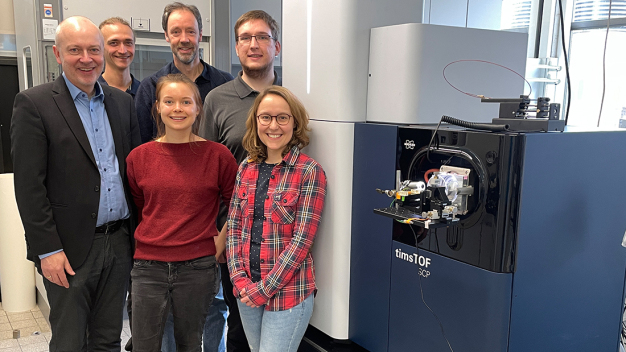
In the picture from left to right: Prof. Dr. Harald Riegel, Max-Jonathan Kleefoot, Lena Kruse, Prof. Dr. Christian Neusüß, Sebastian Funken, and Ann-Katrin Schwenzer next to the newly acquired ion mobility mass spectrometer. © Hochschule Aalen | Andrea Heidel
The global COVID-19 pandemic has made this clearer than ever: one of the main challenges facing our society in the healthcare sector is the rapid development of new medicines and vaccines. In particular, there is a lack of effective and highly precise systems for analyzing antibody-based therapeutics. This is where a newly launched research project at the Hochschule (HS) Aalen comes in: the interdisciplinary team has set itself the goal of significantly accelerating vaccine and drug development. The project "ProCeVen" is funded with around two million euros by the Federal Ministry of Education and Research (BMBF) and enables three students to pursue their doctorates at HS Aalen.
After more than two years with the coronavirus, most of us are probably more than familiar with handling rapid antigen tests. However, few have likely considered in depth how these tests actually work: "Simply put, they detect whether certain virus proteins are present in the throat area of a tested person," explains Max-Jonathan Kleefoot, a doctoral candidate at the Laser Applications Center (LAZ) at HS Aalen.
The investigation of proteins plays a crucial role not only in this context but throughout the entire field of medicine – both in disease diagnostics and in the development of new medicines. Biopharmaceutical companies, i.e., manufacturers of medications, test the effectiveness of so-called antibody-based therapeutics by searching for specific proteins in patients' blood. "The success and safety of these novel protein therapeutics, and thus the healthcare of the population, heavily depend on the capabilities of bioanalytics," notes Prof. Dr. Christian Neusüß, head of the Institute for Analytical and Bioorganic Chemistry at HS Aalen.
Unfortunately, the currently used methods and techniques for analyzing antibody-based therapeutics quickly reach their limits and often delay personalized drug development. Researchers in Aalen now aim to change this with a recently started interdisciplinary project: they are working on a novel analytical system that will allow proteins in biopharmaceutical therapeutics to be examined much more effectively and with unprecedented accuracy in the future. For the first time, researchers from the Institute for Analytical and Bioorganic Chemistry and the Laser Applications Center (LAZ) are collaborating on a joint project.
The team is combining two important instrumental analysis methods that have not been previously compatible: the so-called capillary electrophoresis with ion mobility-mass spectrometry and hydrogen/deuterium exchange. "These seemingly complex methods are used to obtain detailed structural information about the proteins and thus about their medical effects. They also provide information about manufacturing-related variants of the proteins," explains project coordinator Neusüß.
Chip valve works like a revolving door
Furthermore, the team from the field of instrumental bioanalytics is developing a novel, chip-based glass valve with a diameter of about the size of a table tennis ball, which will replace the current plastic component in the analysis device. "This round valve can be imagined as a revolving door. It precisely takes up tiny amounts of liquids in the nanoliter range and transports them with a rotational movement," explains Kleefoot. Since the valve has multiple openings and tiny channels inside, it can sequentially take up several drops and then feed them individually into subsequent separation and characterization by the mass spectrometer.
"For this valve, we need movable glass parts that require highly precise manufacturing. Ultrafast pulsed laser technology with adjustable pulse energy and wavelength makes it possible to produce these glass parts, further functionalize their surfaces, and integrate customized analytical techniques," adds Neusüß. The laser processing part is handled by a team of researchers at LAZ led by Prof. Dr. Harald Riegel. The project also enables three students at HS Aalen to pursue their doctoral projects: Sebastian Funken, a student at HS Aalen, will write his dissertation on laser material processing of glass as part of the project.
Two doctoral students, Lena Kruse and Ann-Katrin Schwenzer, are also working in parallel on the field of instrumental bioanalytics within Neusüß's working group. "Students from fields such as biopharmaceutical sciences, mechanical engineering/production and management, and optoelectronics are also introduced early in their bachelor studies to cutting-edge research topics through direct lab collaboration with the doctoral candidates, thus familiarizing them with scientific work," emphasize Professors Neusüß and Riegel in unison.
"Glass is significantly more suitable as a replacement for the current plastic component because it is more durable, less prone to contamination, and thus more sustainable and long-lasting," describes Funken. With lasers, highly precise, geometrically defined structures and microchannels can be created within the glass body. Additionally, the laser can cut sharply defined edges and holes, as well as integrate optical elements into the glass. Around 500,000 euros of the total funding of approximately two million euros are allocated to research on laser processing at LAZ, with another 800,000 euros invested in expanding the equipment at HS Aalen, such as acquiring an ion mobility-mass spectrometer (shown in the photo) and a laser scanning microscope. The ion mobility-mass spectrometer will be used to explore differences in the spatial structure of biopharmaceutical proteins in the world's first coupling with capillary electrophoresis. These two devices have now been installed and complement the existing equipment, and will continue to be used in future research projects.
Hochschule Aalen - Technik und Wirtschaft
73430 Aalen
Germany