




- Science
- Translated with AI
FoilMet®: Resource-efficient, flexible solar cell interconnection through laser micro-cutting
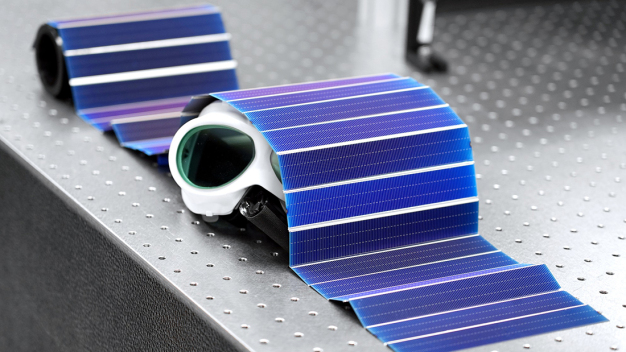
String of shingle cells interconnected using the FoilMet® process. © Fraunhofer ISE
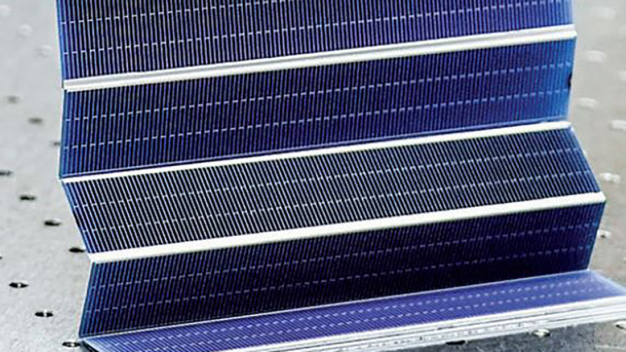
String of shingle cells interconnected using the FoilMet® process. © Fraunhofer ISE
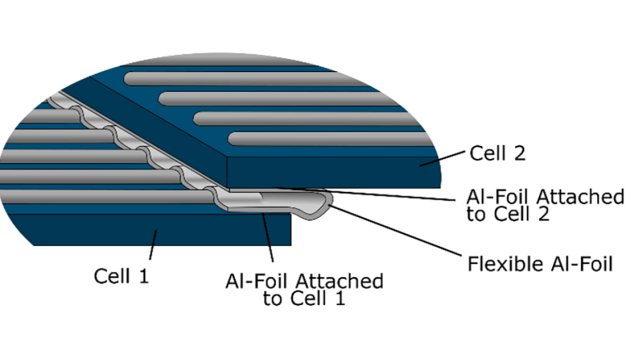
Schematic diagram of the connection area between two adjacent cells using the edge connector made of aluminum foil (The example shows the construction in shingle style). © Fraunhofer ISE
The Fraunhofer Institute for Solar Energy Systems ISE has developed a laser process that allows busbar-free PERC and TOPCon solar cells to be interconnected resource-efficiently and flexibly using an aluminum foil. The FoilMet® technology does not require conductive adhesives or solder and enables a reduction of silver consumption in the solar module by up to 30 percent. The mechanically flexible connection allows, in addition to a curved string design, an arrangement of shingled cells for maximum module efficiency, as well as the common "side-by-side" placement of cells with minimal spacing in mass production for the most cost-effective module construction. At Intersolar Europe (May 11-13, 2022, Messe Munich, Stand A1.540), the institute demonstrated a solar cell string consisting of 30 cells interconnected with this laser process.
In the new laser-based interconnection concept, a thin strip of aluminum foil connects neighboring cells. Researchers at Fraunhofer ISE succeeded in bonding the foil directly to the busbars via a special laser micro-welding process and bonding it to the silicon nitride surface in the finger region. The entire process takes less than a tenth of a second per wafer. It ensures very low contact resistance between the foil and the electrodes, enabling the highest module efficiencies. The key advantage: the process no longer requires the silver busbars and solder pads typically used for interconnection. Depending on the electrode layout, up to 30 percent of silver can be saved. Additionally, copper connectors coated with lead-containing solder or the silver-containing adhesive are replaced with more affordable aluminum.
Strong connection, low resistance
Advances in wafer manufacturing have led to increasingly larger formats in the solar industry over the years. It has now become an industry standard to divide large cells into smaller ones. "Connecting many small cells instead of a few large ones reduces the generated current and resistance losses, and increases the voltage. Despite these advantages, a solar module made of many small cells is more complex and costly to interconnect — precisely what we address with FoilMet®," explains Jan Paschen, doctoral candidate in the Laser Process Technology group at Fraunhofer ISE.
High flexibility in string and cell arrangement
Attaching the foil in the finger region results in very strong mechanical adhesion that exceeds the strength of the metal foil itself. The high mechanical flexibility of the foil allows both shingled interconnection, where the solar cells slightly overlap, and the arrangement of cells directly side-by-side. In both cases, very small bending radii of the string are possible. The interconnection process can be used equally for PERC and TOPCon solar cells.
"What’s fascinating about our technology is that, on the one hand, it promises high module efficiencies and aesthetics due to low electrical resistance and the possibility of shingling, and, together with the very high mechanical flexibility of the string, appears ideal for niche applications in integrated photovoltaics. On the other hand, the high potential for cost and material savings makes the process additionally attractive for the PV mass market," says Dr. Jan Nekarda, Head of Structuring and Metallization at Fraunhofer ISE.
Next, the research team plans to set up a pilot plant to reproducibly produce larger quantities. At the same time, the technology will undergo initial performance and durability tests in modules. This is especially important since aluminum is not a standard material used for interconnection.
Fraunhofer-Institut für Solare Energiesysteme ISE
79110 Freiburg
Germany



