- Density
- Translated with AI
Martin Schramm
Flow meter for hygiene applications with IO-Link
Quick commissioning and easy maintenance through diagnostic data
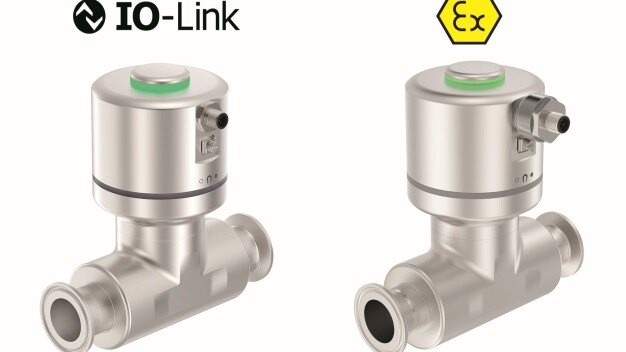
Two new products for Type 8098 FLOWave S: The IO-Link version (left) does not differ visually from the already available FLOWaves, while the HazLoc version (right) shows the special connector. (Source: Bürkert Fluid Control Systems)
The proven FLOWave flow meters from Bürkert are now available not only with a 4–20 mA interface and Ethernet but also with IO-Link. This allows continuous access to diagnostic data in the automation system, simplifies installation and parameterization, and facilitates device replacement during plant maintenance.
The proven FLOWave flow meters from Bürkert Fluid Control Systems are now available not only with a 4–20 mA interface and Ethernet but also with IO-Link (see Figure 1). This enables continuous access to diagnostic data in the automation system, thereby simplifying installation, parameterization, and device replacement during plant maintenance. By using unshielded 3-wire standard cables and hubs, wiring effort is reduced, and less space is required in the control cabinet. As an open communication standard (IEC 61131-9) at the field level, IO-Link meets Industry 4.0 requirements for powerful digital communication of intelligent field devices with minimal engineering effort and can be integrated into all common fieldbus and automation systems. Not least, this is why IO-Link is increasingly used in process automation in the food & beverage, pharmaceutical, water, and environmental technology sectors. Another innovation is that the sensors now meet not only ATEX and IECEx standards but also Hazardous Locations Class 1 Division 2, allowing them to be used in hazardous areas (HazLoc) in North America with substances such as flammable gases, vapors, or dusts with explosion or fire hazards.
Measuring flow and density factor in hygienic applications
The sensor uses Surface Acoustic Waves technology (SAW) for measurement, which detects wave propagation similar to that occurring during seismic activities (e.g., earthquakes). The principle is also suitable for non-conductive media. In addition to measuring the volumetric flow, temperature is always measured, and optionally the differentiation factor and acoustic transmission factor. This allows, for example, the determination of the core temperature, detection of gas bubbles, or reliable recognition of product changes. Due to its design, the smooth measuring tube has no internal components, greatly facilitating cleaning. Its low mass also makes CIP/SIP processes more efficient and reduces the CO2 footprint. This significantly increases the productivity of machines and systems, e.g., for CIP, reverse osmosis (RO), or filtration skids.
Bürkert GmbH & Co. KG
74653 Ingelfingen
Germany