




- Science
- Translated with AI
Flexible and productive – Matrix production systems make factories fit for the future
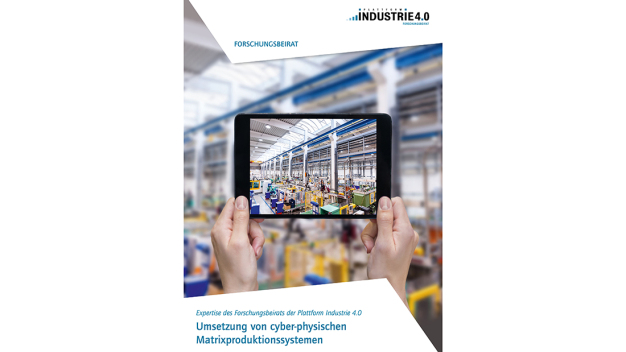
Title Page Matrix Production
How can manufacturers respond more quickly to global crises, cope with supply chain disruptions, and at the same time cater to individual customer wishes? On behalf of acatech, Fraunhofer researchers investigated to what extent cyber-physical matrix production systems can help companies address these challenges.
Such flexibility has rarely been demanded: crisis- and war-related disruptions to supply chains, short-term cancellations or changes to orders, a trend toward ever smaller batch sizes, and increasing product individualization are now everyday realities for many manufacturing companies. At the same time, companies need to increase their productivity to remain competitive globally. New, flexible manufacturing concepts can help with this. This conclusion is reached by the research teams from the Fraunhofer Institute for Production Technology and Automation IPA and the Fraunhofer Institute for Machine Tools and Forming Technology IWU. Fraunhofer IPA and IWU jointly prepared an expertise report on the implementation of cyber-physical matrix production systems on behalf of the German Academy of Science and Engineering acatech.
The term matrix originally comes from mathematics and describes a rectangular arrangement of objects in rows and columns. Production engineers understand a matrix as a chessboard-like arrangement of manufacturing modules: warehouses, manufacturing machines, and transport systems, for example, operate independently of each other. At the same time, however, they are cyber-physically networked: in the virtual space, there is a Digital Twin that models the production processes and manufacturing modules. Through it, material flows and machine utilizations can be optimized. The results are then used to control the real—physical—modules.
Matrix production systems in use: Will manufacturing become more flexible and at the same time more productive?
Cyber-physical matrix production systems are considered by experts to be a key to manufacturing that is both flexible and productive, helping companies increase their resilience and thus survive turbulent times. "Cyber-physical matrix production systems offer an answer to market changes such as declining batch sizes, increasing variety, and poor predictability of customer demands," says Thomas Bauernhansl, member of the research advisory board of the Industry 4.0 platform and director of the Fraunhofer IPA.
The fact that engineers are particularly interested in flexibility and productivity has a good reason. The two sizes have traditionally been seen as opposites in manufacturing: the classic workshop production, where parts such as sheets are processed step-by-step with various tools, is less automated, very flexible, but at least inefficient at medium batch sizes. On the other hand, highly automated line production is highly productive thanks to rigid chaining but inflexible—if, for example, a component is missing, the line stops.
Can cyber-physical matrix production systems make workshop manufacturing more productive and line production more flexible? To answer this question, the Fraunhofer teams surveyed 28 companies, compiled results, and analyzed them. "Our goal was to examine the state of the art and find out to what extent the new systems are already being used in practice and whether they actually increase flexibility and productivity," explains Petra Foith-Förster, head of the study at Fraunhofer IPA.
Large companies use matrix production systems – complete solutions for SMEs are lacking
"Especially large companies, but also larger medium-sized enterprises, are already using matrix production systems," reports Dr. Arvid Hellmich, who led the study at Fraunhofer IWU. The semiconductor industry is a pioneer in implementing these new systems, but larger manufacturers of automobiles or electrical devices also use modular structures that are digitally optimized and controlled. "We were pleased to see that the technologies in many of the companies using matrix production systems already have a high level of maturity," emphasizes the researcher.
To assess the maturity level of cyber-physical matrix production systems, the engineers developed a catalog of criteria. These include, among others, the modular structure of production units, the degree of implementation of a Digital Twin, the use of automated transport systems, and the reconfigurability of the process flow, which allows for quick adaptation of production to changing market requirements.
"The results of the expertise show that matrix production systems enable economical production under challenging market conditions and that companies with various production processes from different industries are already implementing them partially or fully," summarizes Hellmich.
What is still missing are market-ready complete solutions: "It was surprising for us that, although solutions for matrix production systems are offered individually, there are no comprehensive packages including plant technology and process automation," emphasizes Foith-Förster. "The companies that are already working with the new modular systems have developed them themselves. Small and medium-sized companies that cannot afford their own technology development are at a disadvantage. There is an urgent need for better networking between technology providers and potential customers."

Fraunhofer-Institut für Produktionstechnik und Automatisierung IPA
Nobelstraße 12
70569 Stuttgart
Germany
Phone: +49 711 970 1667
email: joerg-dieter.walz@ipa.fraunhofer.de
Internet: http://www.ipa.fraunhofer.de



