




- Science
- Translated with AI
Barbara Halstenberg
Energy for the orbit
In the "SpaceBox" project, the Department of Aerospace Engineering at TU Berlin collaborates with Berlin industry partners to develop lighter and more efficient energy storage systems for satellites.
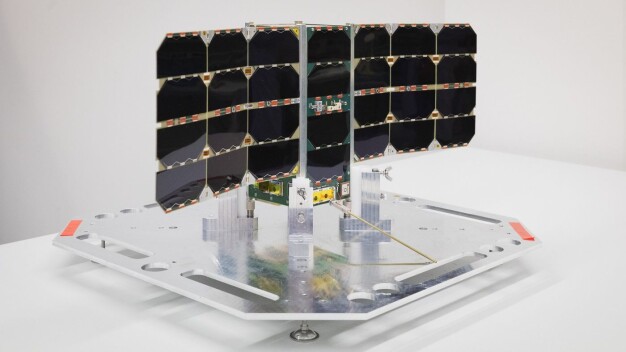
Satellites, like this small satellite from TU Berlin, are then dependent on batteries when they fly through Earth's shadow on their orbit and their solar cells cannot generate energy.
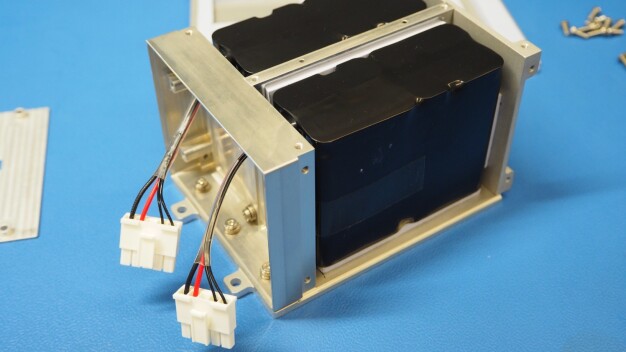
At the heart of "SpaceBox" is a battery module based on innovative lithium-sulfur technology. These batteries can store significantly more energy than the currently common lithium-ion batteries at the same weight. For comparison: the battery box of the TUBIN satellite from TU Berlin currently contains two lithium-ion battery packs.
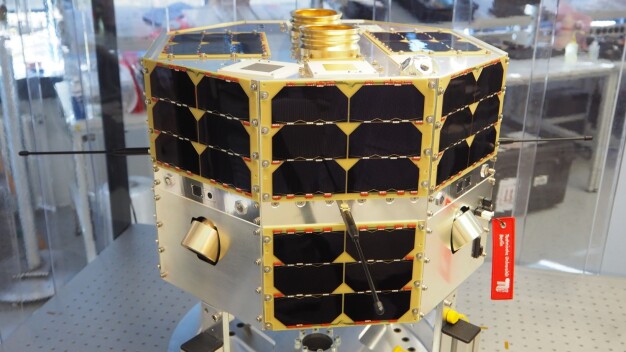
A focus of TU Berlin is on the battery management system, which monitors voltage, current, temperature, and state of charge of the cells, thereby ensuring safe operation in space. The development is based, among other things, on experiences from the successful TUBIN satellite mission. Here, the fully integrated TUBIN satellite can be seen in the laboratory of the Department of Aerospace Engineering.
Satellites rely on reliable energy storage: when they pass through Earth's shadow in their orbit, their solar cells cannot generate energy. Batteries bridge these phases and support operation even when onboard, temporarily, more power is needed than the solar cells can supply. In the research project "SpaceBox," a Berlin-based consortium of science and industry is developing a new generation of space batteries. The goal is an integrated battery system that is significantly lighter and more powerful than current solutions, while also meeting the high demands of space.
More energy with less weight
The focus of "SpaceBox" is a fully integrated battery module based on innovative lithium-sulfur technology. These batteries can store significantly more energy at the same weight compared to today's common lithium-ion batteries. For satellites, this is a crucial advantage: each kilogram saved reduces launch costs and creates room for additional payload, longer mission durations, or smaller and more cost-effective satellite platforms. The lithium-sulfur technology used and further developed in the project aims to achieve energy densities of more than 300 watt-hours per kilogram (Wh/kg). For comparison: lithium-ion batteries, which are most commonly used, typically have 150 Wh/kg.
Tests under space conditions
At the end of the project, a qualified demonstrator will show that the technology is suitable for future space missions. To this end, the Spacecraft Engineering Department of TU Berlin tests battery cells, electronics, battery management systems, and the fully integrated module under realistic space conditions.
The focus is on applications in low Earth orbit (LEO), where most satellites operate, as well as potential uses beyond that. As the distance from Earth increases, the protective effect of the magnetic field diminishes, leading to a significant increase in radiation exposure. This can cause performance degradation, errors, or failures in electronic systems.
Space qualification includes thermal vacuum, shock, and vibration tests, charge-discharge cycles, and tests for resistance against space radiation. These are intended to demonstrate the system's performance under realistic mission conditions and to define its operational limits.
TU Berlin takes on system integration
The Spacecraft Engineering Department of TU Berlin assumes a central role as system integrator within the consortium. It defines the requirements for the battery module, develops the battery management system, coordinates qualification tests, and is responsible for integrating the overall system.
"With SpaceBox, we combine our many years of experience in developing satellite systems with promising battery technology," says Philipp Werner, systems engineer at the Spacecraft Engineering Department of TU Berlin. "The goal is to develop a fully integrated and space-qualified energy storage system that makes future satellite missions more powerful and efficient."
Safety and monitoring in orbit
A particular focus of TU Berlin is the battery management system. It ensures that the battery operates safely and reliably in space. It continuously monitors important parameters such as voltage, current, temperature, and state of charge of individual cells. This allows the system to detect early if something is not functioning as intended and to initiate protective measures. Additionally, the battery management system balances the individual cells to ensure they are loaded as evenly as possible. This helps maintain the performance and lifespan of the battery—even under the unique conditions of space. The development builds on experiences from in-house developments by the Spacecraft Engineering Department for successful satellite missions like TechnoSat and TUBIN. A broad catalog of qualified hardware and modular software, which is further developed in the project, is already available for this purpose.
Good collaboration
"Especially for space applications, we often have to rely on international partners for battery cells," says Philipp Werner. "A competent national partner that can offer our space-qualified cells in the future is already a great benefit for German space projects." Project partners include the Spacecraft Engineering Department of TU Berlin, the Berlin-based battery cell developers theion GmbH, who are developing the novel battery cells, and Space Structures GmbH, which is developing a lightweight and robust housing. The project is funded by the Federal Ministry of Research, Technology, and Space through the German Aerospace Center (DLR) with around 3 million euros and runs over 30 months.
Long-standing experience with small satellites and scientific Nachwuchs
The Spacecraft Engineering Department of TU Berlin has many years of experience in the development, manufacturing, verification, and operation of small satellites. Since 1991, TU Berlin has been involved in the successful launch and operation of 31 small satellites. Current research activities range from CubeSat and micro-satellite platforms to missions to the Moon and Venus. The focus is on robust space electronics, system integration, and radiation hardening issues.
In addition to technological goals, "SpaceBox" also contributes to training scientific professionals. PhD students and students are actively involved in the research work. Among other things, three positions for student assistants are planned. They will gain skills in electrochemical storage technologies, battery management, space systems, and system integration through the project.
Technische Universität Berlin
10587 Berlin
Germany



