

- Science
- Translated with AI
Electrolyzers should become mass-produced items
Hydrogen Technology
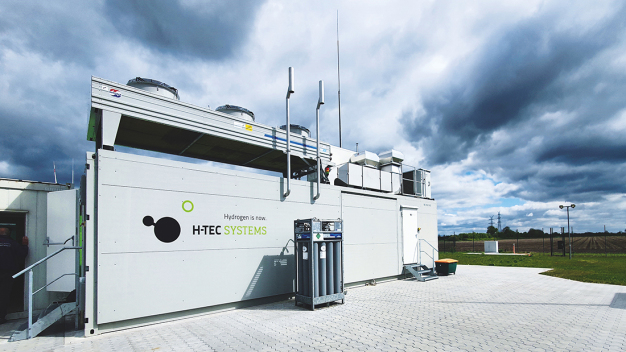
Electrolyzer in Haurup near Flensburg. © H-TEC SYSTEMS GmbH
Anyone who wants to use hydrogen as an energy source needs electrolysers. However, they are rare and expensive because they are still largely manufactured by hand. To enable mass production on an industrial scale in the future, a research team from Fraunhofer IPA is currently developing a fully automated electrolyser factory.
Hydrogen is abundantly available on Earth. However, it is highly reactive and therefore bound in molecules, such as in water (H2O). If one wants to use the gaseous element as a zero-emission energy source, hydrogen must first be extracted from the water molecule. For this, there are so-called electrolysers. They split water into its components: hydrogen (H2) and oxygen (O). Fuel cells can convert the hydrogen back into electrical energy, which then drives motors. Alternatively, the hydrogen can be burned directly in blast furnaces.
Since hydrogen plays an important role in the energy and transportation transition, the world will need大量 new electrolysers in the foreseeable future. However, they are still mostly manufactured manually, which takes a lot of time, is expensive, and prone to errors. Scientists from the Fraunhofer Institute for Production Technology and Automation IPA aim to automate the production of electrolysers comprehensively, together with partners from research and industry. "The goal is an automated electrolyser factory on a gigawatt scale," says Friedrich-Wilhelm Speckmann from the Center for Digitized Battery Cell Production (ZDB) at Fraunhofer IPA. "The electrolysers produced here within a year should have a combined nominal capacity of at least one gigawatt."
Robots will take over stacking in the future
An electrolyser consists of two electrodes – the positively charged anode and the negatively charged cathode – and a separator, in this case a proton exchange membrane (PEM). To increase performance, many electrolysis cells are stacked into a so-called stack. This stacking is still mostly done manually but could be performed by robots in the future.
However, since not only stacking but the entire production line is to be automated, the researchers must also consider all upstream and downstream processes, up to the commissioning of the entire systems. Tasks range from factory and production planning, component testing, to end-of-line testing stations. Additionally, the consortium is developing new stack designs that will simplify and accelerate future production processes.
Manufacturing system planning, robots, and sensors for the electrolyser factory
To realize the automated electrolyser factory, the project partners will first set up a production line according to the current state of technology. This line will then be modularly adapted and expanded piece by piece to improve the integration and automation of individual processes. The scientists are addressing a number of open questions, such as: Which robot topology is best suited for stacking? How must a robot grip the components, and how fast can it move to avoid damaging the sensitive parts? Which optical sensors should be integrated into the system for quality assurance? Which manufacturing technologies enable scaling of electrolyser production? What should a fully automated electrolyser factory look like and how should it be structured?
The research team aims to find answers to these and many other questions by March 31, 2025. At that time, the research project "Industrialization of PEM Electrolyser Production" (PEP.IN), funded by the Federal Ministry of Education and Research (BMBF) with over 20 million euros, will conclude. The consortium includes, besides Fraunhofer IPA, the Fraunhofer Institute for Solar Energy Systems ISE, the Fraunhofer Institute for Environmental, Safety, and Energy Technology UMSICHT, MAN Energy Solutions SE, H-TEC Systems GmbH, Audi AG, VAF GmbH, the Center for Fuel Cell Technology GmbH, and the Forschungszentrum Jülich GmbH. PEP.IN is part of the flagship project "H2Giga," one of three hydrogen flagship projects that form a central contribution of the BMBF to the implementation of the National Hydrogen Strategy.

Fraunhofer-Institut für Produktionstechnik und Automatisierung IPA
Nobelstraße 12
70569 Stuttgart
Germany
Phone: +49 711 970 1667
email: joerg-dieter.walz@ipa.fraunhofer.de
Internet: http://www.ipa.fraunhofer.de