



- Science
- Translated with AI
Economic State Secretary learns about quantum technologies at Fraunhofer IAF
Dr. Patrick Rapp and Prof. Dr. Rüdiger Quay discuss industrial opportunities and collaboration possibilities in Baden-Württemberg
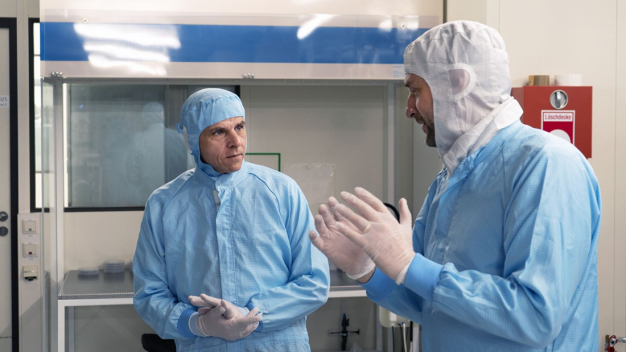
Deputy State Secretary for Economic Affairs Dr. Patrick Rapp and Acting Institute Director Prof. Dr. Rüdiger Quay in the cleanroom of the Fraunhofer IAF. © Fraunhofer IAF
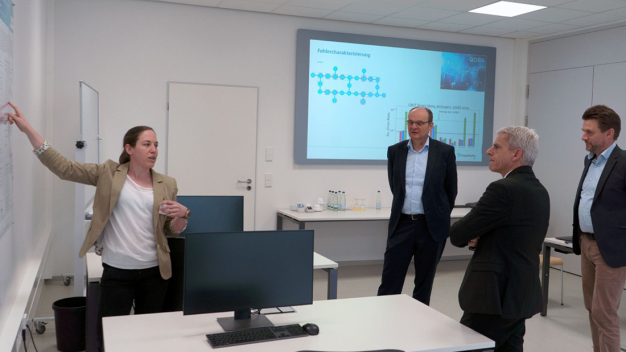
In the Fraunhofer IAF training room for quantum computing, progress in the optimization of quantum algorithms was presented. © Fraunhofer IAF
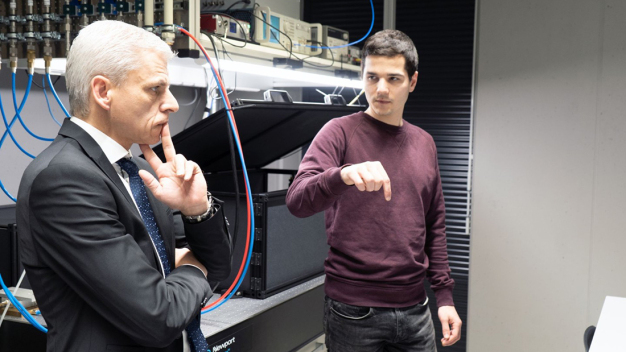
In the Quantum Sensor Application Laboratory at Fraunhofer IAF, state-of-the-art quantum measurement systems are available. © Fraunhofer IAF
During his visit to the Fraunhofer IAF on March 31, 2023, Baden-Württemberg State Secretary for Economic Affairs Dr. Patrick Rapp and the acting institute director Prof. Dr. Rüdiger Quay discussed industrial opportunities and cooperation possibilities in the field of quantum technologies. The visit included tours through the cleanroom, the quantum computing training room, and the quantum sensor application laboratory at Fraunhofer IAF, as well as presentations by researchers from the institute.
On March 31, 2023, Dr. Patrick Rapp, Secretary of State at the Ministry for Economic Affairs, Labor and Tourism, visited the Fraunhofer Institute for Applied Solid State Physics IAF in Freiburg. In discussions with the acting institute director Prof. Dr. Rüdiger Quay and during tours through laboratory and training rooms as well as the cleanroom, the focus was on research and transfer activities in quantum technologies. The Ministry of Economic Affairs is supporting several collaborative projects in this area under the coordination of Fraunhofer IAF to harness the significant potentials in the region and enable transfer into economic and societal applications.
Quantum Technologies for the Innovation Hub Baden-Württemberg
“Research institutions close to industry like the Fraunhofer Institute for Applied Solid State Physics IAF in Freiburg make an indispensable contribution to the competitiveness and future viability of Baden-Württemberg as an innovation location,” said Dr. Patrick Rapp, Secretary of State at the Ministry for Economic Affairs, Labor and Tourism, on his visit to Fraunhofer IAF in Freiburg. “Fraunhofer IAF advances international developments in important future fields such as quantum technologies with its original research on innovative semiconductor technologies and is one of the key pillars of the Quantum Computing Competence Center Baden-Württemberg,” the economic secretary further explained.
Professor Quay emphasized the excellent contribution of the Baden-Württemberg Ministry of Economic Affairs in developing and transferring innovative technologies: “With quantum technologies, we can likely realize more sensitive sensors, more powerful computer systems, or more secure communication connections in the future. They represent a great opportunity for Baden-Württemberg to maintain and expand its leading position among Europe's economically strong, innovative, and livable regions in the long term. The Ministry’s commitment significantly contributes to our joint research and development of quantum technologies, which quickly find their way into applications and generate added value.”
Quantum Computing and Quantum Sensing at Fraunhofer IAF
Following the discussion, Dr. Rapp and Professor Quay visited the Fraunhofer IAF cleanroom, where employees produce interconnect semiconductors and diamonds, from which quantum components are manufactured. In the quantum computing training room, doctoral student Kathrin König from the Quantum Information group demonstrated progress in optimizing quantum algorithms via cloud access to IBM Quantum System One in Ehningen near Stuttgart. As part of the Baden-Württemberg Quantum Computing Competence Center (KQCBW), funded by the Ministry of Economic Affairs and Fraunhofer-Gesellschaft, Fraunhofer IAF, together with other partners from science and industry, conducts research projects (“QC4BW II,” “QORA II,” “SEQUOIA End-to-End,” “SiQuRe II,” “QuESt+”), training programs, and networking events on quantum computing.
Niklas Mathes, who is pursuing his doctorate in quantum sensing at Fraunhofer IAF, presented Dr. Rapp with the wide-field magnetometer in the quantum sensor application laboratory. The device, developed specifically at the institute within the project “QMag – Quantum Magnetometry,” funded by the Ministry of Economic Affairs Baden-Württemberg and Fraunhofer-Gesellschaft, can measure the tiniest magnetic fields with high resolution and sensitivity at room temperature. The technology is based on an innovative approach using nitrogen-vacancy centers (NV centers) in highly pure synthetic diamond as sensors. The quantum sensor application laboratory at Fraunhofer IAF is open to partners from science and industry to test state-of-the-art measurement systems. Possible applications of quantum magnetometry range from imaging procedures in medicine to contactless inspection methods in industry and GPS-independent navigation.
Engagement of the Baden-Württemberg Ministry of Economic Affairs
Baden-Württemberg plays a leading role in the research and development of quantum technologies. Numerous research institutes, universities, and companies of all sizes are working to utilize quantum physical phenomena for technological innovations in areas such as health, mobility, manufacturing, finance, or energy to achieve societal and economic improvements. The Baden-Württemberg Ministry of Economic Affairs supports scientific work, further education, and networking of all actors from research, industry, and politics through funding of research projects, informational events, and interdisciplinary collaborations. The goal is to promote the development of quantum technologies in Baden-Württemberg and their transfer into practical applications as effectively as possible.
Fraunhofer-Institut für Angewandte Festkörperphysik IAF
79108 Freiburg
Germany