




- Translated with AI
Disinfectant residues? Overdose and foaming during mopping?
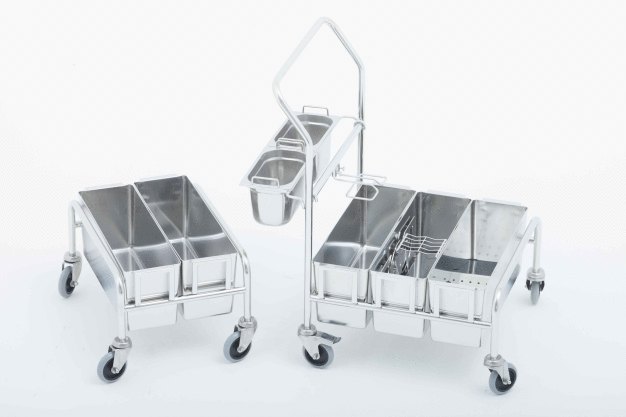
PurQuip ERGO System
For an efficient cleaning result in cleanrooms and GMP areas, a validated and consistently identical process is extremely important. This is especially true for the process of mop moistening, or more precisely: for the liquid amount contained in the mop.
Incorrect procedures or improper handling of mops or trolley systems can quickly lead to improperly wetted floors and ineffective cleaning or disinfection. In practice, it is often observed that very wet mops are used; in many cases, the maximum absorption capacity of the mops is exhausted. This usually happens due to incorrect system application (e.g., dipping the mop into the liquid without wringing it out) or when using mop boxes/preparation systems.
What problems can occur if the cleanroom mops are too wet?
Disproportionately high liquid release in the first meters, leading overall to an uneven liquid film. Excessive liquid release quickly results in overdosing. This significantly increases the risk of disinfectant residues and thick layer buildup.
Reduced cleaning performance - this can be easily understood: the liquid is stored in the mop material (usually polyester fibers, possibly microfiber), through the so-called capillary effect. However, if the mop material is fully saturated with liquid, the mop has very limited capacity to pick up fine particles and contaminants. Contaminations are often just spread rather than absorbed. In contrast, defined cleaning involves absorbing contaminants into the material and removing them from the cleanroom.
To avoid these risks, a suitable cleaning system should be used, through which the mop is not too wet but also not too dry – that is, it contains the exactly right amount of liquid. This allows a defined, safe surface coverage (in the cleanroom, depending on requirements and product, 8-15 sqm). It is particularly important to reduce disinfectant residues and simultaneously increase cleaning performance/effectiveness.
In 2012, the Hydroflex technicians developed an innovative method with the PurQuip® ERGO system to make application as simple as possible. The process is identical and straightforward for every mop moistening. The amount of liquid used to moisten the mop is definable (easily dosed with 4 inserts) and can be validated, as the moistening process is always the same.
Thanks to the logical design of the 3-stage system, error sources are minimized. Since the process is very simple and uncomplicated, it can be learned and repeated very easily.



