




- New building
- Translated with AI
Patrick Pick
Digitally built, real in operation: Roche sets new standards
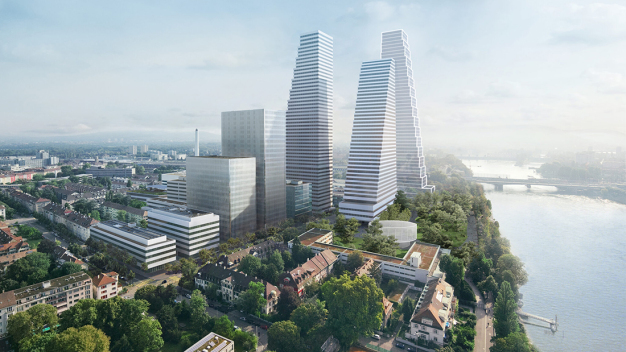
Visualization (Photo: F. Hoffmann-La Roche AG, Basel)

Patrick Pick
Slimly built, visible from afar: With 205 meters, the Roche Tower Building 2 rises above Basel into the sky. In 2020, it replaced Building 1 with 178 meters as the tallest building in Switzerland. The second Roche Tower sets new standards in collaborative planning: Even before Building 2 rose floor by floor, the digital twin allowed for exploration of the building from basement to roof.
What lies behind this digital twin is anything but trivial. Ideas, drafts, simulations, schedules, specifications, budgets, building permits – coordinating all of this requires excellent cooperation among all involved parties. For a smooth project process, the client, architect, planners, and executing companies rely on Building Information Modeling, or BIM.
Digital replica of a building with extensive information depth
The term Building Information Modeling most closely corresponds to the translation of Building Data Modeling. This does not only involve the use of appropriate software. Rather, it encompasses planning methods and processes to create, coordinate, and transfer accessible digital building data models for all construction stakeholders. BIM is primarily an information, coordination, and management method to bring together planning-, execution-, and usage-related building information in trade-specific models and databases. These include, for example, different planning areas such as architecture, structural engineering, facade, or technical building equipment (TGA). In BIM, responsible parties do not just draw but construct a digital model of the later building from individual elements, similar to automotive production.
Simplified, BIM follows the straightforward but proven motto: “Plan first, then build.” A fundamental difference from traditional CAD planning models is that BIM allows not only the creation of a simple digital replica of a building but one with extensive information depth. In addition to the virtual description of the geometry of a structure, data on individual building elements such as material, weight, surface, volume, and name, as well as their function and location within the building geometry, are recorded. This also includes information on the lifespan of materials, sound transmission, fire protection, or costs. Ideally, BIM holistically encompasses the entire lifecycle of a building – from planning through construction and operation to disposal or recycling.
With BIM, planning and execution quality increases
BIM enables early detection and elimination of planning errors, preventing them from affecting the construction process. This makes it possible to avoid costly mistakes or planning discrepancies in advance. Since Roche pursues a consistent BIM collaboration approach, the entire planning process becomes significantly more efficient. For example, task management and collision documentation are already performed during digital coordination meetings (DCM). And by all stakeholders using specialized cloud-based communication tools, maximum transparency and traceability of coordination points are maintained at all times. Roche can thus reduce schedule, cost, and quality risks through BIM. Additionally, advantages such as consistency, clarity, and the potential for reusing BIM model data are evident.
Clients also benefit from efficient workflows, which improve planning and execution quality. The costs of construction projects can be predicted more accurately, and construction schedules can be planned more reliably. Design variants linked to costs and schedules can already be tested at a very early stage. Not least, geometric clashes between building models of different planners can be identified early and resolved at low cost. Simulated construction and assembly sequences provide protection against unpleasant surprises on site.
BIM expertise is crucial for project success
However, a client can only realize these and other advantages if BIM is properly set up and professionally operated for their construction project. This is only possible with the right BIM experts on the client’s side, in project management, and among planners. Because what presents a greater challenge than the technical equipment and underlying processes when using BIM is the competence of the project participants. They must not only master the necessary software but also agree on BIM communication, coordination, and information standards and implement them consistently in the project. Building BIM expertise, defining responsibilities, and redistributing roles are essential. Stakeholders – whether clients, architects, or planners – need to invest time and financial resources to train staff, offer workshops, and practice BIM knowledge through pilot projects.
Early benefits of BIM working methods in projects
A client deciding for BIM for the first time or based on a pilot project must initially clarify a number of questions. What are the goals for implementing BIM and a fully digital project process? What do the decision-making processes look like within the company? Who takes on which roles, responsibilities, and service descriptions within the BIM method? What are the BIM and IT standards? What is the information requirement for organizational and technical building management? What is the planned procurement and awarding strategy?
At Roche, the following aspects served as guiding principles for digital planning, summarized in the BIM Execution Plan (BEP):
- Establishment of the project environment (Owner BIM) and definition of data exchange and processes (definition of data drops and coordination of the digital planning process);
- Setting up BIM processes in coordination with specialists and the client, including quality assurance processes, and creating and updating the BIM Execution Plan (BEP) for various project phases;
- Definition and establishment of digital collaboration processes, including digital reporting on the performance of project participants and progress controls;
- Setting up the Information Delivery Manual (IDM) for planning phases regarding attribute requirements of different trades and components, defining delivery times, authorship, and establishing a central model project database;
- Model-based quantity calculation for preparing the bill of quantities;
- Quality assurance processes, especially regarding geometric and alphanumeric model qualities (LOG and LOI), based on modeling rules established within the project team.
Once these topics are addressed, clients can already look forward to the advantages of BIM-based working methods in very early project phases. This begins with basic data collection and pre-design phases, where BIM mass models can be created in 3D. Thanks to BIM, project participants have access from the start to building key figures according to DIN 277, such as gross volume or gross floor area.
While setting up and maintaining the BIM data model is more complex in early project phases than traditional 2D planning, it pays off because much can be semi-automatically derived from the model in subsequent approval and execution planning phases.
As a result, project participants can present multiple, visually simplified design alternatives to the client, including quantity and cost analyses, providing a solid decision basis. The client can then easily compare cost differences between alternatives, for example, in building form, materials, and equipment. In early planning, they can optimize the building form based on the intended future use of the building.
Defining BIM strategy based on project goals
The BIM strategy a client should pursue mainly depends on their objectives. For example, if the goal is an energy-optimized building, they benefit from model-supported energy simulations. If they will operate the building after completion, early integration of Computer-Aided Facility Management (CAFM) into BIM is essential. For buildings intended for large groups of people – such as event venues – simulations of pedestrian movements and climate control options are also relevant.
Therefore, it is important for the client to determine the appropriate level of BIM complexity early on. If they want to benefit from advantages such as automated data transfer, reduced planning time and costs, or collision detection and error minimization, they must be able to rely on cross-disciplinary standardization of BIM modeling.
Digital memory for the building
Furthermore, the model views created with BIM can be used for presentation of the planning status to users and the public. This significantly improves the quality of coordination. From staff in various departments, political stakeholders, to media and the public, many different groups are involved in the Roche new construction project. Their consistent involvement is crucial – not only to ensure the building’s optimal functionality but also to foster early identification with the project and thus acceptance. Visualizations of the building, its surroundings, access routes from real planning data, and simulations of workflows, traffic situations, etc., are extremely helpful. The three-dimensional views generated from the BIM model are intuitively understandable, giving users a realistic and vivid impression of the functional areas and the entire building. At Roche, a virtual tour using VR glasses is even possible. Users can move freely in the virtual space, simulate processes, and make well-informed decisions about equipment, operational workflows, and room layout.
After project completion, the cloud-based overall model serves as the basis for facility and lifecycle management – facilitating the economical operation of the building. The facility manager can use the model systematics as a kind of “organization system” for building management. At the same time, all future operational data – maintenance, renovations, or refurbishments – can be recorded on this data basis, and the data necessary for facility management can be continuously updated, enabling efficient building operation. From the “as designed” and “as built” models from planning and construction, an “as performed” model is derived – a digital building twin that enables resource-efficient and effective property management throughout the building’s life cycle.

Drees & Sommer SE
Geisenhausenerstraße 17
81379 München
Germany
email: lifesciences@dreso.com
Internet: https://www.dreso.com/life-sciences



