



- Science
- Translated with AI
DFG funds sustainable modernization of the central research facility at TU Berlin
Plasma deposition system at the Center for Nanophotonics is being renovated with 490,000 euros
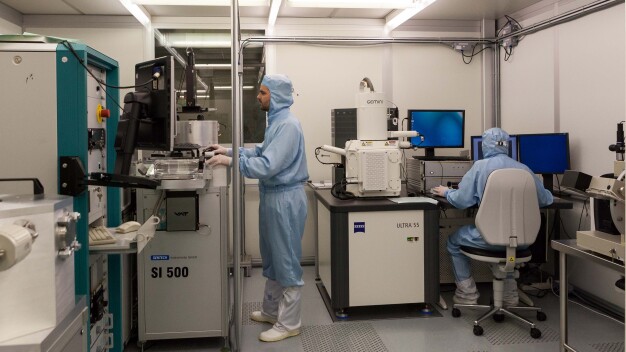
Plasma deposition system in the cleanroom of the Nanophotonics Center at TU Berlin.
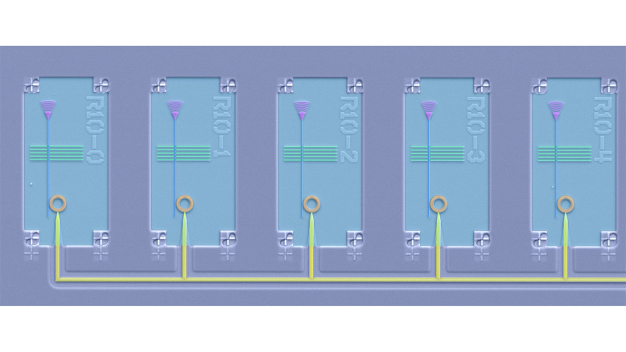
Electron microscopic image of so-called quantum circuits. They consist of microlasers (circular, orange), waveguides with integrated light sources for individual light particles – photons – (blue) and tap-off elements (purple). These complex nanostructures are being developed as part of the "Berlin Quantum" initiative for future photonic quantum computers and can only be produced with a modern, highly precise plasma etching system.
A central research facility of the Technical University of Berlin is being prepared for the coming decades: With support from the German Research Foundation (DFG) and the State of Berlin, the plasma etching system in the cleanroom of the Center for Nanophotonics is being extensively renovated with a total budget of approximately 490,000 euros. 50 percent of the funds are financed by TU Berlin. The modernization extends the lifespan of the existing system and ensures its performance for photonics and quantum research. It also reflects TU Berlin's commitment to sustainable management of research infrastructure, as outlined in its environmental guidelines. In the future, the system will be part of the new Center for Integrated Photonics Research (CIPHOR) on the Charlottenburg campus of the university.
The system to be renewed combines a device for "plasma etching" and one for "plasma coating" in a single unit and is among the most important devices in the cleanroom of the Center for Nanophotonics. It is needed to structure semiconductor materials with the highest precision and to apply functional layers only a few nanometers thick. This enables, among other things, the creation of quantum light sources, nano- and micro-lasers, photonic circuits, highly efficient waveguides, or modern LED components.
Highest precision for the generation and transmission of light particles (photons)
A particular strength of the system lies in its exceptional precision. It allows semiconductor materials to be structured with nearly vertical sidewalls at the nanometer scale. Such highly precise structures prevent optical losses and are essential for enabling photonic components to guide light intentionally or to reliably generate individual light particles. At the same time, sensitive semiconductor materials can be gently coated with thin layers to enhance their functionality without impairing their optical properties. "Our system enables manufacturing processes with a precision in the range of a few billionths of a meter. It is currently already crucial for five research groups at TU Berlin and will potentially be used by many more partners, especially from the Berlin University Alliance," says Prof. Dr. Stephan Reitzenstein, head of the "Optoelectronics and Quantum Devices" department at TU Berlin and director of the Center for Nanophotonics.
Refurbishment of the 20-year-old system also preserves existing expertise
With the refurbishment, key components of the system acquired in 2006, which have exceeded their lifespan, are being brought up to the latest technological standards. As part of the modernization, vacuum, control, high-frequency, and temperature regulation modules are being replaced, plasma generator technology is being renewed, and new process control and safety components are being installed — for a total of around 490,000 euros. Purchasing a new system would have cost double to triple that amount. For Stephan Reitzenstein, the refurbishment is not only technologically essential but also a means of preserving important expertise at TU Berlin: "We are not just extending the lifespan of a proven system. It also ensures that the specialized knowledge our staff has built up over many years remains relevant for the future. Especially in highly complex manufacturing processes, cutting-edge research relies not only on the latest technology but also on the experience in handling it."
Plasma etching system will become part of the new physics research building CIPHOR
With the planned move to the new Center for Integrated Photonics Research (CIPHOR) in the eastern part of the Charlottenburg campus, the modernized system will remain an important part of TU Berlin's research infrastructure for many more years. CIPHOR will consolidate key technologies for integrated quantum photonics and create optimal conditions for developing new applications — from secure quantum communication and quantum sensing and metrology to medicine and photonic quantum computing.
Technische Universität Berlin
10587 Berlin
Germany