


- Hygiene & Cleaning
- Translated with AI
Dipl. Ing. Michael Mohr
Decontamination with hydrogen peroxide vapor
Comprehensive service for the cleanroom
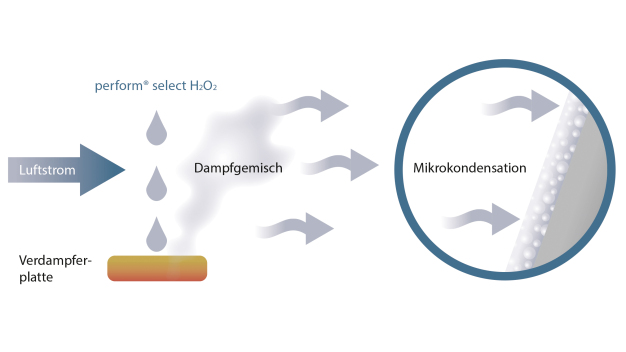
Fig. 1: Principle of H2O2 decontamination
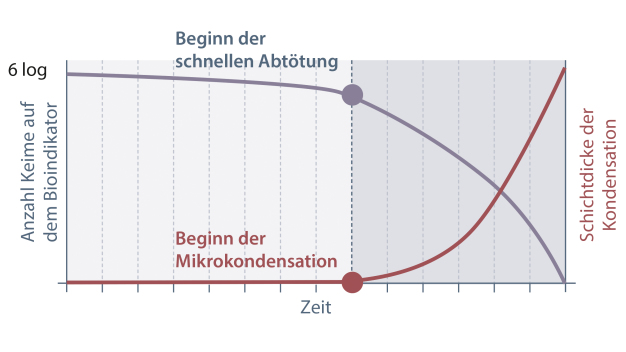
Fig. 2: Course of H2O2 decontamination
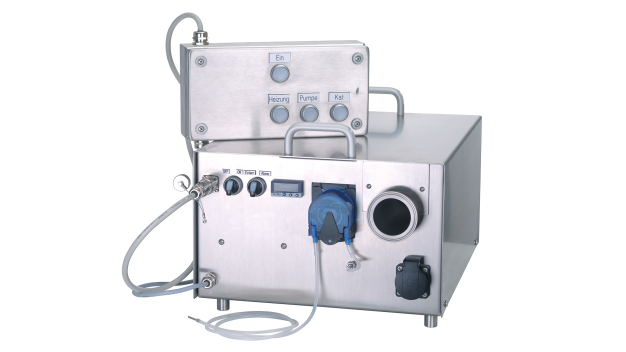
Image 1: Steam generator for vaporizing hydrogen peroxide
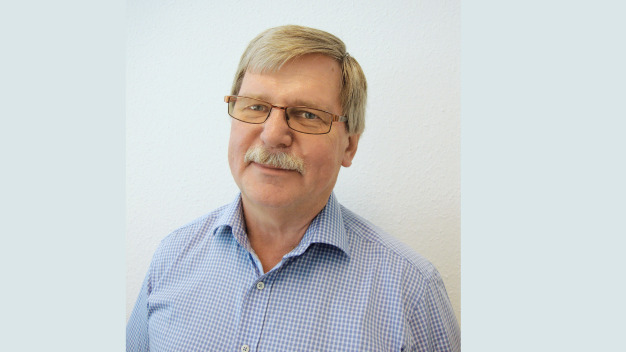
Dipl. Ing. Michael Mohr, Schülke & Mayr GmbH, Hygiene International, Engineering – Life Sciences
For the disinfection of surfaces, equipment, and products, there are different procedures. Typically, one speaks of the classic "manual" disinfection, where ready-to-use or concentrate-based disinfectant solutions are applied to surfaces by wiping or spraying.
However, in rare cases, manual disinfection does not achieve the required result. The reasons for this vary. On the one hand, the disinfectant may have a too narrow spectrum of activity and, for example, be ineffective against spores; on the other hand, the cause and source of contamination may not be identified. Also, when reprocessing a sensitive production environment, such as a cleanroom during commissioning, after maintenance work, or after accidents, manual disinfection often is not sufficient to restore the microbiological environment to the desired level.
A very successful method that has gained increased prominence in recent years is the vaporization of hydrogen peroxide (H2O2). In this technology, hydrogen peroxide is vaporized drop by drop until micro-condensation occurs on all surfaces. The resulting efficacy against microorganisms is extremely broad, including spores. After the decontamination process, the hydrogen peroxide is catalytically broken down into water and oxygen. This simple fundamental principle is carried out with specially coordinated steam generators and high-purity hydrogen peroxide.
The principle of the technology
The H2O2 solution drips onto a hot plate and vaporizes instantly. An airflow captures the warm vapor, cools it to ambient temperature, and distributes the vapor evenly throughout the room. The H2O2 concentration in the room is continuously monitored and controlled according to humidity and room temperature.
Depending on environmental conditions such as temperature and humidity, the room air is exposed to H2O2 vapor until the dew point (condensation point) of hydrogen peroxide is reached. At this point, vaporization is stopped, and the holding time begins. During this phase, only the H2O2 that condenses evenly on surfaces is replaced, maintaining a constant concentration in the air.
Micro-condensation
Micro-condensation refers to the uniform wetting of all surfaces and the contact between the active substance and microorganisms that results from this. It begins when the dew point is reached and marks the start of the active phase. This is also called the holding phase, as the concentration of H2O2 in the air is kept constant. An optically invisible, seamless film approximately 2-6 µm thick forms on the surfaces. A visible layer is only detectable at a thickness of about 50 µm.
If the H2O2 concentration were below the dew point, contact between H2O2 molecules and the surface, as well as the microbes on it, would be purely coincidental. Only through micro-condensation does optimal decontamination occur throughout the room and on all surfaces.
The principle of micro-condensation also allows for excellent microbiological efficacy without the need to adjust environmental conditions such as temperature and humidity. This is a significant advantage over other systems, as no time or energy is required for drying and cooling the room air. (see Fig. 1)
What does the decontamination cycle look like?
The decontamination process is divided into four phases: conditioning of the device, gasification of the room, exposure time, and ventilation or catalytic breakdown of H2O2.
In the first, relatively short phase, the system is powered up, environmental parameters are measured, and the heating plate is preheated.
In the subsequent gasification phase, H2O2 solution is vaporized, and the room is filled with vapor until the dew point is reached. This process duration varies depending on room size and environmental conditions.
During the subsequent exposure time, H2O2 exerts its full effectiveness through even micro-condensation on all surfaces. (see Fig. 2)
The final phase is the ventilation phase. Here, the H2O2 vapor is catalytically broken down into water and oxygen in an environmentally friendly and residue-free manner. The duration of this phase depends on the room size. To accelerate the process, special auxiliary devices can be used or the central ventilation system can be connected.
Implementation & Conditions
To successfully carry out decontamination using H2O2 vaporization, certain conditions must be observed. No permit is required for gasification with H2O2, and it does not have to be performed by a "state-certified disinfectant," but hydrogen peroxide is a hazardous chemical for humans and must only be used with specific safety precautions.
The ventilation system must be turned off in the room to be decontaminated during the entire first three phases. Additionally, doors and all other openings must be sealed or taped "gas-tight." This prevents H2O2 vapor from escaping through leaks into areas where staff are working. Ultimately, decontamination with hydrogen peroxide should only be performed by specially trained personnel. (see Image 1)
Room decontamination as a service
In addition to purchasing your own generators, there is also the option of having room decontamination performed as an external service. This service covers the entire process, from preparation including risk assessment and procedural description, through execution by specially trained technicians, to GMP-compliant evaluation and documentation.
Process of the decontamination:
1. On-site inspection to assess spatial conditions such as room volume, layout, equipment, materials, climate control, access routes, and emergency exits
2. Quotation preparation
3. Information on occupational safety, preparatory measures, and safety instructions
4. On-site execution – environment preparation, safety briefing, setup of devices, placement of biological indicators, execution of decontamination, disassembly of devices, and preparation of bioindicators for evaluation
5. Evaluation – analysis of bioindicators, interim report
6. Final report – documentation of the service in a comprehensive report with all parameters, process steps, and results
The costs for the service are calculated individually for each application and vary according to the required effort. In most cases, performing a service is more cost-effective than purchasing your own equipment and devices.
Conclusion
Decontamination using hydrogen peroxide offers an interesting alternative to sometimes very elaborate manual disinfection of entire rooms and their inventory.
It is highly effective against all known germs, including spores, and is residue-free and environmentally friendly compared to other methods.
The decontamination is particularly suitable for preparing highly sensitive areas or rooms contaminated by particularly persistent germs or unknown sources, as every surface in the room is disinfected.
Since the devices often require a certain investment and specially trained personnel are needed to perform room decontamination, it may not be practical for every company to carry out such decontamination themselves. Instead, it is possible to utilize a service, such as the Schulke Decon Service.

Schülke & Mayr GmbH
Robert-Koch-Str. 2
22851 Norderstedt
Germany
Phone: +49 40 521000
email: life.sciences@schuelke.com
Internet: http://www.schuelke.com