


- Filter
- Translated with AI
Contamination-free sterility tests
Time-saving and economical execution through H₂O₂ gasification
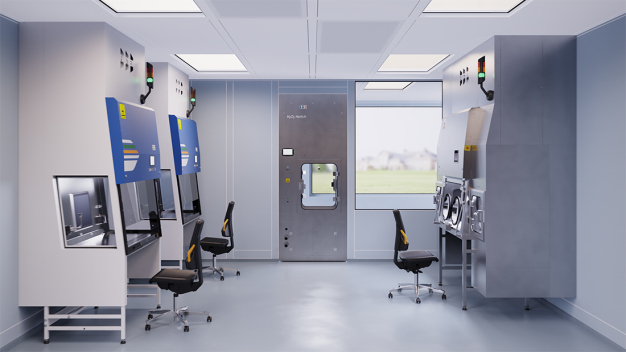
Material lock with H2O2 sterilization
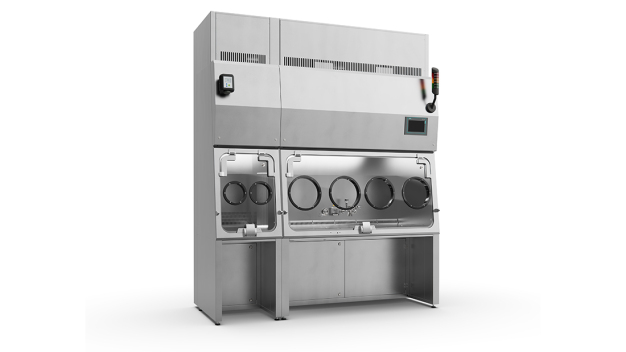
Sterility test isolator with H2O2

Sebastian Lamprecht
Decontamination using H2O2 fumigation in isolators has established itself as the technical standard. Among the usual fumigation methods, the misting process offers significant advantages in practice for sterilization tests in the pharmaceutical industry.
In the field of drug manufacturing and production monitoring, particularly strict hygienic standards apply. Therefore, great attention is paid to sterilization tests for medical products, with product quality regularly checked through sampling. It is therefore essential that the test environment is also sterile to prevent contamination with particles and microorganisms or cross-contamination with other measurement series.
Sterility tests are therefore conducted in isolators designed as positive pressure chambers of cleanroom class A (ISO 5). The surrounding room air — typically a cleanroom D (ISO 8) — is drawn in by the isolator's ventilation system, passed through particle filters to achieve cleanroom class A, and directed unidirectionally through the working space for maximum product protection. Continuous particle counting and air monitoring inside the isolator ensure a clean working environment.
Biodecontamination with H2O2
Before testing, necessary biodecontamination of possible microorganisms on the surfaces of product containers and testing equipment is carried out. Both individual work areas, such as pass-throughs, and the entire interior can be treated separately. H2O2 fumigation is considered the current and future standard, with two different methods available:
– Dry process
– Mist process
Clear procedural differences
In the dry process, gaseous hydrogen peroxide is generated and introduced into the isolator atmosphere. In the mist process, either a concentrated H2O2 solution is vaporized on a hot plate and distributed into the chambers — also called VHP technology (vaporized hydrogen peroxide). Or the solution is atomized very finely through special nozzles into the chamber. In both cases, a microbiologically effective film forms on the surfaces, called microcondensation.
In practice, differences become apparent that directly affect process costs and application range. The dry process operates at temperatures of 40°- 60°C, limiting its use to temperature-insensitive products. For an effective process, a humidity below 30% is necessary, which additionally requires a dehumidification step. Another aspect is the condensation of H2O2 on metal or glass surfaces of the isolators. Their walls often need to be equipped with heating coils, leading to increased operating costs.
"How long does it take?"
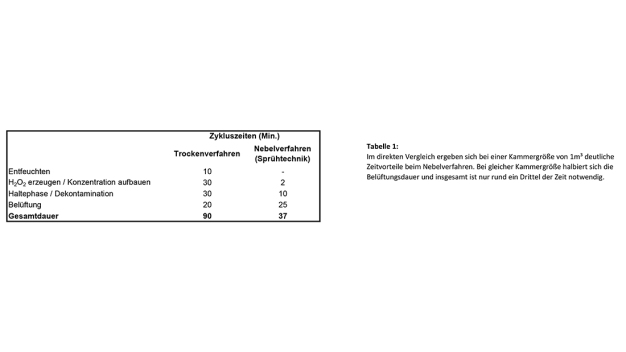
The key factor for users is the time aspect, which has the greatest influence on process costs, efficiency, and system availability. In the extensive cycle — "Loading — H2O2 generation and concentration buildup — Decontamination — Sterility test — Ventilation — Unloading" — the waiting times for concentration buildup, decontamination, and ventilation are the time-determining phases. Since such a cycle is not only routinely performed overnight but also before each product load and according to process-specific requirements, a quick cycle with consistent decontamination performance is the basis for efficient time planning in the testing laboratory.
Among the fumigation methods, the mist process using spray technology offers clear advantages, which is why Carlo Erba Reagents exclusively relies on this process for their isolators. The greatest influence comes from direct injection of H2O2, which practically immediately builds up the biologically effective dose inside the isolators, while both alternative methods take significantly more time. At the same time, less H2O2 is used overall, reducing ongoing system costs. Humidity regulation is unnecessary if not required by the medications themselves.
If only a pass-through needs to be decontaminated, as is the case with consistent product series, the isolator has a quick fumigation option. This usually takes less than 15 minutes.
Advanced filter technology
The ventilation depends on whether the working space has an exhaust air system. If not, the isolator atmosphere is first passed through a catalyst that splits H2O2 into water and oxygen before the air is released into the room. For existing exhaust systems, the isolator atmosphere is directly and efficiently vented into them.
The impact of filter technology on the ventilation phase is still underestimated. Most isolators use HEPA filters made of fiberglass. These have the property of adsorbing H2O2 during the fumigation process and outgassing during ventilation. Carlo Erba Reagents equips all devices with ePTFE filters. These do not store H2O2 and enable faster ventilation in comparison. The filter material has a service life of around 10,000 operating hours, making it more durable, increasing system availability, and reducing ongoing costs.
Fully integrated control system
Each fumigation method requires its own generator type for H2O2 production. It would be theoretically possible to equip existing isolators with external generators and integrate them into the isolator control via interfaces. In practice, this can lead to control errors or prevent full automation of all steps.
In system solutions, the components are integrated from the start, and the entire control runs user-friendly via a single control panel. The control system also includes automatic safety functions, so that pass-through doors, for example, cannot be opened as long as the integrated measurement technology still detects H2O2 concentrations that are too high.
Design tailored to cleanroom standards
An additional advantage comes from the system design: The H2O2 generator is housed within a casing. This significantly helps maintain the cleanroom class, minimizes particle sources, and allows for time-saving maintenance and cleaning. Even in case of service or regular validations, only one contact person is needed. This minimizes system downtime and simplifies workflows.
All systems are offered with a complete validation package, including Design Qualification (DQ), Factory Acceptance Test (FAT), Installation Qualification (IQ), and Operational Qualification (OQ). Whether as a series product or customized according to customer requirements, the isolators are created based on 2D drafts and 3D models to ensure that the respective technical requirements and desired H2O2 cycle times are optimally met.
FASTER GmbH
79312 Emmendingen
Germany