

- R+D & Community of Interest
- Translated with AI
"Competence Center Biointelligence" Gains Momentum
White Paper on Biointelligence handed over to ministries
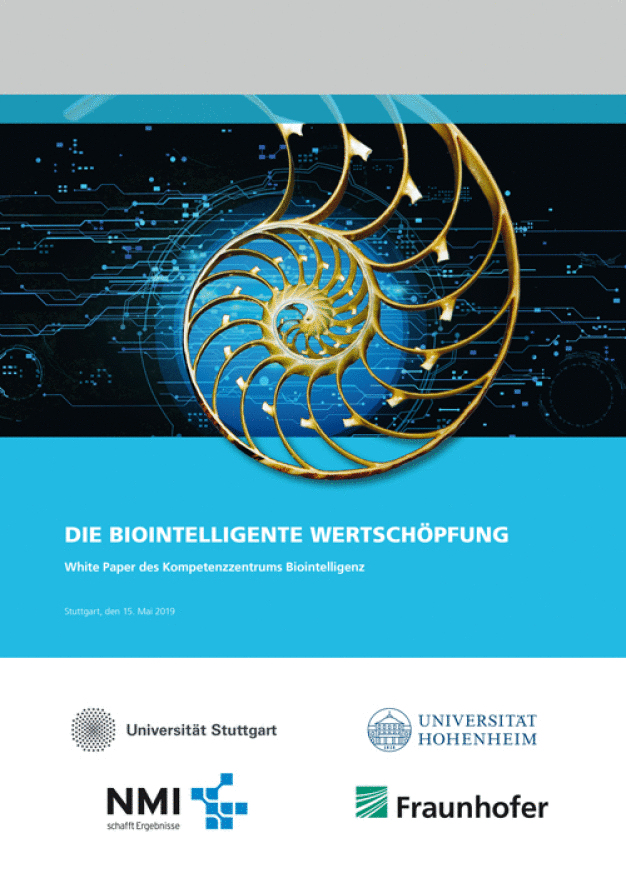
Title page of the White Paper Biointelligence (© Competence Center Biointelligence)
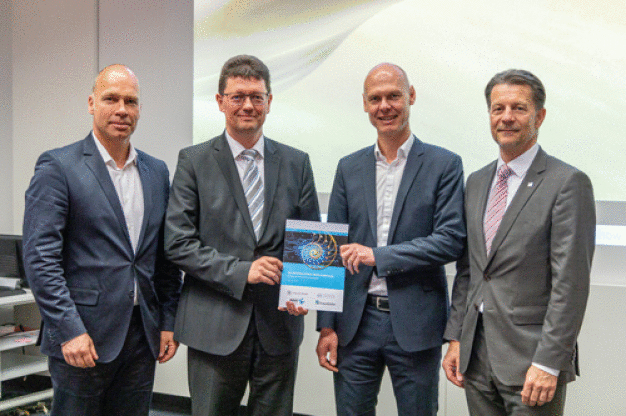
Professor Thomas Bauernhansl, Fraunhofer IPA, Markus Wiedemann, Baden-Württemberg State Ministry, Dr. Pascal Bader, Ministry for Environment, Climate and Energy, and Dr. Markus Wolperdinger, Fraunhofer IGB, at the handover of the White Paper. (© Fraunhofer IPA/Photo: Nikola Kaloyanov)
Since the beginning of the year, 40 representatives from renowned research institutions in the Stuttgart area have been working intensively and interdisciplinary to shape the paradigm shift of Biological Transformation together. On May 15, 2019, the 1st Conference on Biointelligent Products and Production – the Sustainable Revolution of Industry – took place, during which a call from scientists of this "Center of Excellence for Biointelligence" was handed over to policymakers. The White Paper on Biointelligent Value Creation describes the benefits of biointelligent systems and explains why they are essential for a sustainable future.
"The question we need to clarify is: How can we sustainably meet the needs of people worldwide in the areas of housing, nutrition, health, consumption, and energy in the future? Complementing digitalization, Biological Transformation will be key. We are convinced of this," says Professor Ralf Takors, head of the Institute for Bioprocess Engineering at the University of Stuttgart.
Therefore, in the "Center of Excellence for Biointelligence," 40 scientists from the Universities of Stuttgart and Hohenheim, as well as from NMI in Reutlingen and Fraunhofer Institutes IPA, IGB, IAO, IBP in Stuttgart, are collaborating to accelerate Biological Transformation. They conduct research in diverse fields such as mechanical engineering, biology, biotechnology, medical technology, architecture, nutrition science, and computer science, with a common goal: sustainable production and lifestyles that truly deserve the name.
The Biological Transformation of industrial value creation involves the increasing use of materials, structures, processes, and organisms from living nature in technology. This systematic application of knowledge about biological processes leads to a growing convergence of manufacturing, information, and biotechnology, with the potential to profoundly change future products, manufacturing processes, organizations, and overall ways of living.
Currently, the term sustainability is still associated with economic losses and restrictions. Biological Transformation aims to address this by making sustainability economically attractive through new concepts and innovations. The potential of Biological Transformation proves to be diverse – from structural innovations and modernization of German corporate and educational culture to a sustainable economic approach. It just needs to be fully exploited.
For comprehensive implementation, the scientists in the White Paper argue that long-term funding measures are necessary. The research and development of basic technologies such as bioinformatics, systems biology, information technology, biosensing, bioprinting, additive manufacturing with biointelligent materials, or cell and tissue engineering are crucial building blocks. Additionally, a nuanced societal and interdisciplinary discourse must be conducted, as these topics often have ethical implications and contain potential conflicts.
Interdisciplinary qualification and training programs are indispensable here, as adaptable, multidisciplinary education is considered essential for the success of Biological Transformation. The goal must be to strengthen basic technologies in relation to the transformation process to ensure that German companies maintain a leading position in the future.
What needs to be done? – Theses from the Center of Excellence White Paper
It is the task of our generation to realize a radical, structural change towards sustainable value creation. Biological Transformation will play a decisive role in preserving Germany's economic position and simultaneously presents a unique opportunity to implement innovative, sustainable value creation. From the perspective of the Center of Excellence for Biointelligence, the following theses emerge for the successful development of biointelligent value creation in Germany:
- In many relevant fields of biointelligent value creation (e.g., applying artificial intelligence to develop new active substances and products, translating biotechnological innovations into commercial applications, etc.), Germany is currently not a leader. This is partly due to comparatively restrictive legislation and limited access to venture capital. To avoid falling behind other nations, it is crucial to create space for science and interaction platforms with industry. Entrepreneurs who significantly contribute to transferring ideas into market-ready products should be supported through deregulation, simplified access to capital, and improved social security.
- Biological Transformation presents an immense challenge. If Germany aims to position itself as a pioneer, it is important to implement interdisciplinary flagship projects now, develop a joint political agenda, and establish regional competence and transfer centers. Research institutions are called upon to pool their expertise and form cross-disciplinary partnerships. Companies should strategically position themselves in this innovation field by creating interdisciplinary research and development teams and looking beyond their own horizons.
- Biological Transformation will visibly influence fundamental human needs (health, nutrition, housing, consumption, energy). This can cause uncertainties among the population. Acceptance by the public is a critical success factor. The pros and cons of certain courses of action must be developed through extensive citizen dialogues and information campaigns in public discourse.
- The long-term success of Biological Transformation depends on broad and fundamental knowledge in natural sciences, engineering, computer science, as well as social and humanities sciences. This is necessary both in education and in research and development. The research and educational hub of Stuttgart has already made very successful preliminary efforts in this regard, for example through the integration of engineering and natural science research and study programs. Building on this promises a sustainably successful biological transformation.
- The Center of Excellence for Biointelligence sees biointelligent value creation as a unique opportunity for Germany to implement a positive vision as a pioneer, which not only allows the economy to further expand existing competitive advantages but also guarantees sustainable progress. The key is the timely formulation of a political agenda that enables citizens, industry, and research to shape the topic together successfully.
The White Paper of the Center of Excellence for Biointelligence was handed over to representatives of the relevant Baden-Württemberg ministries at the 1st Conference on Biointelligent Products and Production – the Sustainable Revolution of Industry, including the State Ministry as well as the Ministries for Environment, Economy, Research, and Agriculture.

Fraunhofer-Institut für Produktionstechnik und Automatisierung IPA
Nobelstraße 12
70569 Stuttgart
Germany
Phone: +49 711 970 1667
email: joerg-dieter.walz@ipa.fraunhofer.de
Internet: http://www.ipa.fraunhofer.de