



- 3D printing
- Translated with AI
Cleanroom Pressure Laboratory for Packaging at Wafer, Chip, and System Level
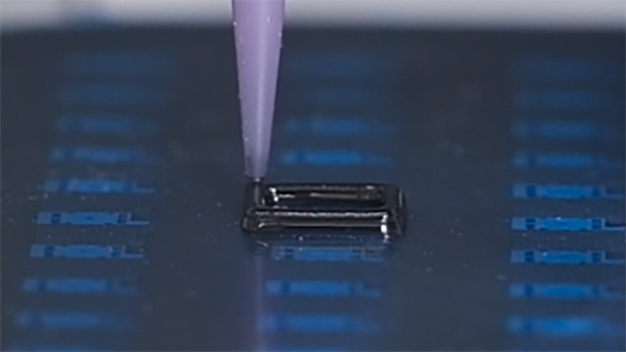
Dispensing technology for Dam&Fill processes at wafer level, PCBs, or chip level. © Fraunhofer ENAS
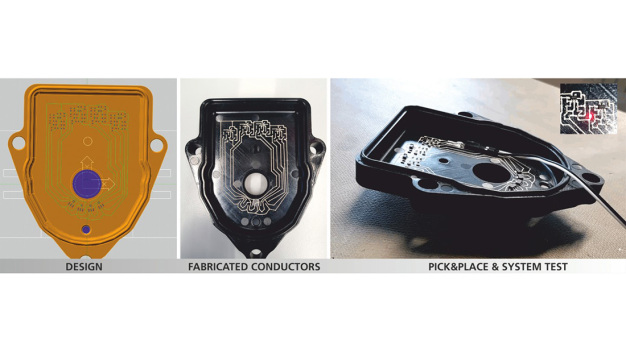
CAD/CAM process chain for coating 3D objects, demonstrated here using an example of magnetic field sensors on a gear cover. © Fraunhofer ENAS
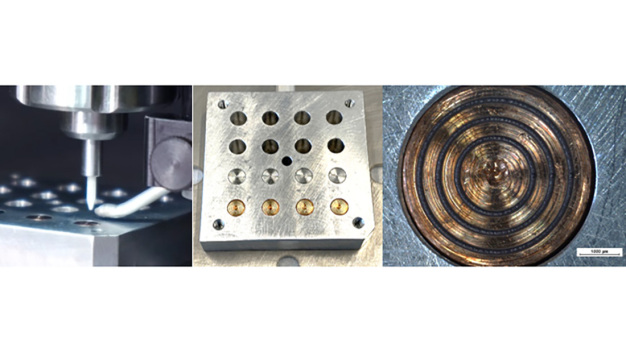
Aerosol Jet printing of nanoparticle solder materials (here Ag and Sn) on cylindrical substrates in a substrate holder. © Fraunhofer ENAS
The Fraunhofer Institute for Electronic Nano Systems ENAS combines, at its Chemnitz location, a new cleanroom laboratory for printing technologies used in packaging microelectronics components at wafer, chip, and system levels. With various additive processes and a new cluster system for 3D conformal material deposition in a particle-free laboratory environment, the research institute offers a process chain of unparalleled scope for developing and executing printing processes for assembly and interconnection technology.
Printing Technologies in the Packaging Process
Unlike conventional packaging technologies, printing technologies enable the use of new materials and a greater variety of substrates. Since many materials are now available in paste form and thus not suitable for traditional deposition methods used in packaging, there is increasing focus on integrating additive processes into packaging procedures for microelectronic components. These methods allow the use of nanoparticle inks, chemicals, sensory materials such as CNT pastes, as well as solder pastes, electrically conductive, and insulating materials, often in combination. Additionally, the range and shape of substrates are expanded through the use of printing techniques, as materials can now be deposited onto 2D, 3D, or topographical surfaces on chips and wafers. An additional advantage is maskless fabrication, enabling rapid transition from concept to prototype.
To fully exploit these new possibilities for microelectronics packaging, Fraunhofer ENAS has established an entire printing laboratory with a process chain within a cleanroom environment. This laboratory is unique in this scope and enables a nearly particle-free process for constructing miniaturized and highly functional assemblies using additive methods.
Research and Development Examples
At Fraunhofer ENAS, the application of printing technologies for packaging microelectronic components has been researched for ten years. "Additive technologies such as screen printing and dispensing processes have been integral parts of the process chain for electronic component packaging for many years, for example, when applying glass interlayers for bonding processes or potting materials to protect sensitive wire bonds. But current developments, such as miniaturization, 3D integration, and the integration of various functional components into a so-called 'System in Package,' demand new materials and thus new technologies," explains Frank Roscher, Deputy Head of the System Packaging Department at Fraunhofer ENAS.
Through the use of innovative additive manufacturing technologies, researchers have advanced packaging technologies. For example, passive packaging components with electrical functions have been developed, such as an electrical circuit with magnetic field sensors directly on a molded gear cover, or approaches for low-temperature curing processes based on nanoparticle inks to lower curing temperatures via nanoeffects, or implementing pillar structures with high aspect ratios. The space required for bond frame structures has been reduced through process optimization of screen printing technology, and special materials for optical assemblies have been deposited with the highest precision on substrates, with the digital aerosol jet process enabling individual coating of optical pixels.
Highlights in the Cleanroom Printing Laboratory
The newly designed and fully equipped cleanroom laboratory at the Chemnitz site now combines a variety of additive processes. The complete cleanroom environment ensures a particle-free transport of substrates from pretreatment through deposition systems to drying stations. In addition to screen and stencil printing methods, XY robots are available for dispensing solder pastes, electrically conductive and insulating materials, potting compounds, or adhesives.
The latest equipment development is a cluster system for 3D conformal material deposition on complex substrates for building three-dimensional electronic systems. Researchers combine jetting and extrusion processes with a five-axis handling system to, among other things, refine planar and structured wafers, circuit boards, individual electronic components or chips, or complex three-dimensional substrates made via injection molding with electrical functions or build substrates directly from the integrated 3D printer. For the integration of SMD components, a pick-and-place tool has been integrated into the process line to mount passive and active components on three-dimensional bodies. In ongoing projects, Fraunhofer ENAS is developing process control and evaluating material combinations to demonstrate industrial applications, such as a functional gear cover. Already, conductive traces have been demonstrated directly on injection-molded parts. The team has thus implemented complex electrical circuits with magnetic field sensors to detect gear position and demonstrated the feasibility of functionalizing previously passive assemblies.
High-precision deposition is achieved through a well-established aerosol jet process. This method allows nanoparticle-laden inks to be deposited with resolutions up to 10 µm line width on planar and topographical substrates. In completed projects, the team has succeeded in replacing typical wire bonds with printed interconnects between sensors/electronics and circuit boards, among other achievements.
For the first time, additive manufacturing can be used in a particle-free process flow for the development of miniaturized and highly functional applications, custom processes, material testing, and prototype production.
Fraunhofer-Institut für Elektronische Nanosysteme ENAS
09126 Chemnitz
Germany