- R+D & Community of Interest
- Translated with AI
Cleanroom on Demand
Clean Multipurpose Cover« is the world's first flexible cleanroom system
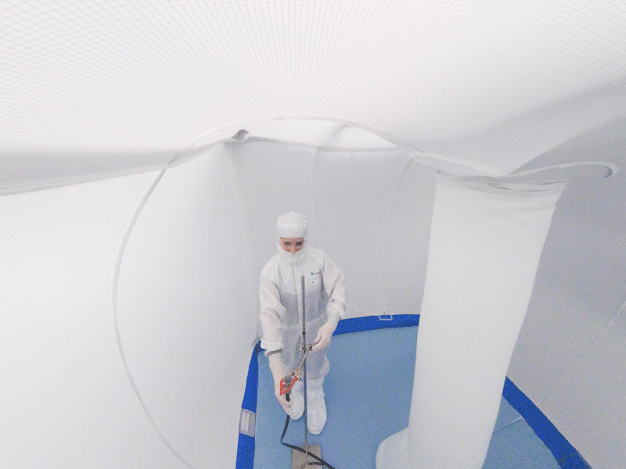
The "Clean Multipurpose Cover" is the world's first cleanroom system that can be assembled flexibly and protects products from contamination during transport.
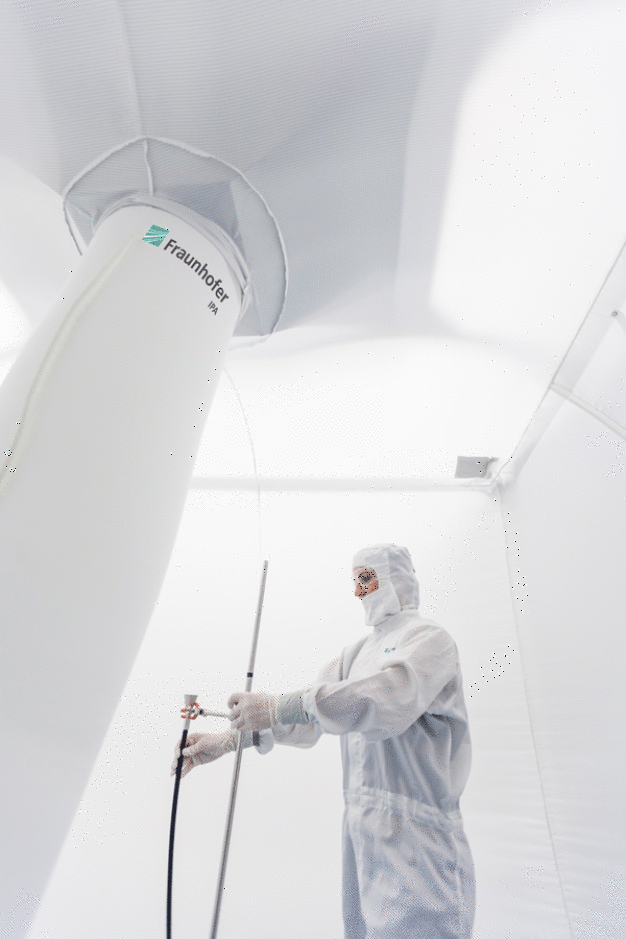
Clean Multipurpose Cover
Even minor contaminations cause significant quality losses in many industries. For example, if contaminants reach microchips, spacecraft, or lenses, it can lead to defective or faulty end devices. To prevent damage to high-quality products, companies isolate the affected manufacturing and assembly steps in cleanrooms. However, these are expensive, not available everywhere, and do not protect against transport-related contamination. With the "Clean Multipurpose Cover," Fraunhofer IPA has developed the world's first cleanroom tent that can be set up flexibly and keeps parts clean during transport thanks to its mobility.
Particular contaminants or filmic contamination cause additional costs in many industries. These include, among others, the semiconductor, food, or automotive industries, aerospace, and pharmaceuticals. "When contamination occurs here, it either leads to scrap or the workpiece must be re-cleaned," explains project manager Tanja Meyer from Fraunhofer IPA. If companies cannot rely on the cleanliness of their production environment, analyses are required afterward, says Meyer. Both are time-consuming and costly.
Companies circumvent the problem by manufacturing sensitive products in cleanrooms. But there are also difficulties here. "Not all companies, especially SMEs, have their own cleanroom available. While they can rent one or have parts cleaned externally, this is often uneconomical in the long run," Meyer explains. Furthermore, contamination also occurs during transport. Static cleanrooms, as they exist today, cannot protect products outside their own four walls. Therefore, IPA scientists have received multiple inquiries from industry to develop an affordable, flexible solution.
Companies save energy and maintenance costs
With their "Clean Multipurpose Cover," the Stuttgart researchers have met these requirements. The world's first flexible cleanroom system has the cleanliness standards of a cleanroom but can be quickly and easily set up anywhere. Operating "on demand," the company does not experience the utilization constraints of static cleanrooms and thus saves significant energy and maintenance costs. Another major advantage is the short assembly time of less than an hour and immediate usability after a brief startup phase. For their system, the Stuttgart researchers developed a airflow concept based on TVOC-lean and abrasion-resistant materials with an attached filtration system. "This allows us to guarantee a contamination-free manufacturing environment up to ISO Class 3, certified according to DIN ISO 14644-1," explains Meyer. The Clean Multipurpose Cover is modular and can be individually configured according to requirements. It is available in various sizes up to four square meters, optionally with or without a floor. The assembled system is portable, weighs no more than 20 kg in the medium size, and is fully functional.
Confirmed suitability for cleanroom use in lab tests
The IPA scientists realized an initial prototype in June 2016. "The test series in the cleanroom laboratories of the Contamination Control Center confirmed its functionality," Meyer reports with satisfaction. Companies can now request their customized model from Fraunhofer IPA. In collaboration with their research and industry partners, the scientists determine the need. The costs are calculated individually and vary depending on requirements, size, and air cleanliness class. Currently, the Stuttgart researchers are working on further developing the system for industry- and customer-specific needs, such as chemical and microbiological contaminants.

Fraunhofer-Institut für Produktionstechnik und Automatisierung IPA
Nobelstraße 12
70569 Stuttgart
Germany
Phone: +49 711 970 1667
email: joerg-dieter.walz@ipa.fraunhofer.de
Internet: http://www.ipa.fraunhofer.de