


- Translated with AI
Roger Schärli (Sto AG), Wolfgang Konle (StoCretec GmbH Deutschland)
Cleanroom Compatibility of Coatings
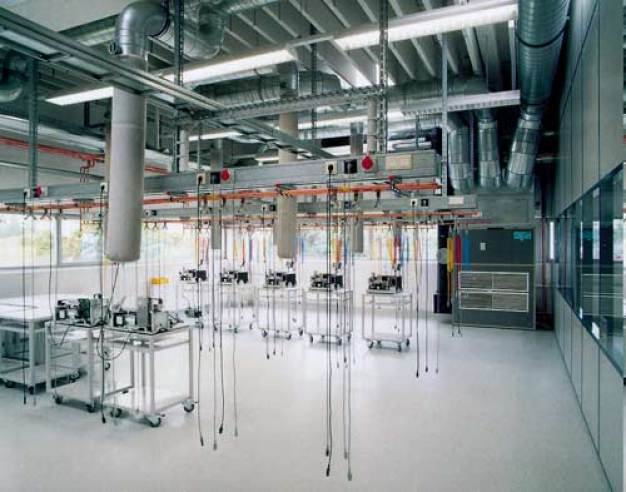
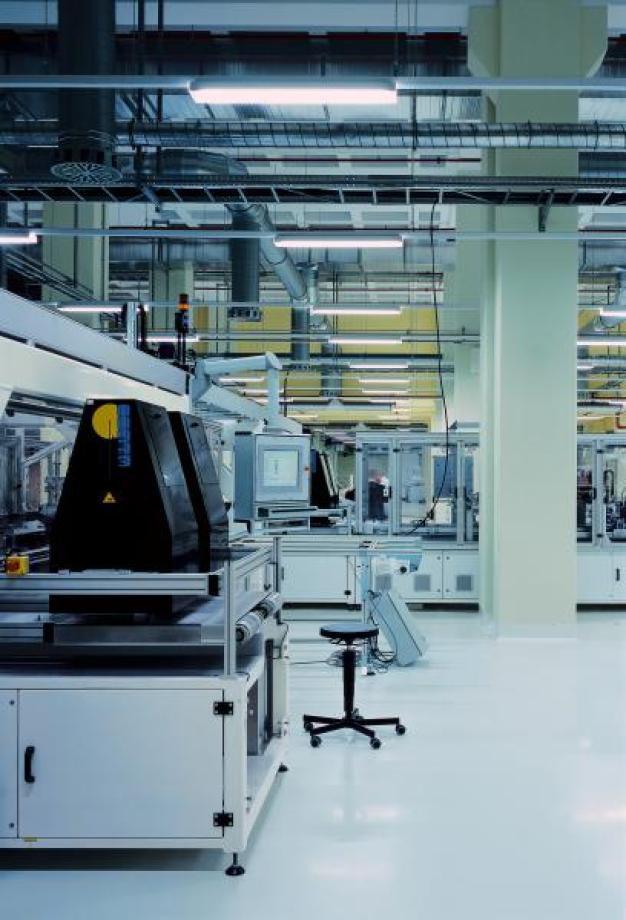
Production hall of Inficon GmbH in Cologne: ESD cleanroom floor coating system from Sto AG (solvent-free, aqueous system: StoPox WB 110)
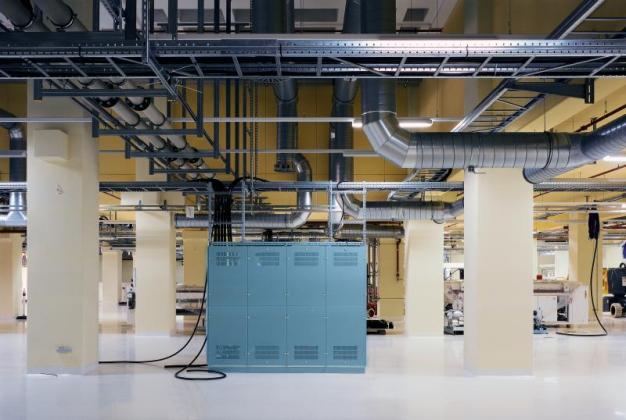
Conergy SolarModule GmbH & Co. KG in Frankfurt: Cleanroom floor coating systems from Sto AG (Systems: StoPox WHG and StoPox BB OS)
CSM Logo
A significant influence on the air quality of cleanrooms is exerted by the coatings of floors, walls, and ceilings. Depending on the industry, different coating systems and corresponding testing methods are required.
The development in the Swiss market in the fields of Life Sciences, Medtech, Food, Pharma, as well as the semiconductor industry, is enormous. This leads to an increasing number of companies for whom manufacturing under pure conditions becomes indispensable to ensure process flows and product quality. The goal of these conditions is to reduce production costs by minimizing waste and ensuring process continuity. The requirements of different industries can vary significantly.
The following outlines the different requirements and the properties needed for coating systems for floors, walls, and ceilings.
Cleanliness areas and safety levels
Cleanliness areas are established to protect sensitive surfaces and goods. A cleanliness area aims to maintain the specified cleanliness quality of components, auxiliary materials, and assemblies during processing as much as possible. The cleanliness level should not be reduced due to environmental influences, which is why contamination must be avoided. Any contamination that does occur is targeted and eliminated. The design and use of cleanliness areas are based on product-specific cleanliness requirements [1].
The critical particle sizes typically range between 5 and 1000 micrometers. The classification of cleanliness areas according to VDA 19, Part 2, is divided into 4 levels: Non-regulated area (Cleanliness level 0, SaS0), Clean zone (SaS1), Cleanroom (SaS2), and Ultra-cleanroom (SaS3). To meet the requirements from cleanliness level 1 onwards, floors must primarily have good abrasion resistance (low particle generation when driven over by floor vehicles) and good mechanical durability. Additionally, a pore-free, easy-to-clean surface is necessary. Depending on the manufacturing process, other properties such as chemical resistance, slip resistance, electrical conductivity, and crack bridging may also be required.
In laboratories for research, development, and microbiological analysis, where microorganisms are handled in bacteriology, mycology, virology, and parasitology, or where genetic engineering work is performed, the main focus is on preventing the escape of microorganisms dangerous to humans, animals, plants, and the environment. According to DIN EN 12128, these laboratories are classified into four safety levels, from S1 to S4, with S1 being the lowest and S4 the highest safety level. From S3 onwards, the surfaces of workbenches, floors, walls, and ceilings must be easy to clean and accessible for maintenance. The surfaces must be waterproof and resistant to disinfectants, cleaning agents, acids, alkalis, solvents, and other chemicals commonly used, and must not be inhabited or metabolized by microorganisms. For this reason, coating materials are tested for their biostatic properties according to ISO 846 [8], [9]. Nowadays, coating systems are also expected to be crack-bridging to prevent microorganisms from settling in cracks that may form later in the structure, which cannot be removed by wiping disinfection.
Suitability of operating materials in cleanrooms
Current standards and regulations define parameters that the finished cleanroom must meet, which the operator determines in advance according to the requirements of their production process. The purity of the "cleanroom" system depends significantly on various factors (standard DIN EN ISO 14644-1 [2] or guidelines VDI 2083 Sheet 1 [3]). These factors influencing the cleanliness of a cleanroom include, besides the supply air quality, air supply, surfaces, and personnel, also the operating materials present in the room [4]. Operating materials include, for example, interior furnishings such as walls, doors, ceilings, and floors. Operating materials have a significant impact on contamination in the manufacturing environment and must therefore be tested for their cleanroom suitability. Key parameters for the cleanroom suitability of operating materials include:
- – Emission of airborne particles
- – Outgassing behavior
- – ESD properties
- – Cleanability
- – Resistance to chemicals and disinfectants
- – Smooth and crack-free surface
- – Metabolizability/microbicidal properties
The requirements vary considerably across different industries. There are also differences in particle cleanliness classes between DIN EN ISO 14644-1 and GMP (Good Manufacturing Practice) and cGMP, which are applicable for the manufacture of human and veterinary medical products. According to DIN EN ISO 14644-1, particle cleanliness classes are divided from Class 1 to 9, with Class 1 having the lowest permissible particle count. In GMP, classes are A to D, with Class A roughly corresponding to ISO Class 5. Additionally, FDA approval is increasingly being required (FDA § 175.300).
For most production processes, airborne particles pose the greatest problem. Increasingly, airborne molecular contamination (AMC) also plays a role. This refers to the presence of molecular substances in the gas or vapor phase within the atmosphere of a cleanroom that can have harmful effects on the product, process, equipment, or personnel [5].
Outgassing from the materials used to manufacture operating equipment, such as coatings for walls/ceilings/floors, can have significant negative effects (see VDI 2083 Sheet 8.1 Appendix D). Therefore, suitable and tested materials must be selected for the planning and construction of a cleanroom.
Testing methods - Industry alliance
In all existing standards and guidelines for cleanrooms, no specific testing criteria are established for operating materials, including coating systems for floors, walls, and ceilings. Only indirect references exist to the desired or maintained condition of the room air in cleanrooms. Therefore, cleanroom manufacturers and operators have established criteria for systems in cleanrooms based on experience. Some have developed their own testing procedures, such as the M+W Group with their "specifications for semiconductor clean rooms" [7]. To develop testing methods for the cleanroom suitability of operating materials and to create optimized products, an industry alliance called Cleanroom Suitable Materials (CSM) was initiated by the Fraunhofer Institute for Production Technology and Automation IPA Stuttgart. Based on the insights gained from the CSM industry network, the first draft of VDI 2083 Sheet 17, published in June 2013, described testing criteria for the suitability of materials for cleanroom and cleanliness applications. Sto AG actively participates as a member of CSM in the further development of suitable materials for coating walls, ceilings, and floors in cleanrooms and offers tested and tailored coating systems for all requirements. Today, the suitability of coating systems for cleanrooms can be demonstrated through testing procedures, significantly increasing safety in the construction and operation of cleanrooms.
Suitable coating systems
The most suitable systems for cleanroom requirements are seamless epoxy resin systems, which have proven their advantages through their smooth, pore-free surfaces and excellent chemical resistance. They also exhibit very good abrasion behavior under mechanical stress, such as foot or vehicle traffic, resulting in low particle generation. In recent years, product development has further improved outgassing behavior through targeted selection of ingredients. The latest generation of epoxy resin dispersions or emulsions contains, apart from water, hardly any volatile components. Depending on the cleanroom requirements and the intended production process, tested coating systems such as Sto Cleanroom Floor Systems and Sto Cleanroom Wall / Ceiling Systems are available. Sto AG supports planners and customers from project planning through customized solutions to detailed designs, material suggestions, and tendering throughout all phases of a construction project. This ensures that builders, planners, and contractors are supported with well-thought-out services to make the right decisions for tomorrow.
Sources:
[1] VDA Quality Management in the Automotive Industry, Volume 19, Part 2: Technical Cleanliness in Assembly.
[2] DIN EN ISO 14644-1, Cleanrooms and associated controlled environments, July 1999.
[3] VDI Guideline 2083 Sheet 1, May 2005 [4] VDI Guideline 2083 Sheet 9.1, December 2006.
[5] VDI 2083, Sheet 8.1, July 2009.
[6] VDI 2083, Sheet 8.1, July 2009.
[7] M+W Group GmbH, Lotterbergstr. 30, 70499 Stuttgart.
[8] DIN EN 12128, May 1998 [9] VDI 2083, Sheet 17, June 2013.
Sto AG
8172 Niederglatt
Switzerland



