




- Translated with AI
Certainly mastered: Reliable valve technology for hydrogen applications
With valve solutions from Schubert & Salzer, plant builders and operators are equipped to meet the specific challenges of the demanding alternative energy carrier hydrogen.
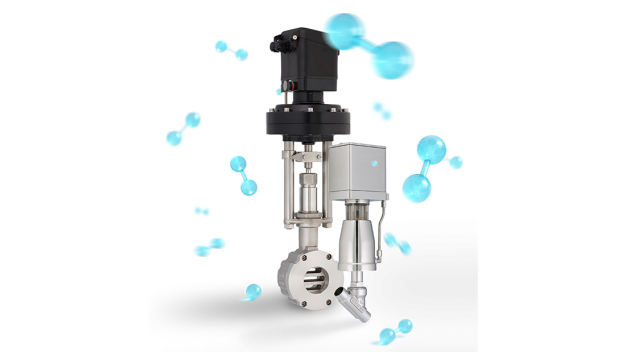
Slide valve 8021 and angle seat control valve 7025 with hydrogen molecules
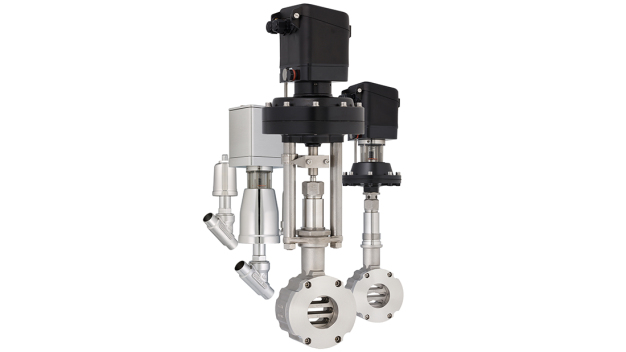
H2 Valves 8021 8028 7025 7015
Hydrogen is developing into a key technology for the energy transition in industry. However, the atoms of the "green" energy carrier are the smallest and lightest of all elements. Their small size allows them to penetrate many materials and can lead to structural changes there. This places the highest demands on all plant and system components in process and plant engineering, including shut-off and control valves. Especially valves made from ferritic and martensitic steels are susceptible to so-called hydrogen embrittlement, which can lead to material failure.
Material selection determines safety
Schubert & Salzer addresses this challenge with slide gate valves made from austenitic steels such as 1.4408 and 1.4404. These materials ensure very high resistance to hydrogen-induced cracking. The Ingolstadt-based manufacturer of control and shut-off valves also produces seat valves specifically for hydrogen applications from stainless steel 1.4408.
Additionally, traditional sealing materials like EPDM or FKM are not fully suitable in hydrogen environments. To prevent material failure caused by infiltrating hydrogen, Schubert & Salzer relies on special plastics or – especially at high pressures – on metallic seals to ensure long-term integrity and safety even during sudden, strong pressure drops.
Permanent tightness prevents explosion risk
The extreme flammability of hydrogen also poses a significant hazard. The explosion range in air is between 4 and 75 percent by volume, which is considerably larger than that of other gaseous energy carriers. This greatly increases the risk of forming an ignitable atmosphere.
To reduce this risk, the slide gate valves from Schubert & Salzer are technically permanently tight according to the Technical Rules for Hazardous Substances and meet the requirements of TA-Luft 2021 in accordance with EN ISO 15848-1. Special designs achieve even leakage rates of less than 5 · 10⁻⁹ mbar l/s – making them suitable for use in enclosed spaces.
Schubert & Salzer's seat valves also maintain tightness in hydrogen applications. Selected variants comply with Category I of the Pressure Equipment Directive; with options such as metal bellows, welding, or flange connections, they offer excellent tightness. Particularly, types 7015 and 7025 are well suited with proof of leakage rate according to TA-Luft.
“In hydrogen applications – whether in production, storage, or transportation – every component must operate absolutely reliably even under demanding conditions,” emphasizes Christoph Lukasik, Head of Design and Development at Schubert & Salzer. “Materials and design of our control and shut-off valves enable long-term safe and economical use of this key technology on an industrial scale.”
Schubert & Salzer Control Systems GmbH
85009 Ingolstadt
Germany