



- Translated with AI
Biological Batteries
Student project aims to harness electricity from bacteria
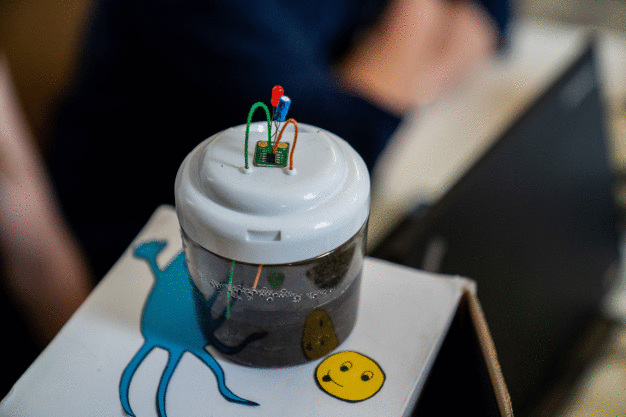
Some soil bacteria transfer electricity to their surroundings. Optimizing this process is the goal of Smart B.O.B. (© TU Berlin / PR / Dominic Simon)
From an evolutionary biological perspective, they are ancient, but their potential is only now gradually being discovered: So-called electromicrobes are currently under special observation by many scientists worldwide in the sustainability debate. They can produce and transfer electrons – essentially electricity – and do so largely without energy losses. When looking at electricity on a molecular scale, it is essentially nothing more than a directed flow of electrons that all living organisms utilize within their cells. As part of this year's BIOMOD competition (Biomolecular Design) for students from around the world in San Francisco, an interdisciplinary team at TU Berlin is working precisely on this topic. "Our goal is a biological battery," says Franziska Graeger, a master's student in Biological Chemistry at TU Berlin and a member of the Smart B.O.B. team (Smart Biologically Optimized Battery).
Within a cell, the transfer of electrons from one molecule to another releases energy during some jumps. For several years, scientists have known bacteria capable of releasing electrons into their environment in this way. Some of these bacteria transfer the electrons to their surroundings via specific membranes, for example to positively charged metal ions.
The scientists of Smart B.O.B. use various bacterial species and combine their abilities. "The bacterium Shewanella has a special protein construct in its membrane to specifically transfer electrons to iron or manganese in the environment. Our first step is to genetically insert this protein into cyanobacteria." Cyanobacteria are a kind of interface between plants and bacteria. They are autotrophic, meaning they can produce the energy carriers glucose and oxygen from atmospheric carbon dioxide with the help of sunlight. "If we succeed in bringing the protein complex from Shewanella into the cyanobacteria, these proteins could specifically take over the electrons from photosynthesis and transfer them outside to an electrode. This could generate an electric current," explains the biochemist, outlining the group's plans.
It is already possible to capture small amounts of free electrons from various soil bacteria. The scientists demonstrate this impressively with a small lamp on a jar of soil. Two special electrodes pick up the electrons from the soil bacteria in the earth and transfer them to the lamp. "Of course, only a small amount of current is captured," says Franziska Graeger. "With this, we can only operate a small lamp. Our goal is to clone as many protein complexes from Shewanella into the cyanobacteria as possible so that significantly more current flows. These special bacteria could then be directly applied onto the electrodes with the help of a conventional printer, creating an immediate exchange of electrons and optimizing the yield."
Since 2015, an interdisciplinary team from various Berlin universities has been participating in the international BIOMOD competition. The project is hosted by the Department of Biocatalysis led by Prof. Nediljko Budisa and the Excellence Cluster UniSysCat at TU Berlin, supported by the Award for Exemplary Teaching from the Society of Friends of TU Berlin. "Interdisciplinarity is extremely important for the project," says Franziska Graeger. "Because we not only need to work successfully in the lab and perform biochemical experiments but also organize everything ourselves: a functioning laboratory, a good website, an engaging performance at the Jamboree in October in San Francisco, and not least, the entire funding of the project and our trip to the competition. That’s why we are still looking for new supporters."
Technische Universität Berlin
10587 Berlin
Germany