




- Translated with AI
Berlin University Alliance secures the title of excellence
Second major success for the three major Berlin universities and Charité in the Excellence Strategy competition
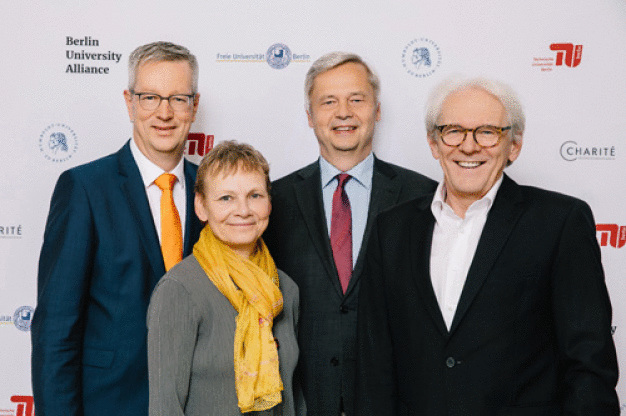
Prof. Dr. Günter M. Ziegler (Free University of Berlin), Prof. Dr.-Ing. Dr. Sabine Kunst (Humboldt University of Berlin), Prof. Dr. Christian Thomsen (Technical University of Berlin), and Prof. Dr. Karl Max Einhäupl (Charité – University Medicine Berlin) (Image source: Patricia Kalisch)

(Image source: Matthias Heyde)
Excellent Berlin Science: The Berlin University Alliance is funded as an Excellence Network in the Excellence Strategy competition of the federal and state governments. This was announced by the Science Council on July 19, 2019, in Bonn. The four Berlin partners – Freie Universität Berlin, Humboldt-Universität zu Berlin, Technische Universität Berlin, and Charité – Universitätsmedizin Berlin – were able to convince with their application "Crossing Boundaries toward an Integrated Research Environment" in the highly competitive process. Starting from November 1, 2019, they will receive up to 196 million euros for initially seven years. Additionally, the Berlin Senate will contribute 6 million euros annually through the Einstein Foundation Berlin to support top-level appointments and research projects.
In total, 17 universities and two university alliances applied for the excellence status; 11 received funding approval today. The Berlin alliance of Freie Universität Berlin, Humboldt-Universität zu Berlin, Technische Universität Berlin, and Charité – Universitätsmedizin Berlin is the first and only excellence network in Germany. After securing seven excellence clusters in the first funding line of the competition in September 2018, the Berlin University Alliance achieves its second major success in the Excellence Strategy.
The President and Presidents of the involved Berlin universities – Prof. Dr. Günter M. Ziegler, Prof. Dr.-Ing. Dr. Sabine Kunst, Prof. Dr. Christian Thomsen – as well as the Chair of the Charité – Prof. Dr. Karl Max Einhäupl – were extraordinarily pleased with the outcome: "Today is a very special day for our four institutions, our scientists, our students, and the people of Berlin. We are very pleased to be able to work even more intensively together now and to further develop our cooperation, which has grown over more than three decades, across institutional boundaries. Together, overcoming boundaries – under this motto, we will now usher in a new era of collaboration and establish a unique alliance with international influence. We are so proud of our many employees and all those involved who made this great success possible – our special thanks to all of them for their tireless commitment!"
The four partners aim with the funding pledged today to overcome institutional and disciplinary boundaries in order to develop Berlin into one of Europe's leading science locations through their combined strength. The overarching goal of the Berlin University Alliance is to shape a joint integrated research space as a driving force and thus further develop Berlin as a science hub that ranks among the international top. Many questions that concern society and science are so large and complex that they can only be researched through the collaboration of scientists from various disciplines. At the same time, it requires the involvement of society and the strengthening of dialogue with Berlin's science, politics, economy, culture, civil society, and international partners. To this end, the Berlin University Alliance will expand the quality of collaboration to a new level and pursue key themes together. The partners specifically want to address major societal challenges through interdisciplinary research, strengthen the ongoing exchange between science and society, and better and jointly promote scientific career paths. Additionally, they aim to establish uniform standards in research quality and share scientific infrastructure, such as modern laboratories and expensive large equipment, with less bureaucratic effort.
For the Berlin University Alliance, diversity, openness to the world, and tolerance, as well as the training of young scientists, are prerequisites for excellent research and teaching. Accordingly, the partners want to focus on key cross-cutting themes such as promoting diversity and gender equality, research-oriented teaching and learning, and internationalization. The Berlin University Alliance already looks forward to its cooperation with the University of Oxford.
The 10 selected excellence universities and the Berlin excellence alliance will each be funded for seven years with up to 105 million euros for individual universities and up to 196 million euros for alliances. As an alliance, up to three universities with at least three excellence clusters can apply together. The funding is permanent. Conditions include a positive evaluation after seven years and the successful re-application for the necessary number of excellence clusters. Berlin has already achieved outstanding success in the Excellence Strategy: on September 27, 2018, seven excellence clusters were approved for funding. These interdisciplinary research projects have been funded since January 1, 2019.
The Berlin University Alliance
The Berlin University Alliance is the consortium of the three Berlin universities – Freie Universität Berlin, Humboldt-Universität zu Berlin, Technische Universität Berlin – as well as Charité – Universitätsmedizin Berlin – for the joint development of science in Berlin. The four partners have come together to further develop Berlin as a research hub that ranks among the international top. The focus of their collaboration is on researching major societal challenges, strengthening exchange with society, supporting young researchers, questions of research quality and value, and cross-cutting initiatives in research infrastructure, teaching, diversity, equal opportunities, and internationalization. Together, approximately 1,700 professorships, 100,000 students, 12,000 doctoral candidates, and 26,000 employees work in the Berlin University Alliance. Even now, Freie Universität Berlin, Humboldt-Universität zu Berlin, Technische Universität Berlin, and Charité – Universitätsmedizin Berlin are already collaborating across institutions in all 7 excellence clusters, in 70 percent of their 30 Collaborative Research Centers, and in more than 75 percent of their 47 doctoral programs. Since 2012, the scientists of the excellence network have secured six Leibniz Prizes and 55 ERC grants from the European Research Council.
Technische Universität Berlin
10587 Berlin
Germany