

- Translated with AI
Automation in the cleanroom ensures efficient production
Automation in the cleanroom ensures efficient production
Allrounder and robot systems form a unit
• Selogica control makes programming possible even for six-axis robots
• Manufacturing cells stand for high output and injection molded part quality
Medical technology manufacturing requires not only high precision but also an extremely clean working environment. The top priority in cleanroom conditions is to prevent contamination of injection-molded products with dust, pollen, bacteria, organic aerosols, and other airborne impurities. Furthermore, medical technology demands the highest quality parts, which are to be produced in large quantities with the shortest cycle times. Through a comprehensive cleanroom concept and the modularity of the Allrounder program, Arburg is optimally positioned to precisely implement all tasks in this area.
Particularly the requirements for precision, cleanliness, and speed of processes often necessitate the use of automated manufacturing cells with integrated robot technology to minimize contamination. Arburg, as a provider of both injection molding machines and robot systems that can be integrated via the Selogica control, offers the right tools to provide suitable configurations for cleanroom production.
Modularity, high quality and output, as well as consistently pure production conditions, characterize Arburg's flexible manufacturing cells. As a general contractor, customer specifications are captured in detail and implemented consistently. This ensures trouble-free and high-quality production even in series operation.
Two options for cleanroom production
Arburg pursues two approaches in cleanroom manufacturing. On one hand, Allrounders — with or without robot systems — are offered with additional equipment for docking to cleanrooms via conveyor belts; on the other hand, specially equipped machines operate directly in the cleanroom. In principle: hydraulic Allrounders are more frequently docked outside the cleanroom, while electric Allrounders can also operate directly inside.
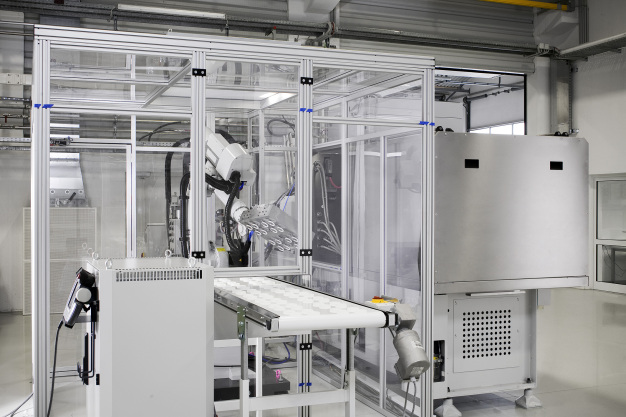
To keep particle contamination in cleanrooms as low as possible, Arburg places machines outside the cleanroom and connects them via sealed conveyor belts. The Allrounders are equipped with a clean air module including ionization on a transfer frame above the clamping unit to ensure full accessibility. The generated permanent airflow results in a high air exchange rate in the production room. The resulting displacement airflow prevents particles from penetrating. Falling parts can thus be produced in a clean environment. An extended conveyor belt with tunnel cover transports parts into the cleanroom, where they are further processed, e.g., assembled or packaged. Automated processes requiring removal and placement are handled by robot systems integrated into the machines. These are enclosed with transparent PC panels and also covered with a clean air module. The placement then occurs on a sealed conveyor belt, similar to falling parts, which transports items into the cleanroom.
Alternatively, if machines are to be used directly inside the cleanroom, measures against potential contamination must be implemented. These include, for example, increased machine stand to facilitate cleaning, light-gray powder coating, execution of various machine panels in stainless steel, nickel-plated clamping plates with covered holes, close-fitting media connections, as well as water-cooled drive motors and control cabinets.
Automation advancement: programming six-axis robots via Selogica control
Six-axis robots are particularly suitable for demanding handling tasks. They offer very high functionality and allow for very complex movements. Additionally, they can precisely follow 3D contour lines and rotate parts freely in space. The space requirement for a six-axis robot is also comparatively small.
Implementing the Selogica user interface on the robot control offers significant advantages: operators are familiar with the control system, enabling even complex robot movements to be programmed independently and without special knowledge, similar to machine operation. This significantly reduces setup effort and makes robot use efficient even in high-end sectors like medical technology. The robot is directly connected to the machine control. Online communication goes far beyond the Euromap interface, offering functions such as synchronized movements and simplified machine startup. This results in shorter setup and cycle times. Also, minor adjustments required in practice can be completed within minutes.
Practical example: LSR manufacturing cell for medical parts
An example of using such a six-axis robot is the production of a medical cover cap. The manufacturing cell is docked to a cleanroom. The flexible concept around an electric Allrounder 520 A with 1,500 kN clamping force and injection unit 400, equipped for cleanroom operation — including a special stainless steel enclosure of the mold with access hatch for the ejector — was specifically designed for pharmaceutical articles. The machine features numerous options necessary for medical production, such as lubricants approved by FDA/NSF, a sealed knee lever, corrosion-resistant fixed and movable clamping plates, spray-side machine stand cover, nozzles and quick couplings made of stainless steel, and enclosures for water batteries and riser pipes. Cleanroom modules on the machine and in the robot area ensure the required high-purity ambient atmosphere.
The white cover caps are produced in a 32-cavity mold. They are injected directly and without waste via a cold runner system and nozzles. When the mold opens, all 32 caps are on the cores of the ejector side. The robot, placed in the docked cleanroom, moves into position with the handling head and secures itself via centering devices on the mold. The 32 caps are pushed through an integrated perforated plate into the demolding module via the mold ejector.
All parts are captured in this manner within a special enclosure. The robot then moves out of the mold to the conveyor belt. Here, a flap on the demolding module opens so that all parts can be precisely placed together onto the also-enclosed conveyor belt for further processing.
The solution, combined with a Kuka robot, already approaches conventional cleanroom standards because the robot, by its design and electric drives, operates very cleanly. The concept of removal at the rear of the machine allows all enclosure requirements in conjunction with clean air modules to be realized.
The system is designed so that the conveyor belt, where parts are placed, is directly connected to the cleanroom. This allows production to be transferred immediately to subsequent processing stations, such as tempering, inspection, or packaging.
Part removal without air is already fully suitable for cleanroom use. It is also crucial that parts are guided and transported purposefully. This ensures all items are injection-molded, removed, and placed with high quality, meeting the standards of defect-free medical technology manufacturing.
Practical example: Active ingredient implant made of LSR
Arburg played a leading role as a general contractor in developing and mass-producing an LSR ring that women can use for HIV prevention. The active ingredient is directly incorporated into the two liquid silicone components to slowly and controlledly release from the vaginal ring. The entire production cell was checked and qualified during and after its completion based on customer requirements. The development and optimization of all key process parameters were documented within a validation process.
The vaginal ring, with the integrated active ingredient, weighs eight grams and contains 25 milligrams of the active substance. It is homogeneously and finely dissolved in the platinum-curing two-component LSR matrix. The outer diameter of the ring is 56 millimeters, with a profile diameter of 7.7 millimeters.
A major step toward trouble-free mass production of such drug-releasing LSR rings is, besides a highly automated injection molding system adapted to medical manufacturing with quality control via nondestructive spectroscopic analysis combined with optical part measurement, also a perfectly machined mold with minimal tolerances.
For the production of the active ingredient implants for clinical testing, the 16-cavity cold runner mold from project partner Rico was used on an Arburg-configured electric Allrounder with integrated six-axis robot, special cleanroom equipment, and a shared Selogica user interface.
Machine and system technology precisely coordinated
The electric Allrounder 520 A with 1,500 kN clamping force and injection unit 400 is not only adapted to LSR processing but also to hygiene requirements in medical technology. It is made of stainless steel and equipped with an LSR cylinder module, vacuum control, and vacuum pump. The feed pressure of the dosing system can be monitored graphically, and flow and temperature of the process-relevant cooling water supply can also be fully monitored.
The Allrounder and the entire automation system are enclosed in a cleanroom cell with clean air modules including ionization, thus meeting ISO 3 cleanroom standards. The six-axis robot has also been adapted for cleanroom use and supplemented with a special removal gripper and conveyor belt. Overall, the production cell complies with ISO 13485, FDA requirements, and Good Manufacturing Practice (GMP) standards.
Electric machines designed for cleanroom applications
The trend in cleanroom manufacturing is clearly moving toward the use of electric machines, which are well-suited due to their speed, precision, low emissions, and energy-efficient operation. Arburg is well-positioned in this sector with its two electric series. Together, they cover a clamping force spectrum from 350 to 3,200 kN and encompass the entire application range. While the Edrive machines are designed for standard products, the Alldrive machines are used in high-end sectors. Ultimately, the product determines which machine technology is most economical.
The machine operates directly in a cleanroom, where parts are removed for further processing and placed on a conveyor belt.
ARBURG GmbH + Co KG
72290 Loßburg
Germany