


- Science
- Translated with AI
Automated cell analysis for cancer diagnostics
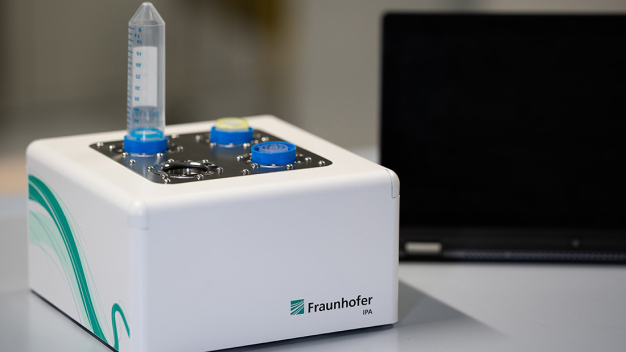
The automated, rapid, and enzyme-free extraction of living cells with the TissueGrinder for the examination of biopsy samples. © Fraunhofer IPA
Using the TissueGrinder developed at Fraunhofer IPA – an automated miniature mill for delicate tissue samples – clinics in the future will be able to quickly and accurately analyze cancer patient cell samples even without the help of an experienced pathologist. Patients will benefit most of all. When cell analysis is performed during surgery and the appropriate treatment steps are initiated almost immediately, patients often avoid a second operation.
During a cancer operation, precise information about the removed tissue is needed quickly to assist the surgeon in their next steps. Currently, a biopsy sample is sent to a pathologist who assesses whether the tissue is healthy or how far the cancer has spread. This process takes a lot of time and resources.
In collaboration with the Fraunhofer Institute for Manufacturing Engineering and Automation IPA in Mannheim, Friedrich Alexander University Erlangen-Nürnberg, and the University Hospital Erlangen, scientists from the Max Planck Institute for the Physics of Light and the Max Planck Center for Physics and Medicine have succeeded in largely automating cell analysis and subsequent evaluation through the use of artificial intelligence. The study published in Nature Biomedical Engineering by the team led by Dr. Despina Soteriou and Dr. Markéta Kubánková from the Max Planck Center for Physics and Medicine and Prof. Jochen Guck, director at the Max Planck Institute for the Physics of Light, shows how an "artificial pathologist" can help here in the future.
First step: Tissue disintegration with the "TissueGrinder"
The new method allows living cells to be obtained more quickly with the help of the TissueGrinder. The device was developed at Fraunhofer IPA by Dr. Jens Langejürgen and his colleagues and works similarly to a spice grinder: thanks to specially shaped blades that are set in rotation via a mill, it gently shreds the tissue without destroying or altering the cells. "The TissueGrinder has enormous potential for sample preparation in cancer diagnostics and other medical applications, especially for diagnostic analysis methods based on single cells, which form the basis for personalized medicine," says Jens Langejürgen, head of the Clinical Health Technologies department. Previously, cells had to be painstakingly isolated by hand or released with enzymes, which can leave traces on the cell surface and thus influence the results of further investigations.
The automated, rapid, and enzyme-free extraction of living cells with the TissueGrinder significantly simplifies the examination of biopsy samples. "Efficient sample preparation at the beginning of the diagnostic process paves the way for state-of-the-art analysis methods such as real-time deformability cytometry (RT-DC) or artificial intelligence-based procedures, and also improves the quality of analysis results," explains Stefan Scheuermann, research associate at Fraunhofer IPA.
Second step: Physical analysis of cell properties
In the next step, the obtained individual cells are analyzed using real-time deformability cytometry (RT-DC). This is a label-free method developed in the laboratory by Prof. Jochen Guck for analyzing cell deformability, which analyzes the physical properties of up to 1,000 cells per second and is 36,000 times faster than older methods. Similar to palpation during a medical examination, cell deformability provides important information. To utilize this, individual cells are rapidly passed through a microscopic channel, where they deform under pressure and stress. Based on the images captured during this process, scientists can then determine physical properties such as shape, size, and deformability.
Third step: Evaluation using artificial intelligence
To make a diagnosis, the results of the physical analysis must be evaluated in a final step. The Max Planck scientists have succeeded in developing an AI model that evaluates the complex data sets from RT-DC analysis and can then determine whether a sample contains tumor tissue or not. Additionally, the use of artificial intelligence has confirmed the significance of cell deformability as a biomarker.
The entire procedure takes less than 30 minutes from tissue sample to result evaluation and can be performed without an experienced pathologist or physicist. Furthermore, the method can also be used to detect tissue inflammations in a model for inflammatory bowel diseases (IBD).
The next goal of the scientists is to determine how the automated cell analysis procedure can best be applied in clinics to support and complement traditional pathological analysis.

Fraunhofer-Institut für Produktionstechnik und Automatisierung IPA
Nobelstraße 12
70569 Stuttgart
Germany
Phone: +49 711 970 1667
email: joerg-dieter.walz@ipa.fraunhofer.de
Internet: http://www.ipa.fraunhofer.de