


- Transfer systems
- Translated with AI
A sensor is in operation: SF2 Systems makes state changes visible on conveyor lines
How mobile condition monitoring can detect anomalies along the route – without comprehensive retrofitting
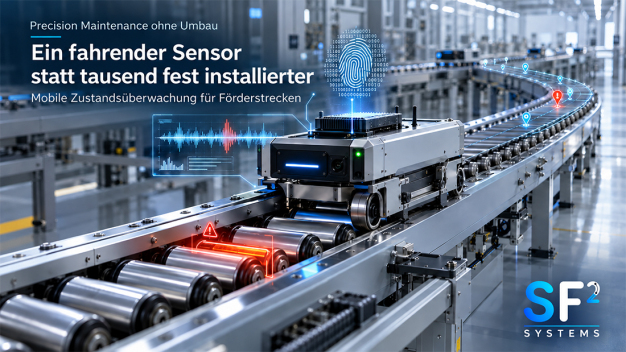
SF2 Conveyor Route State Intelligence: A mobile sensor detects vibrations and movement data along the route. SF2 condenses the signals into compact State Fingerprints, creating a comparable representation of the plant's condition – from individual rollers to the entire conveyor route. (Copyright: SF2 Systems (AI-generated visualization) 2026)
A roller runs unevenly. The system is stationary. A single worn roller can be enough. As long as it only runs somewhat unevenly, it hardly attracts attention during daily operation. If the problem becomes audible or visible, a small change in condition may already have led to a complete shutdown.
With kilometer-long conveyor and transport systems, this is precisely a structural problem: thousands of rollers, bearings, transitions, and drives move every day, but only a small part of them are monitored continuously. The classic solution—instrumenting each component permanently—means additional sensors, complex wiring, high integration costs, and maintenance of measurement technology.
The deep-tech company SF2 Systems now presents a more economical approach: the carrier, which already travels along the route, becomes a mobile inspector itself.
The sensor comes to the component – not vice versa
SF2 developed this approach as part of a Thin[gk]athon organized by Infineon Technologies and ZEISS Digital Innovation, and subsequently implemented it technically with an Infineon PSoC Edge E84 AI Kit in an instrumented transport cart. *)
A carrier, shuttle, workpiece carrier, or test vehicle is equipped with sensors and local data processing. During its normal journey, it records, for example, 3D acceleration and 3D gyroscope data, thus observing the infrastructure beneath it. The transport trip becomes additionally an inspection trip. This significantly changes the economic logic.
A calculation example: a route with 5,000 rollers would require at least 5,000 measurement points with stationary individual monitoring. An instrumented carrier, however, passes all of them without the conveyor system needing to be modified or integrated into the existing control system. Cloud connection for data analysis is also not mandatory.
A deflection is not yet a defect
Since speed, load, or curves generate natural mechanical effects, a single sensor deflection provides little information about a defect. Therefore, SF2 combines the synchronized sensor signals of a passage into a compact state fingerprint. This semantic fingerprint allows for comparison of conditions: Does the passage still behave like a normal run, or does a pattern emerge that has been observed in a known defect passage?
The technical proof in semiconductor manufacturing
The technical proof was provided by a case study independently conducted by SF2 Systems based on sensor data from an Infineon cleanroom conveyor system. The case study includes 418,938 processed measurement values and 72 derived condition features over a 15-meter test track. Known defective roller passages were reliably recognized as recurring characteristic patterns in the fingerprint comparison.
What is crucial is not the number of measurement values, but the demonstrated fundamental principle: a moving sensor unit can detect and compare condition differences along a conveyor route without needing to instrument each roller separately.
From technical proof to operation on your route
For the operator, the question is no longer:
“How does Semantic Folding work?”
What matters is:
What do I need to do to my system—and what do I get in return?
This is exactly where the industrial pilot begins.
Every conveyor system has its own mechanical behavior. Speed, load, route design, as well as roller and bearing types vary. Therefore, the approach is tested on the operator’s specific route. The parameters determined are those relevant for economical use:
– How precisely can noticeable patterns be assigned to a section of the route?
– How stable is the detection under different speeds and loads?
– How early can a relevant wear trend be detected in this specific system?
For route localization, optical markers as well as magnetometer and radar information are used among other methods.
The entry point: start small, get clear decision
You provide
– a relevant conveyor section
– a carrier, shuttle, workpiece carrier, or test vehicle
– existing measurement data or some reference runs
You receive
– an assessment of whether recurring condition differences can be detected on your route
– a comparison between normal conditions and noticeable or known defect passages
– a technical basis for the next steps
– a clear decision-making foundation: stop, deepen, or roll out
The pilot is not meant to be a technology exercise but to prepare a clearly defined technical and economic decision.
Where the approach is particularly relevant
The principle can be tested wherever moving carriers pass through long and heavily stressed infrastructure.
Intralogistics and high-bay warehouses: roller conveyors, shuttles, and conveyor systems.
Logistics and distribution: parcel centers and sorting facilities.
Airports: baggage conveyor systems with long and branched routes.
Automotive and manufacturing: workpiece carriers, skids, and transfer lines.
Semiconductor manufacturing: wafer transport and cleanroom conveyors.
Pharma and food: sensitive or hygienically demanding transport systems.
The common denominator is always the same: many mechanical components. Long routes. High availability requirements. And no economically attractive way to instrument everything individually.
For OEMs, this can open a new service business
For conveyor system manufacturers and system integrators, the approach is also commercially interesting. Condition monitoring does not necessarily mean selling additional hardware for each component. Selected carriers can be instrumented, conditions regularly recorded, and the same SF2 software logic used across different customer systems.
This creates a future additional digital service for OEMs for new and existing systems. Instead of costly retrofitting of each route, condition information can be provided via mobile measurement nodes and local state intelligence.
Show us your route
“Why instrument thousands of components individually when a sensor can pass by them every day?” says Christoph Gretzmacher, Business Development at SF2 Systems.
SF2 is currently looking for operators, system builders, and system integrators to pilot the approach in real operation on specific routes.
The entry is deliberately manageable:
Select route → reference runs → compare conditions → test in real operation → decide.
Does a carrier, shuttle, workpiece carrier, or container already travel the same route daily on your system? Then we want to see that route.
*) The mention describes the development and testing context and does not constitute a partnership or manufacturer recommendation.
SF2 Systems GmbH
1190 Wien
Austria