

- Translated with AI
48 experiments simultaneously
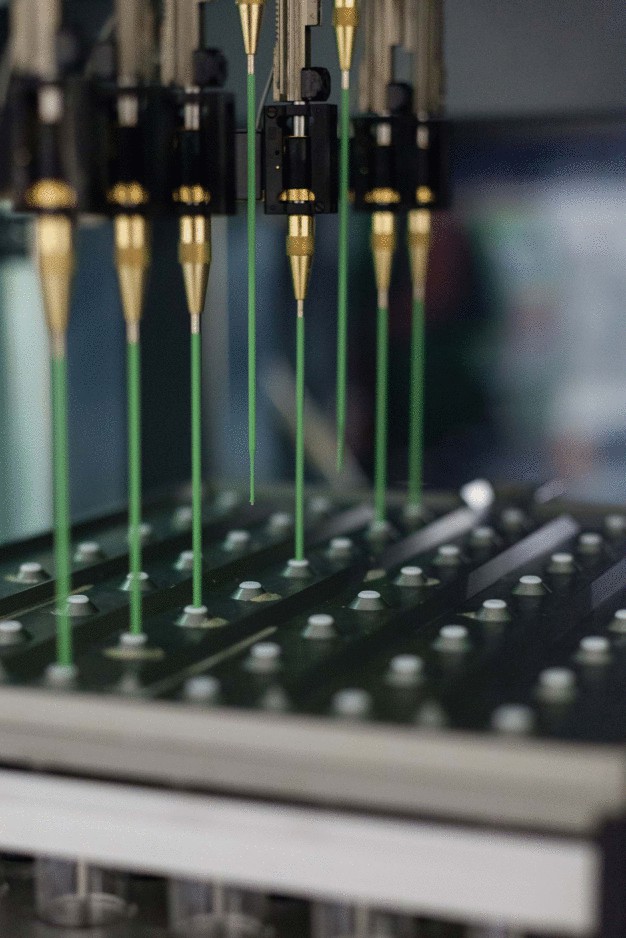
In the "Lab of the Future," the filling of bioreactors with various substances is carried out fully automatically according to a previously defined pattern. (© TU Berlin/PR/Felix Noak)
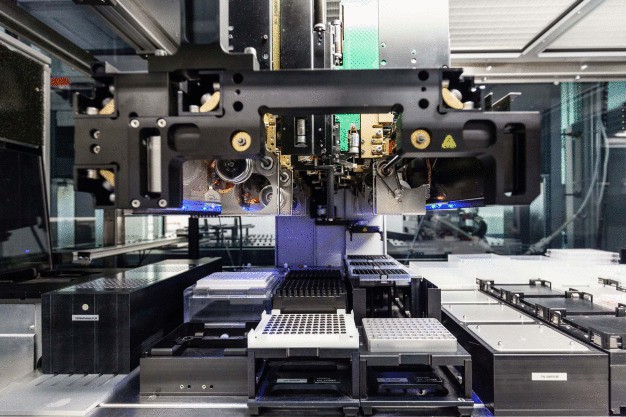
In the "Lab of the Future," 48 experiments can be conducted simultaneously. (© TU Berlin/PR/Felix Noak)
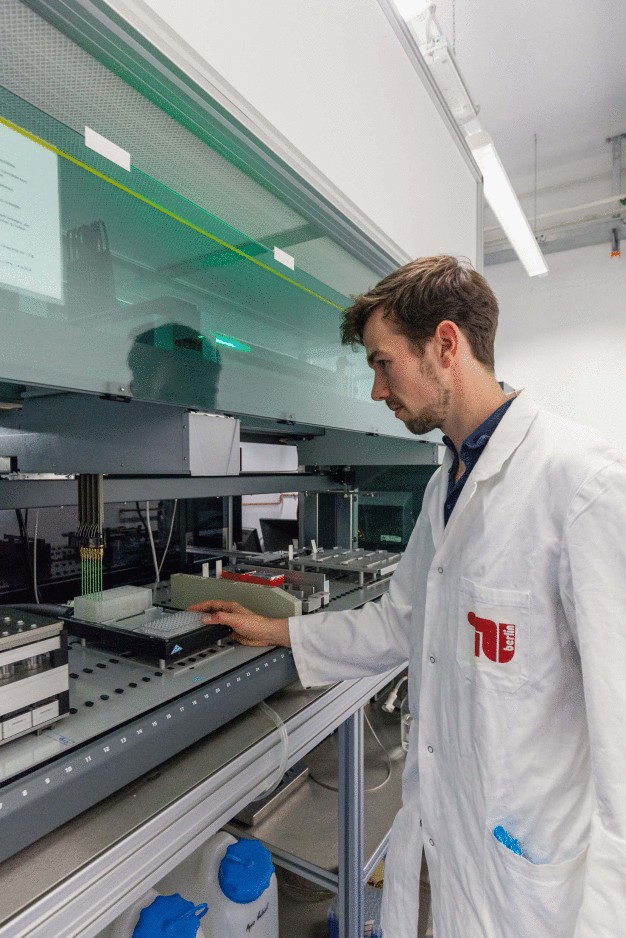
Labor manager Florian Glauche uses a sample holder with solutions that are filled into the bioreactors. (© TU Berlin/PR/Felix Noak)
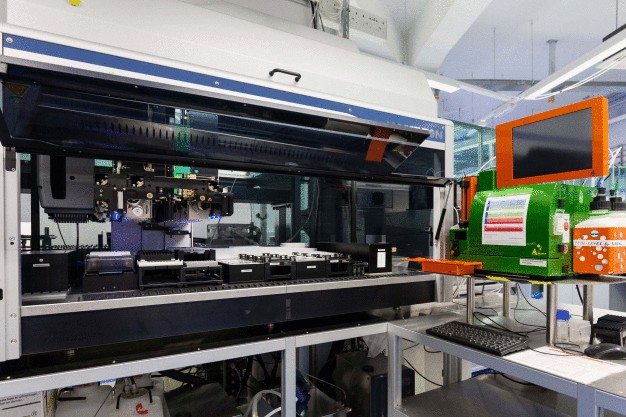
Robot arm for loading and storing various sample holders and measurement devices for fully automatic evaluation of ongoing experiments (right). (© TU Berlin/PR/Felix Noak)
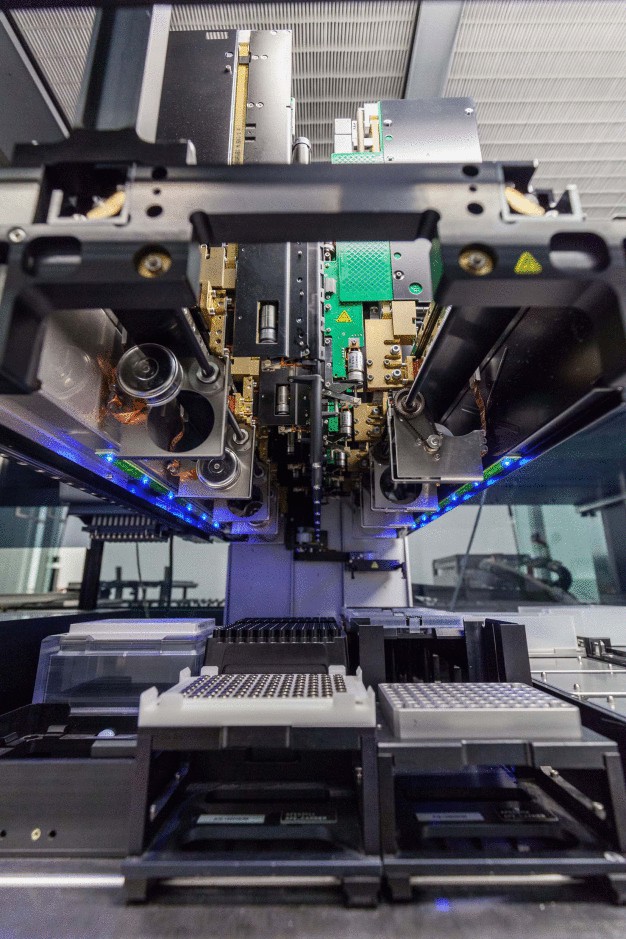
Robot arm for covering and storing various sample holders. 48 experiments can be conducted simultaneously in the "Lab of the Future". (© TU Berlin/PR/Felix Noak)
In the "Lab of the future" at the Department of Bioprocess Engineering, development times for the production of medicines and other biological products are to be drastically shortened and costs significantly reduced. This is made possible through the complete digitalization of the processes.
The development of new processes for manufacturing antibiotics or cancer drugs is lengthy and expensive. "Today, it takes ten to fifteen years for a new product to reach the market, and investments in the billions are not uncommon," says Prof. Dr. Peter Neubauer, head of the Department of Bioprocess Engineering. Therefore, he has developed a laboratory where he aims to drastically shorten development times and thus significantly reduce costs. The path to this goal: the processes for developing an innovative bioproduct are fully automated. Manually performed laboratory work, including the manual planning and analysis of experiments, is to become a thing of the past. The "Lab of the future" is located on the TU campus on Ackerstraße in Berlin-Wedding.
The heart of the lab currently consists of two robots: one is responsible for all analytical tasks, the other handles cell cultivation. This robot contains a mini bioreactor system with 48 culture vessels, each of which can have its cultivation conditions set individually. This allows 48 independent experiments to be conducted simultaneously. Cultivation and analysis are no longer temporally separated in the "Lab of the future."
What happens in the "Lab of the future" revolutionizes bioprocess technology. Although robots are already used in laboratories today, they usually "master" only one process step. They can either cultivate or destroy cells to access ingredients, or analyze samples. The approach of Peter Neubauer's team is to integrate all these steps into one robot and control it with intelligent computer systems.
Since 2012, Dr.-Ing. M. Nicolas Cruz Bournazou, group leader of Computer-Aided Bioprocess Development, and Dipl.-Ing. Florian Glauche, head of the Future Lab, have been developing tools that better harness the potential of automation technology. Their primary goal is to move away from the traditional workflow of experimental planning, execution, and analysis, and to better exploit the interplay between computers and robots. The cultivation and analysis of cell cultures using robotic technology are routine in industry, but these experiments typically only involve endpoint measurements. M. Nicolas Cruz Bournazou and Florian Glauche aim to obtain more information from individual experiments to mathematically describe cell growth and the synthesis of the desired product. To do this, they continuously measure cell growth, oxygen concentration, and pH value during an experiment. For control and evaluation, they have developed a network of programs that analyze the available data during the experiment, adapt a mathematical model, and send instructions to the robots for the next time window. An experiment can thus take a completely different course during execution than initially planned. This makes it possible to gather the maximum amount of information and thus obtain the most accurate mathematical description of the production process. Dr. Anke Wagner, also a research associate in the Department of Bioprocess Engineering, uses the future lab for the production of proteins that are subsequently used to manufacture bioactive substances. Bioactive substances in this case include antiviral agents or cancer drugs. "The biological synthesis of novel active substances requires new biocatalysts. In the future lab, the production of a large number of biocatalysts can be carried out in a very short time. Numerous parameters of the process can be monitored and continuously optimized," says Anke Wagner. Additionally, the future lab enables the identification of new enzyme activities from hundreds of novel proteins, whose functions are not yet precisely known.
"With the research project 'AutoBio,' we began our research in 2012 on building the 'Lab of the future.' At that time, there were no facilities, approaches, or works that enabled the integration and automation of all steps in the development of bioprocesses for the production of innovative bioproducts such as enzymes used for therapeutic purposes. Our approach is new and unique worldwide. After four years of research, we have now, through the EU projects 'LeanProt' and 'BioRapid,' with our 'Lab of the Future,' provided initial proof that complete digitalization and automation in bioprocess engineering are possible," says Prof. Dr. Peter Neubauer.
Technische Universität Berlin
10587 Berlin
Germany