




- Science
- Translated with AI
3D Imaging of the Future
Faster and more precise: Researchers at the University of Siegen are working on the ULTRA-SENSE 3D project on camera systems based on sensors made from amorphous silicon.
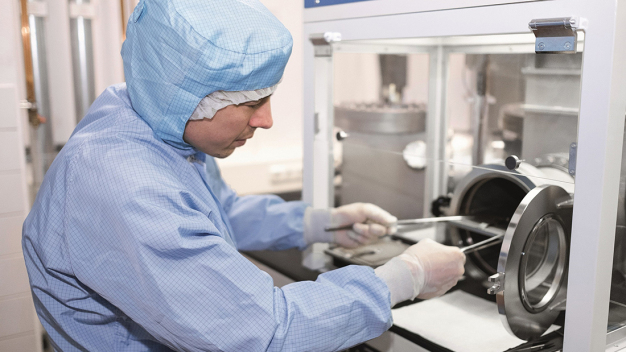
Dr. Andreas Bablich at work in the cleanroom. (Photo: Heiner Manderbach)
Whether in the automotive industry, medical technology, security systems, or smartphones: 3D cameras are increasingly widespread and versatile. A technology that is developing rapidly. As a forward-looking topic with high societal relevance, the necessary sensor technology is a central research area of the Chair of "Graphene-based Nanotechnology" and the Chair of "High-Frequency Technology and Quantum Electronics" at the University of Siegen.
A method that is gaining popularity in 3D camera systems due to its user-friendliness is the Time-of-Flight (ToF) method. It allows precise distance measurements based on the time difference between an emitted light pulse and the reflected light from an object, thus producing images with spatial depth. However, the relatively complex ToF sensors require quite a lot of chip area, making them expensive and limited for applications with high integration demands. The degree of integration refers to the absolute number of light-sensitive sensors on a microchip.
Scientists at the University of Siegen are working on a new research project "ULTRA-SENSE 3D" on innovative, highly precise, and powerful 3D camera systems based on Focus-Induced Photoresponse (FIP). "FIP is a relatively new technology, the foundation of which was laid through intensive research activities here at ZESS, the Center for Sensor Systems at the University of Siegen," explains Dr. Andreas Bablich, who, together with Prof. Dr. Peter Haring Bolívar, leads the project. The research now focuses on the performance potential of 3D-capable FIP sensors based on amorphous silicon. "I am pleased to demonstrate the close and fruitful collaboration between fundamental research and innovation impulses for industrial implementation in such a project," states Prof. Dr. Peter Haring Bolívar. ULTRA-SENSE 3D is funded by the German Research Foundation (DFG) with nearly three-quarters of a million euros for three years. For Dr. Andreas Bablich, the success of his initial application is an important milestone in his research career. The DFG explicitly supports young researchers through its funding.
FIP sensors can identify highly precise depth information over large distances much more sensitively than current concepts, all within a single pixel. This is because, with the FIP effect, not only the amount of incoming light is measured, but also the size of the light spot, enabling exact distance measurements in real-time—even in less optimal ambient lighting conditions. "However, the readout speeds and sensitivities of current FIP detectors based on organic or lead-containing materials are severely limited," explains Dr. Andreas Bablich further. In the new approach, the Siegen working group has developed FIP sensors based on amorphous silicon (a-Si:H), which currently exhibit a FIP effect about two orders of magnitude faster, more sensitive, and controllable compared to the state of the art. The active material, amorphous silicon, is deposited as a thin layer at low temperatures onto a chip. In technical terms, this is also called the growth of silicon on the chip surface. Typical layer thicknesses range from 10 nanometers to 1.5 micrometers, with the latter approximately one hundredth of the diameter of a human hair. "We develop, optimize, and characterize the sensor concepts not only at the chair but also produce the sensors in the university's current cleanroom," says Bablich. "Furthermore, we will continue to advance and intensify the technological implementation of this and other exciting research topics in the emerging INCYTE research building on the Adolf-Reichwein-Straße campus."
In addition to sensor technology, the Siegen scientists have also devised a novel readout concept that could significantly increase the frame rates of integrated 3D cameras and reduce noise influences. Dr. Bablich: "Initial distance measurements have already been successfully conducted, and the achieved resolutions of around 500 micrometers show significant potential to improve the FIP detection process considerably." A future-oriented application field envisioned by the researchers is high-sensitivity 3D scene recognition, for example in security technology or industrial quality control.
Universität Siegen
57076 Siegen
Germany