



- Przetłumaczone przez AI
Imec demonstruje wzór linii/przestrzeni o rozstawie 18 nm za pomocą procesu samoskładania kierowanego o wysokim Chi
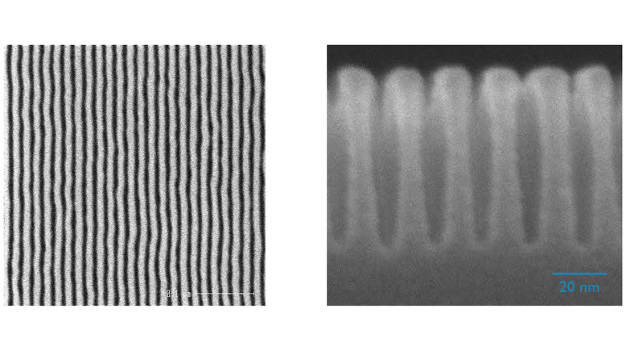
Widoki REM z góry (po lewej) i przekroju (po prawej) na 18-nm wzór linii/przestrzeni po High-Ï-DSA i następnie wstawione do docelowej warstwy SiN.
W tym tygodniu, na konferencji SPIE Advanced Lithography 2021, imec, światowy lider w dziedzinie badań i innowacji w zakresie nanoelektroniki i technologii cyfrowych, po raz pierwszy zaprezentował zdolność Directed Self Assembly (DSA) do strukturyzacji linii/przerw o pitchu zaledwie 18 nm, przy użyciu procesu opartego na wysokoci-BCP (High-Ï BCP) w warunkach produkcji na dużą skalę (HVM). Zastosowano zoptymalizowaną suchą chemię trawienia, aby skutecznie przenieść wzór na znajdujący się poniżej gruby warstwę SiN - co umożliwia dodatkową inspekcję defektów. Te wyniki potwierdzają potencjał DSA jako uzupełnienia tradycyjnej top-downowej strukturyzacji w przemysłowej produkcji technologicznych węzłów poniżej 2 nm.
Further miniaturization of components will require structuring of features with critical dimensions below 20 nm. At these small feature sizes, traditional top-down lithography is increasingly challenged by issues related to the response of photoresist materials to light - such as stochastic defects in printing and line-edge/line-width roughness (LER/LWR). Since 2010, industry has begun to explore alternative bottom-up structuring approaches, such as directed self-assembly (DSA), as a potential way to complement and further develop photolithography-based patterning.
DSA utilizes the microphase separation of a block copolymer (BCP) to define a pattern. The pattern can be generated by tuning the composition and size of the polymer. The assembly can be further guided - directed - by using a pre-pattern of lines/prerrows or holes. This leads to a final regular pattern at the nanoscale with much closer spacing (30-5 nm) than the guiding template. In 2019, imec was able to generate a pattern of lines/prerrows with a 28 nm pitch with low and stable defectivity (i.e., bridges and dislocations), based on DSA of the PS-b-PMMA block copolymer.
Based on these insights, imec is now focusing on developing the DSA process towards sub-20 nm pitch structuring using second-generation block copolymers, i.e., high-Ï BCPs from imec’s DSA material partners (Merck KGaA, Darmstadt, Brewer Science Inc., Nissan Chemical Corp., Tokyo Ohka Kogyo Co. Ltd.). The pattern was produced from a 90 nm guiding pattern with full pitch, created via 193-immersed lithography. After 60 seconds of self-assembly of high-Ï BCP on a HVM-friendly surface (SCREEN Semiconductor Solutions Co., Ltd.), no dislocations were detected in the best case on the 18 nm pitch L/S pattern. „The subsequent transfer of the high-aspect-ratio lines into the underlying material stack was very challenging,” says Hyo Seon Suh, Team Leader of Exploratory Patterning Materials at imec. „As a first step, we etched one block of the BCP using a dry etching process with optimized etch selectivity. After opening this block, the other block was transferred into the underlying stacks, which served as a hard mask for further structuring of a SiN layer. A tailored dry etching chemistry, developed in close collaboration with Tokyo Electron Ltd., enabled the successful transfer of the 18-nm line/prerrow pattern into a SiN layer deep enough for subsequent defect inspection, without significant line jitter or collapse.” In the next phase, this structured layer will be used to set up metrology for defect inspection and LER/LWR measurements.
„In recent years, DSA has attracted significant industrial interest, which has resulted in a valuable ecosystem of universities, metrology experts, material and equipment suppliers. Our DSA ecosystem has been key to the results we have achieved so far,” says Steven Scheer, VP of Advanced Patterning Process and Materials at imec. „For the first time, we have demonstrated that DSA can go beyond 20 nm pitch to produce lines and spaces. The process is scalable to smaller pitches by gradually increasing the Ï-value of the BCP. We believe this bottom-up approach can complement traditional top-down structuring methods or be used in combination with EUV lithography to pattern the most critical features of tomorrow’s devices.”
IMEC Belgium
3001 Leuven
Belgia