



- Battery
- Translated with AI
Worldwide first agile battery cell manufacturing opens
A robot-based and modularly constructed, agile production system enables the future production of customer-specific battery cells in the required quantities as needed.
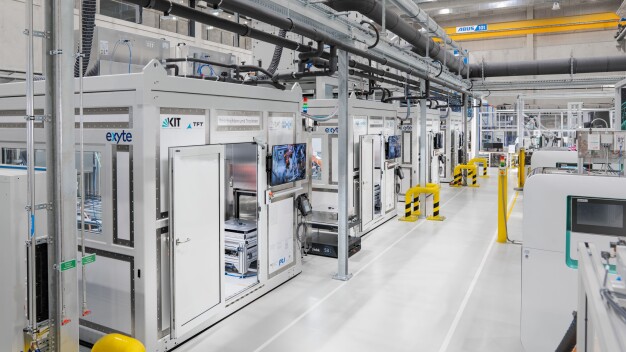
Pilot line of an agile, modular battery cell manufacturing in the Karlsruhe Research Factory. (Photo: Amadeus Bramsiepe, KIT)
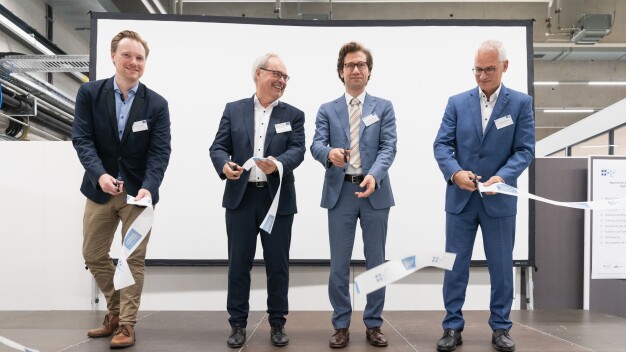
With guests from business, science, and politics, representatives of the involved ministries and KIT symbolically opened the new agile battery cell manufacturing line in the Karlsruhe Research Factory by cutting a ribbon. (from left to right: Stefan Jung, BMBF; Jürgen Fleischer, KIT; Ronny Feuer, MWK; Joachim Knebel, KIT) (Photo: Amadeus Bramsiepe, KIT)
Battery cells – for example for electromobility or power tools – to be produced more flexibly in the future, researchers from the Karlsruhe Institute of Technology (KIT) have established an agile battery cell manufacturing process. Based on highly flexible robot-based automation, they have achieved a level of flexibility that was previously only possible in manual cell production. This enables companies to adapt more quickly to new technologies and volatile markets and can strengthen Germany's competitiveness as an industrial location. The federal and state governments funded the setup with a total of nearly 19 million euros.
According to the Federal Ministry for Economic Affairs and Climate Action, battery cells are increasingly important as versatile and efficient energy storage solutions. They are, for example, the driving force behind the ongoing electrification of mobility. For manufacturing companies, this key technology is of high strategic and economic relevance. Currently, demand is mainly met through cost-driven mass production in Asia and North America, which also impacts machinery and plant engineering. "We do not have the prerequisites in Germany to be competitive in purely cost-driven mass production of cells and the associated machinery," says Professor Jürgen Fleischer, head of the WBK Institute for Production Technology at KIT. "The opening of the world's first agile battery cell manufacturing facility in the Karlsruhe research factory shows how we can differentiate ourselves from the global market with highly flexible and resource-efficient production and specifically target the high-margin premium segment and niche markets."
Flexible and resource-efficient battery cell manufacturing
For battery cell manufacturing, KIT researchers developed special robot cells together with the company Exyte. "These represent a world first in this field. They serve as local dry rooms, also called microenvironments, to protect moisture-sensitive battery materials," explains Fleischer. Compared to conventional dry rooms, the volume of space to be dehumidified is significantly smaller. Therefore, this technology offers a particularly high potential for energy savings. Four such microenvironments, along with their associated process modules, form the physical structure of the agile battery cell manufacturing in the Karlsruhe research factory of the WBK.
Furthermore, the project participants built a "digital twin," a virtual replica of the production system. This allows scientists to investigate software-based scaling effects by multiplying individual microenvironments and to determine production-related parameters such as the optimal batch size. This simulation can also be used for production planning of the agile battery cell manufacturing. The real system is connected to a database to enable future process adjustments and improvements based on AI.
Close cooperation between science and industry
The scientists developed the battery cell manufacturing process in the research project AgiloBat together with medium-sized machine and plant builders. This aims to enable them to jointly offer competitive plant technology along the entire process chain. The process knowledge contributed by KIT for more flexible and modular plant technology also allows the participating companies to sustainably produce battery cell variants flexibly, resource-efficiently, and automatically in the future, as well as to test new material systems through industry-related manufacturing with small material quantities. The infrastructure developed complements the research infrastructure for battery cell manufacturing established at KIT since 2011.
Further information about AgiloBat
In the AgiloBat research project, researchers from seven KIT institutes are working with partners from the Center for Solar Energy and Hydrogen Research Baden-Württemberg and the Fraunhofer Institute for Chemical Technology. Additionally, from machinery and plant engineering, Coperion GmbH, SAUERESSIG Group, Schunk Group, Herrmann Ultraschalltechnik GmbH & Co. KG, Siemens AG, DEHOF engineering+technology, and Exyte Technology GmbH are involved.
The Federal Ministry of Education and Research funds the project with 14.5 million euros, and the Ministry of Science, Research, and the Arts of Baden-Württemberg with 4.5 million euros. (kla)
Karlsruher Institut für Technologie
76131 Karlsruhe
Germany