


- Translated with AI
Workplace designer Treston equips spaceflight specialists Astrofein
From Saturn to Mercury – terrestrial precision work for extraterrestrial missions
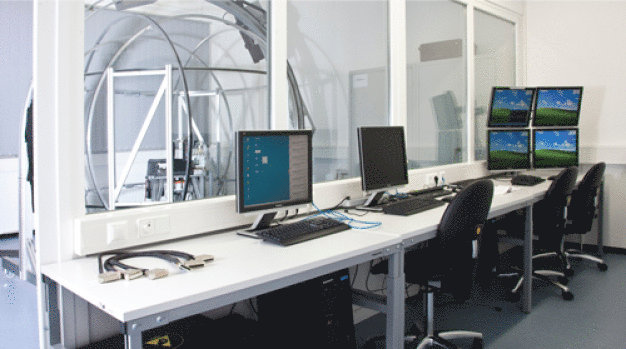
The spaceflight component manufacturer Astrofein relies on workplace solutions from Treston.
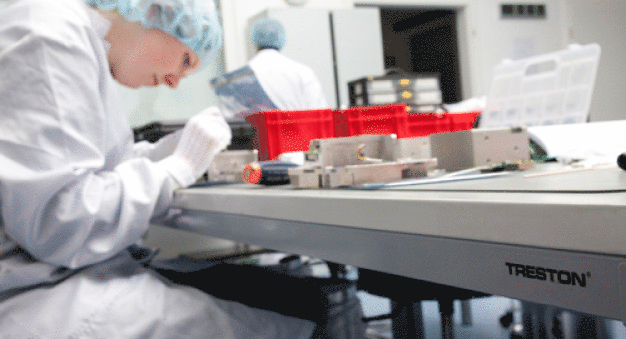
Cleanroom-compatible, ESD-safe, flexible: The Treston furniture convinced Astrofein at first glance.
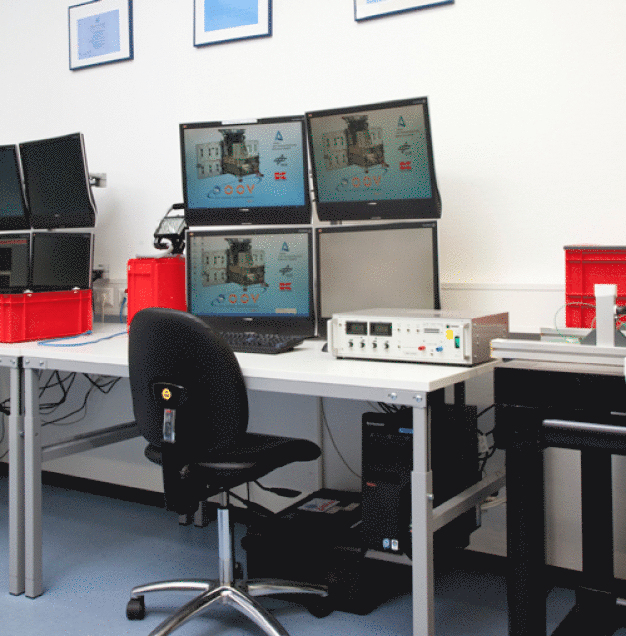
Health-conscious work: The Treston furniture used at Astrofein is highly ergonomic.
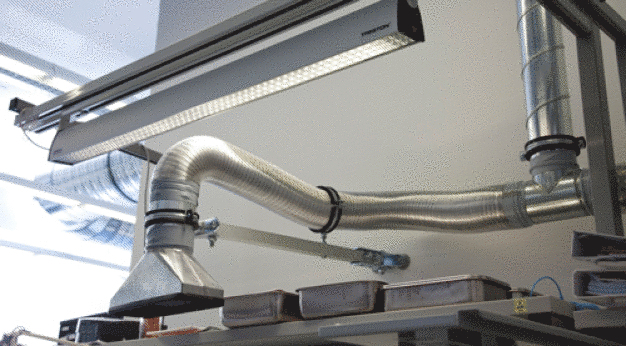
The Treston workspace lights illuminate the entire work surface without taking up space.
The term satellite comes from the Latin "satelles" and means "companion" or "bodyguard." Silently, artificial space bodies glide through space, orbiting planets or moons. In the dark depths of space, satellites have very different tasks: they measure geophysical and astronomical data, collect weather information, send navigation signals, or transmit messages.
To make satellites suitable for galactic deployment, a lot of expert knowledge is required. For example, this expertise is possessed by Astro- and Fine Mechanics Adlershof GmbH, short Astrofein, in southeastern Berlin. The company develops, manufactures, and tests primarily aerospace components. Astrofein has received multiple awards: among others, it won the "Bavarian State Prize 2011" for the TET-1 satellite platform and is a prize winner in the nationwide innovation competition "365 Places in the Land of Ideas." In 2010, Astrofein won the "Lilienthal Prize."
Diploma Engineer Stephan Roemer, responsible for project development and marketing in the space sector at Astrofein, explains: "A satellite platform manufactured by us weighs between 50 and 200 kilograms and is valued at approximately 7 to 15 million euros. The most important measure: we always have to work precisely and reliably."
It takes two to three years for a satellite to be ready for use. The rocket launch costs 130 to 140 million euros, with Astrofein's satellites flying as secondary payloads at a lower price, essentially as co-passengers. Once a satellite is in space, repairs and maintenance are very difficult or impossible. Therefore, Astrofein strives to manufacture the satellites absolutely flawlessly. Among other things, the personnel certified by the European Space Agency (ESA) weld and glue at the workplaces: unlike terrestrial applications, for example, employees must explicitly weld with lead-containing materials, and zinc (e.g., for handle shells) must not be used. The reason: the satellite operates later in the vacuum of space, and nothing may evaporate, as this could cause short circuits or damage to the optics. Therefore, the company also uses special adhesives.
The cleanroom suitability according to at least ISO 8 is particularly important: the concentration of airborne particles at the workplaces must be as low as possible. Particles present in normal ambient air could damage the integrated circuits and optics during construction.
Suitable work furniture for high-precision work
To meet these professional workplace conditions, Astrofein decided in 2008 and 2009 to collaborate with the Finnish workplace furniture supplier Treston. Stephan Roemer: "On the one hand, we knew the name Treston. On the other hand, we were convinced by the cleanroom suitability of the products and the ESD safety, i.e., protection against electrostatic discharges. The flexibility of the products and the price-performance ratio were additional advantages."
Currently, Astrofein uses, among other things, Treston workbenches of the types TPH and TP, including lighting and shelves. The tables are height-adjustable between 65 and 90 centimeters, with the base frame made of powder-coated steel profiles. The shelves are height-adjustable between 108 and 155 centimeters and can carry up to 50 kilograms.
All products are highly ergonomic. The workplace lights OL 254 and side lights SL 224 illuminate the work surfaces evenly without restricting them. All tables are freestanding and do not need to be bolted down. This allows the workplaces to be quickly rearranged if needed, to make room for larger assemblies and satellites.
"Treston also provides us with the security that spare parts and accessories remain available for ten to fifteen years and everything stays compatible. The 20 tables, chairs, and shelves provided by Treston fully meet all our requirements," says Roemer, adding with a smile: "The next space mission can come."
About Astrofein
The Berlin-based Astro- and Fine Mechanics Adlershof GmbH, short Astrofein, is a private company founded in 1993 by former employees of the Berlin-Adlershof research center of the German Aerospace Center (DLR). In recent years, it has developed into an independent future-oriented company with 70 employees. Besides aerospace, Astrofein is involved in the aviation industry, optics/calibration standards, and scientific instrument manufacturing.
In 2010, Astrofein received the "Lilienthal Prize": Otto Lilienthal (1848-1896) is considered a pioneer of aviation and a founder of scientific aerodynamics in the Berlin-Brandenburg region. To motivate other people in companies and scientific institutions to innovate in aerospace, the "Lilienthal Prize" foundation was established.
TRESTON GmbH
22175 Hamburg
Germany