




- Facilities
- Translated with AI
Why dust makes our lives difficult?
Cleanroom Concepts – the How and Why
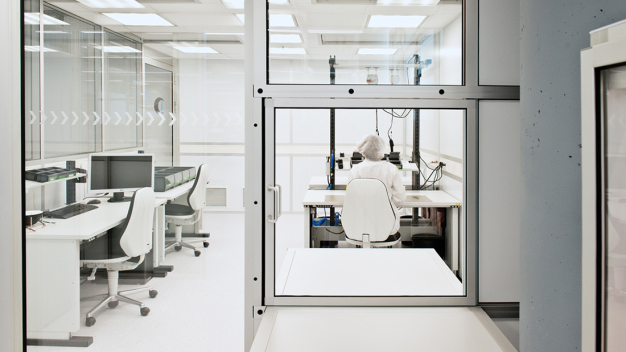
Figure 3: Photo of a cleanroom in the microelectronics industry
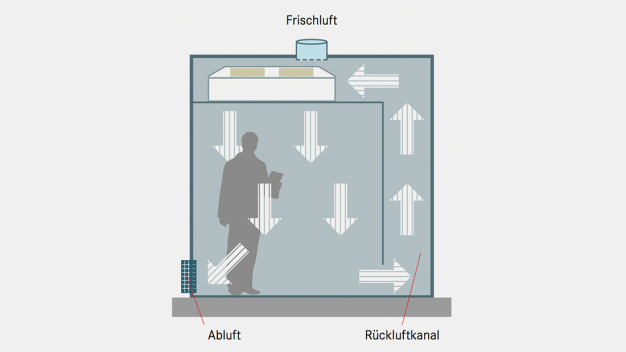
Figure 1: Schematic representation of the laminar airflow in a cleanroom cell
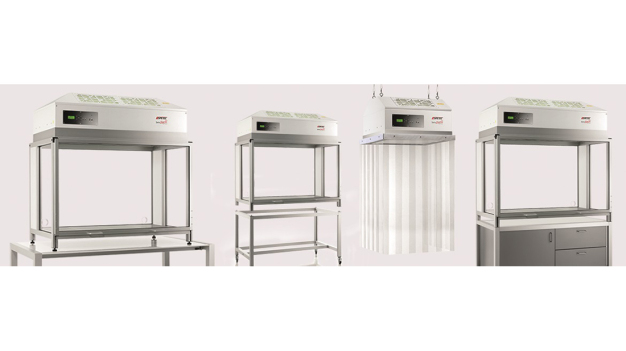
Figure 2: Different types of laminar flow cabinets
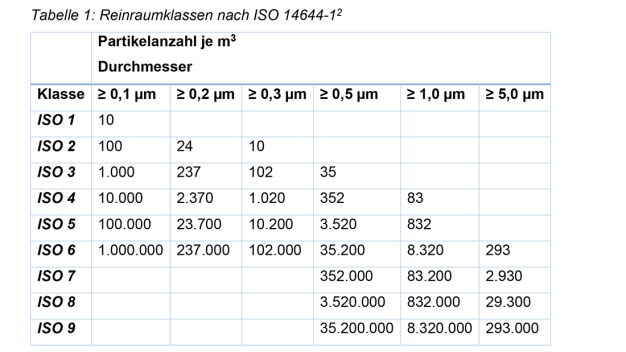
Table 1: Cleanroom classes according to ISO 14644-1
The dust that lies in large clumps in corners is easily visible and can be easily removed by dusting. But we want to deal with the dust that can no longer be perceived so well with the naked eye. To do this, we arbitrarily pick 2 events from the past year. One event is Saharan dust, because last year there were several instances where fine dust from the Sahara gave us particularly beautiful, reddish sunsets. This naturally occurring fine dust can be significant depending on the season, as we know from weather patterns influenced by Saharan dust. The numbers are staggering: over half of the global tropospheric aerosol and about 35% of the primary emitted particle mass consists of mineral dust particles, of which in Europe about half originate from the Sahara and the rest from other desert regions of the Earth. Wind erosion of mineral dust contributes approximately 1.8 billion tons per year to the global aerosol balance. Mineral dust influences the Earth-atmosphere system through scattering and partial absorption of incoming solar radiation, but also in cloud formation through condensation nuclei.
We know from Sahara dust that it can be carried hundreds, if not thousands of kilometers by air currents and can enter every indoor space through tiny openings. As drivers, we also know how stubborn and red it sticks to every car paint.
The second event we experienced at the turn of the year, because here the fine dust problem became visible: the air was "cutting" through. This year, it finally happened again: the new year was welcomed with a spectacular fireworks display. While fireworks are beautiful to watch, the consequences, especially injuries and property damage, were particularly controversial this year. Less considered were the health-related and economic damages, as approximately 2,050 tons of fine dust (PM10) are released annually from fireworks, mostly on New Year's Eve. This amount is roughly one percent of the total anthropogenic fine dust released per year in Germany.(1)
Due to its physical properties, small particles are often also called suspended particles. Fine dust is a part of suspended dust. Suspended dust (English "Particulate Matter": PM) refers to particles in the air that do not immediately settle to the ground but remain suspended in the atmosphere for a longer period. Depending on the "grain size" of the dust particles, we distinguish different fractions: PM10 (PM2.5) generally refers to all dust particles with an aerodynamic diameter smaller than 10 micrometers (2.5 µm). Both of these size fractions are monitored daily at over 600 measurement sites across Germany, and there are often daily exceedances of the limit values, even if the permissible annual average of 40 µg/m³ was not exceeded in 2021. Generally, the PM10 fraction is referred to as fine dust. Fine dust is not visible to the naked eye, only during certain weather conditions or like Saharan dust or New Year's fireworks can it be seen in the form of a "haze" or "fog."
Regardless of their source, the properties of these particles are mainly characterized by two parameters: firstly, their size, more precisely their hydrodynamic diameter, and secondly, their concentration, i.e., their mass or the number of particles per cubic meter of air.
Fine dust originates from two different sources: natural and anthropogenic. Natural fine dust can, as explained, be caused by soil erosion but also from biological sources, as we repeatedly observe during pollen flight in spring. Pollen is unpleasant even in very low concentrations for allergy sufferers, and other biological suspended particles such as mold spores or germs like bacteria or viruses can spoil food or cause diseases. This portion of natural-origin fine dust is unavoidable. However, a much larger but avoidable portion of fine dust is produced by human activity: this fine dust results from emissions from motor vehicles, power and district heating plants, ovens and heating in residential buildings, metal and steel production, or during the handling of bulk goods. In urban areas, road traffic is the dominant dust source. Fine dust enters the air not only from engines—primarily from diesel engines—but also through brake and tire wear and by stirring up dust. Another important source is agriculture, as emissions of gaseous precursor substances, especially ammonia emissions from livestock, contribute to secondary fine dust formation. Human-made fine dust emissions in Germany are estimated at around 200,000 tons per year (according to the Federal Environment Agency).
In summary, we can say that suspended particles (dust and fine dust particles, germs, aerosols, or other bio-particles) occur everywhere in the ambient air and indoor spaces, and due to their small dimensions under 10 µm, they can remain in the room air for a long time or be transported over large distances by the airflow.
Where and what do we need to protect ourselves from fine dust?
Not only humans are harmed by fine dust and can develop health problems, but also microelectronic, medical, or pharmaceutical products can be affected! This is especially true for the manufacturing of mechanical and electronic components, whose structural properties are in the micron range, such as in microelectronics, high-resolution optical components like sensors, especially camera and video sensors, but also in data storage.
In medical technology and pharmaceuticals, particles of biological origin are particularly problematic, because many products must be guaranteed to be germ-free or the number of germs must not exceed certain limits.
Products whose properties can be altered, impaired, or completely destroyed by particles of any origin must be protected from particles of all kinds if certain product qualities and characteristics are to be maintained.
When we talk about particle contamination in indoor spaces, we need to keep two sources in mind. Fine dust particles originating from the ambient air can be quite easily controlled through appropriate airflows and air filtration systems. But the second source of particles is humans themselves, as they release a very large number of these suspended particles as aerosols when speaking and breathing or directly as particles (skin flakes, fiber particles from clothing) with every movement. Whenever people are involved in production, manufacturing, or packaging, additional measures are therefore necessary. Alone through skin and clothing, more than 600 million particles (> 0.5 µm diameter) are released per cubic meter by each person in a clean room (ISO class 8), as data from the Fraunhofer Institute for Process Engineering and Automation (IPA) in Stuttgart show.
How can we protect products from fine dust?
Among the various technical possibilities for cleaning room air, filtration techniques have proven particularly effective because they are a cost-effective and operationally economical alternative and can also be retrofitted later. Only through proper cleaning of the room air can suspended particles and fine dust be avoided!
Merely installing an air purification system is not enough to keep particles away from manufacturing and packaging; a strategic overall concept must be developed. This consists of a series of measures, such as cleaning the room air with suitable filter systems, wearing appropriate protective clothing, optimizing workflows, and directly shielding products from particles emitted by staff. For especially high requirements, personnel and product airlocks are also necessary, as well as staff training and regular measurement of particle counts to monitor air quality.
The quality of a cleanroom or smaller cleanroom areas, such as a flow box, is assessed according to DIN norm EN ISO 14644, in which the classes of cleanliness are defined by the number of particles in a specified size fraction: see Table 1.(2)
The function of a cleanroom is quite simple; see the schematic representation of the laminar airflow in a cleanroom cell in Figure 1. The room air is drawn in by a fan (our customers particularly prefer very quiet fans from the Super-Silent series) and pushed through a high-performance particle filter. Both components are installed in a module in the ceiling area of the FMS series by Spetec GmbH. The HEPA 14 filter has an isolation factor of 10^4, thus reducing the number of particles and improving the air quality inside by at least 10,000 times compared to the outside environment. The filter arrangement generates a laminar airflow in the work area behind the glass panels (or lamellas), meaning the air flows like a curtain from top to bottom in parallel streamlines, protecting the sample, product, or work area from incoming particles through overpressure. Suspended particles present in the room air or released by personnel are captured by the airflow and removed via an exhaust duct or recirculated through a return air duct back to the filter unit.
Alternatively, for many applications, smaller modules called laminar flow boxes have proven effective, as shown in Figure 2, which depict different designs developed for various applications in manufacturing, assembly, or packaging of microelectronic or optoelectronic components. Depending on the design variant, these are also available as certified ISO class 5 workbenches in different sizes or made with specific materials to meet GMP guidelines, Annex Biocontamination, and to permanently prevent germs in the work area.
By combining cleanrooms or laminar flow boxes, entire production lines can be built so that products never come into contact with particles of any kind during the manufacturing process. The setup or arrangement, as well as the design of individual components, can be tailored to the customer's needs.
Application example: assembly of microelectronic sensors for high-resolution video cameras
At this point, a cleanroom concept will be discussed using an example. When assembling high-resolution camera and video sensors, even tiny dust particles can become huge sources of interference. The higher the resolution of the cameras, the more complex the manufacturing and assembly become. To avoid any contamination in their video technology systems, a customer decided to install an ISO Class 5 cleanroom from SPETEC GmbH in Erding, because the demand for high-resolution and ever faster camera sensors is steadily increasing, as are the quality requirements.
Particle-free conditions are necessary during the assembly of the sensors installed in the cameras to protect the very dust-sensitive components in these complex microelectronic systems. The jointly developed concept for this included, in addition to cleanroom-specific sizes, the requirement for optimal working conditions in ergonomic terms.
The installed SPETEC cleanroom cell, measuring 9 x 4 meters (see photo in Figure 3), consists of a surface-bonded wall system made of aluminum fixed elements and viewing windows, as well as sliding doors for personnel access, an emergency exit door, and service entry/exit. In addition to the air conditioning system, six laminar flow modules with the "SuSi Super Silent" version for air filtration were installed to ensure the best ergonomic working conditions at the four work or assembly stations, as well as to minimize background noise. Staff wear lint-free clothing, hoods, masks, and overshoes, which drastically reduce particle emissions from personnel, helping to maintain particle-free conditions in the cleanroom during various work processes.
The installed SPETEC® laminar flow modules use a high-performance filter of type H14 with an efficiency of 99.995%, achieving an isolation factor of 10^4. This means the air quality under the laminar flow module is improved by at least a factor of 10,000 compared to the outside environment, and the particle concentration within the unit, which is around 15 million/m³, is reduced to about 1,500 particles larger than 0.5 µm.
The installation also includes a particle measuring device, a material lock with compressed air cleaning, a local exhaust system at a workbench for aerosols generated during soldering, coordinated LED lighting in the ceiling, and an extra flow box in the lock for pre-cleaning electronic and optical components. In this configuration, a cleanroom class ISO 5 is guaranteed even with full staffing, which is checked and documented daily.
Within the cleanroom cell, additional "furnishings" include a wardrobe and a bench. According to the company, this ensures the highest level of purity in the assembly process, thus guaranteeing maximum product quality when sensor boards and lenses of various camera types are hermetically screwed together under these optimal conditions.
Conclusion
In summary, laminar flow boxes are ideal for protecting products from particles and germs whenever production steps require little space. If customer needs grow, an entire production line can be built by combining cleanroom modules. If larger space is needed or if the boxes need to be walk-in due to more complex production or packaging, then a cleanroom or cleanroom cell is an ideal solution. An existing cleanroom can be expanded later at any time using the modular system. This protects the customer from costly misinvestments and is particularly sustainable because existing components can be integrated into a new concept.
The company SPETEC GmbH has decades of experience in developing and applying cleanroom and air purification systems and offers its customers not only a technical solution but also develops a cost-effective strategic overall concept with them. +
(1) Fine dust from New Year's fireworks / Federal Environment Agency
(2) https://www.beuth.de/de/norm/din-en-iso-14644-1/238330395

Spetec Gesellschaft für Labor- und Reinraumtechnik mbH
Am Kletthamer Feld 15
85435 Erding
Germany
Phone: +49 8122 959090
Fax: +49 8122 9590955
email: info@spetec.de
Internet: https://www.spetec.de



