



- Translated with AI
When the nerve cells give up the ghost
New institute construction for the research of neurodegenerative diseases, DZNE Magdeburg<br>pbr AG provided planning for architecture and electrical engineering
(Source: Christian Bierwagen; fotodesign-bierwagen)
(Source: Christian Bierwagen; fotodesign-bierwagen)
(Source: Christian Bierwagen; fotodesign-bierwagen)
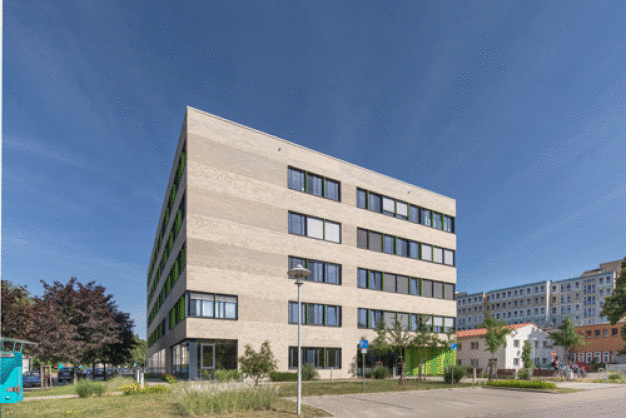
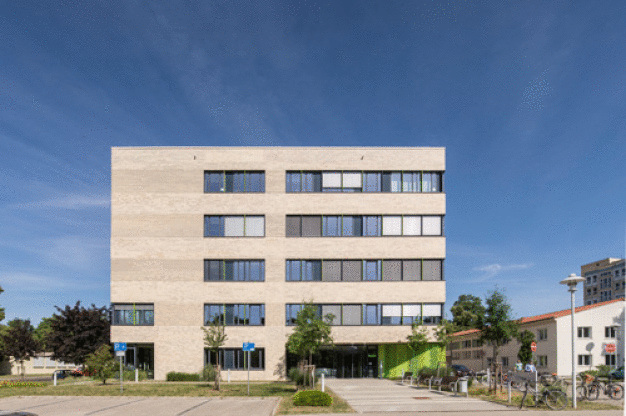
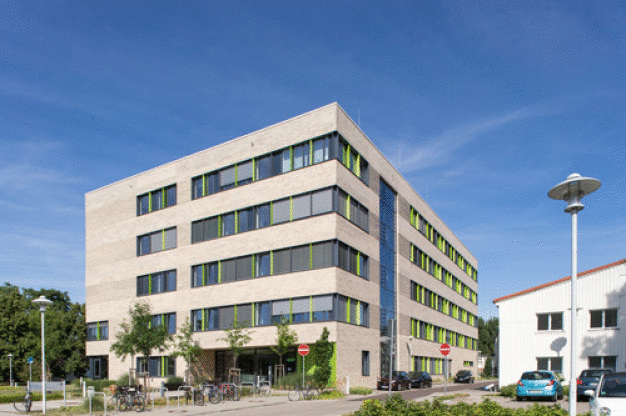
On the grounds of the Medical Faculty of Otto von Guericke University in Magdeburg, a new research building for the German Center for Neurodegenerative Diseases (DZNE) was completed at the end of 2013. For the five-story institute new construction, pbr AG provided the planning of architecture and electrical engineering. The construction costs amounted to approximately 21.8 million euros.
The DZNE was founded in 2009 as a member of the Helmholtz Association and as one of the German Centers for Health Research, serving the investigation of prevention, diagnosis, and therapy of diseases of the human nervous system.
Due to the short research cycles that are common today, the planning of the DZNE included the requirement for secondary usability: the raw structure, corridor design, and elevator placement were designed for later use as a bed facility. In the event of repurposing, the location of the elevators allows the corridor to be relocated, enabling the room structure to be unified.
The new building encompasses areas for experimental research and theoretical work, as well as service spaces, communication areas, and therapy zones. Two main corridors serve as actively controllable zones, ensuring a strict separation between two self-contained functional areas. To meet the special requirements for installing an MR-PET device, the planners incorporated shielding of high-frequency fields with specialized cabins, considering safety distances from traffic areas to the extreme magnetic fields both inside and outside the room. In the control area, special radiation protection measures are to be implemented based on a radiation protection report, with sizing of individual components and consideration of device data. The external wall features concealed entry openings to facilitate the exchange of large equipment. The north facade was fitted with a reversible cladding of coated metal panels in this area. To ensure a high degree of neutrality and flexibility in use, the room widths in the external bays are largely standardized. The wet labs and electrophysiological measurement rooms on the second and third floors are located on the climatically favorable north side of the building. Since device heat can significantly warm the room air in this area, cooling is included in the ventilation system. Rooms for storing chemicals and gases are permanently ventilated.
In addition to an external sun protection, laboratories and offices are equipped with roller blinds with screen fabric as glare protection. E-Labs are additionally fitted with motorized blackout systems for complete darkness.
The new institute building harmoniously fits into the campus of Otto von Guericke University. This is achieved through the choice of facade material. Brick, which references the origins of the campus, creates a connection between the existing and the new building in a contemporary application. Window sills organize the facade in the rhythm of the five stories. Running around corners, they merge the facade sides and create a light, floating character. The closer one gets to the building, the more the simple large form dissolves into fine detail work. For example, facade profiling in the masonry continues the lines of the window sills, and sunlight reflects off the glazed, protruding brick layers. The window sills set in metal frames are rhythmized by pilasters in varying shades of color. An increase in the wind stability of the sun protection devices is the constructive reason behind this. The green hue is deliberately chosen and serves as an independent design theme, continuing both on the campus grounds and inside the institute.
Currently, another laboratory and institute building is being constructed in Göttingen on the grounds of the University Medical Center, which is also used by the DZNE. Here too, the central design feature reflects the goal of a corporate architecture to demonstrate the unity of the institutes.
pbr Planungsbüro Rohling AG
49076 Osnabrück
Germany



