- Furnishing & equipment
- Translated with AI
What do aerosols, dust particles, and microbes have in common?
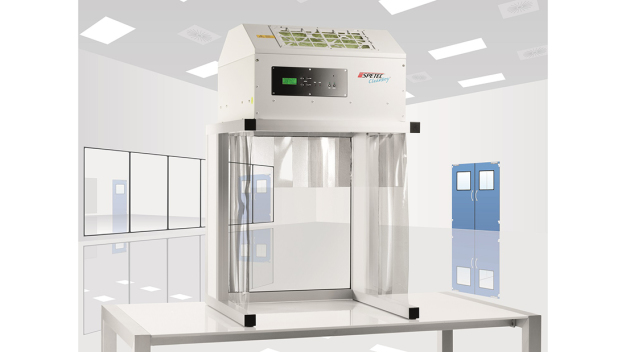
(Figure 2: Photo of a Flow-Box (Spetec Clean Boy® Mini))
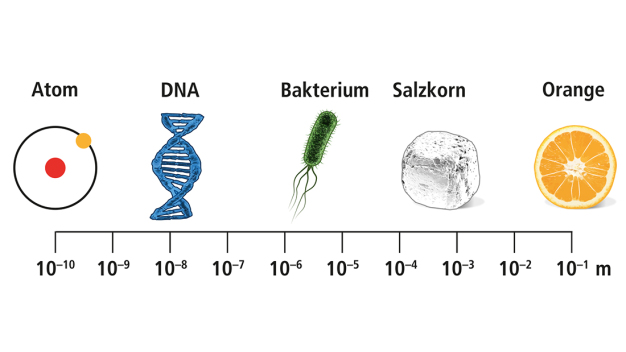
(Figure 1: Sizes of the particles compared)
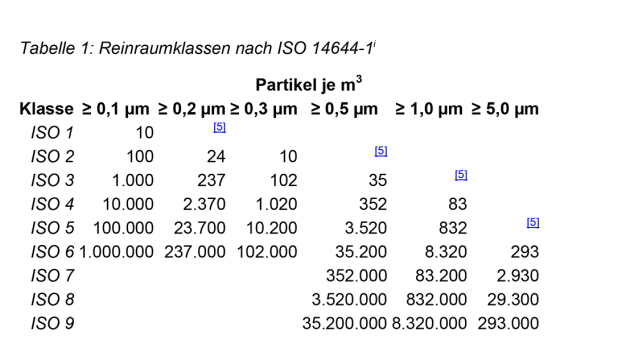
Table 1: Cleanroom classes according to ISO 14644-1
The answer to this complex question is of a physical nature and quite simple to give: it is the size that all three differently acting particles share, or more precisely, their extent.
What sizes do these particles have?
The size ratios of some selected objects are shown in Figure 1.
The size scale ranges from an atom at 10-10 m up to an orange with a diameter of 10 cm (0.1 m). In this article, we are interested in objects smaller than 0.1 mm, i.e., 100 µm, which can no longer be seen with the naked eye and therefore belong to the micro-objects that, although invisible, can significantly influence our lives.
Spherical particles (particles, aerosols, microbes) with diameters under 30 µm can be transported through the air over long distances, and recently Japanese scientists have even shown that aerosols produced by humans can remain in room air for up to 20 minutes if not ventilated, before gravity causes them to sink to the ground.
An aerosol is a heterogeneous mixture (dispersion) of solid or liquid suspended particles in a gas. The suspended particles are called aerosol particles or aerosol droplets. The smallest particles are only a few nanometers in size and can no longer be seen with a light microscope, only with an electron microscope, such as viruses, but the aerosols we are interested in here have diameters in the micrometer range. Aerosols are currently a hot topic because they are inevitably produced by humans during breathing and speaking, especially when singing, and others can inhale these aerosols, which may contain viruses or bacteria, if they do not take appropriate precautions, e.g., maintaining distance or wearing a mouth-nose mask, or they settle on surfaces, potentially altering product properties negatively.
Bioaerosols refer to all collections of particles of biological origin in the airspace, containing fungi, bacteria, viruses, or pollen, as well as their cell wall components and metabolic products (e.g., mycotoxins), or particles to which these bio-particles adhere. In a broader sense, all particles of biological origin, such as skin flakes or fiber parts, are classified as bioaerosol particles. Humans themselves are the largest producers of bioaerosols indoors. Tiny droplets are released into the surrounding air when breathing out, and with every movement, flakes, skin particles, and fibers from clothing are shed and often remain suspended in the room air for a long time.
Among larger biological suspended particles are pollen with aerodynamic diameters ranging from 10 µm to 100 µm, while viruses generally have diameters in the range of 0.02 µm to 0.4 µm. Considering that quite large pollen can travel long distances to trigger allergies far away, smaller particles like viruses can also follow air currents indoors and are no longer removed by modern air conditioning systems. Without ventilation and air exchange, they can remain airborne for many hours without contact with a surface where they could be absorbed.
Aerosols are not only exhaled by humans but are also easily inhaled. About 10% of all inhaled aerosol particles remain in the respiratory tract, while the rest are exhaled again or expelled by the activity of cilia in the lungs. Particles that can reach at least the bronchial region are called lung-penetrating. This includes all aerosol particles below approximately 10 micrometers in diameter (PM10). Larger particles are already expelled in the nose or throat or cannot be inhaled at all. The least expelled are particles with diameters between 0.5 micrometers and 1 micrometer, which simultaneously means they can penetrate particularly deep into the lungs. Wherever dust, aerosols, or particles are released in a production environment, humans must be protected from these particles. We all remember extensive asbestos remediation because even individual asbestos fibers could cause lung cancer.
A microbe is the short form of microorganism, an organism whose size is in the micrometer range below 0.1 mm, and therefore no longer visible to the human eye. All microbes share the fact that they consist of a single cell. If a cell nucleus, usually a double-walled membrane enclosing the DNA, is prominent, we speak of eukaryotes, while prokaryotes lack a cell nucleus. The criterion of small size is also fulfilled by yeasts, algae, protozoa (like amoebae), and slime molds, but newer definitions of microbes include only bacteria and archaea (also unicellular organisms without a nucleus, very similar to bacteria) as well as yeasts. Bacteria and yeasts are often used in the food industry to achieve certain product properties, for example in brewing beer, but they can also spoil products, as we know from molds or E. coli bacteria.
In summary, we can say that suspended particles (dust particles, germs, aerosols, or bioaerosols) occur everywhere in the air and indoors, and due to their small dimensions under 100 µm, they can remain in the room air for a long time or be transported over large distances by air currents.
Where and what do we need to protect ourselves from these suspended particles?
Many of the particles mentioned can alter or even impair product properties.
In the food industry, all airborne microorganisms are undesirable, but they are still present in every room air. We know this from our own experience because many foods are very susceptible. For example, our bread begins to mold; milk sours, or fruit rots if exposed unprotected to these organisms. Sensitive and valuable products must therefore be protected from microorganisms.
In optical and electronic manufacturing, dust particles are the biggest enemy of the manufacturer because they are also present in every room air. In the production of optical or electronic components, particles can alter, impair, or completely destroy the function of the product, and therefore these products must be protected from particles of all kinds.
In pharmaceutical and medical technology, sterility or germ-free conditions are especially important, but germs are present in every room air. Therefore, medical devices such as syringes, scalpels, or bandage materials and plasters must be sterilely packaged and stored. Achieving sterile packaging is relatively simple under a filtered airflow, but sterile storage can become more complex. Consequently, in hospitals, even patients should be stored sterilely if multiresistant germs have already been detected.
When discussing particle contamination in indoor spaces, two sources of particles must be kept in mind. Dust particles from the ambient air can be controlled with suitable airflows and air filtration systems. However, the second source, humans, is much more difficult to control because they themselves release a very large number of these suspended particles as aerosols or directly as particles (skin flakes, fiber particles from clothing) with every breath and movement. Whenever people are involved in production, manufacturing, or packaging, action is required. Only sufficient cleaning of the room air and shielding of the products can protect them from human influence, or in some cases, humans themselves must be protected from emissions, especially from dust or aerosols generated during production.
All these examples show that products and humans themselves must be protected from a wide variety of particles and aerosols.
How can these suspended particles be kept away from products?
Only through proper cleaning of the room air can suspended particles be removed from the air! Among various technical options for cleaning room air, filtration techniques have proven particularly effective because they are a cost-effective and operationally inexpensive alternative and can also be retrofitted later.
The basis for assessing the quality of a cleanroom or corresponding cleanroom areas, such as a flow box, is provided by the DIN standard EN ISO 14644, which classifies cleanrooms. The different ISO classes are summarized in Table 1. (1)
Depending on requirements, entire cleanrooms can be added later to production areas, or if the space requirement is smaller, smaller boxes can be set up to create a local cleanroom environment.
An example is a flow box, such as the Spetec Clean Boy® Mini (Spetec GmbH, Erding, Germany), shown in the photo in Figure 1. It was tested, certified, and classified into ISO 5 (US old: Class 100) by the Fraunhofer Institute for Production Technology and Automation, meaning that a maximum of 100 particles with a minimum diameter of 0.5 µm per cubic foot (3.5 particles per liter or 3,520 particles per m3) are allowed inside the box. The flow box thus has an isolation factor of 104, reducing the number of particles accordingly and improving air quality by at least a factor of 10,000 compared to the surrounding air in the production area. Similar applies to larger cleanrooms—here, the air quality can be adjusted to the customer’s specifications. All cleanrooms are assembled, measured, and subsequently certified on-site by Spetec GmbH.
When evaluating the air quality inside a cleanroom or a laminar flow box, it does not matter whether the particle is an aerosol, a microbe, a yeast cell, or a bacterium, because the removal occurs solely based on the particle size, not its chemical or biological properties.
The function of a flow box is quite simple. Room air is drawn in by a fan, which is installed in the upper housing part (see Figure 2), and pushed through a particle filter. The filter arrangement creates a laminar airflow in the work area behind the plexiglass panels. This means the air flows like a curtain from top to bottom in parallel streamlines, protecting the sample or product from incoming particles through overpressure. Particles or other suspended particles present in the room air that have entered, for example during product setup or change, are captured by the airflow and removed or diverted through the holes in the floor of the flow box or the front opening.
By combining cleanrooms or laminar flow boxes, entire production lines can be built so that the product never comes into contact with particles of any kind during the manufacturing process. The setup, arrangement, and even the design of individual components can be tailored to the customer’s needs.
(1) https://www.beuth.de/de/norm/din-en-iso-14644-1/238330395

Spetec Gesellschaft für Labor- und Reinraumtechnik mbH
Am Kletthamer Feld 15
85435 Erding
Germany
Phone: +49 8122 959090
Fax: +49 8122 9590955
email: info@spetec.de
Internet: https://www.spetec.de