

- Service
- Translated with AI
Well-preserved artworks with the help of the BRIEM Monitoring Software (BMS)
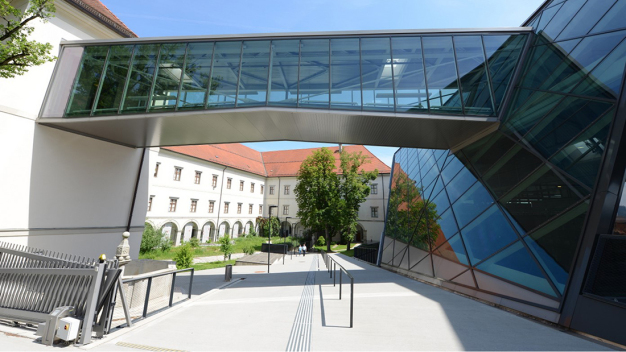
Linz Castle Museum, View into the Courtyard (Image rights: Linz Castle Museum)
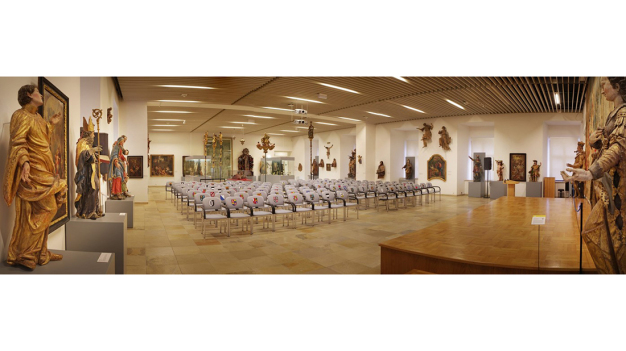
Baroque Hall in the Linz Castle Museum (Image rights: Linz Castle Museum)
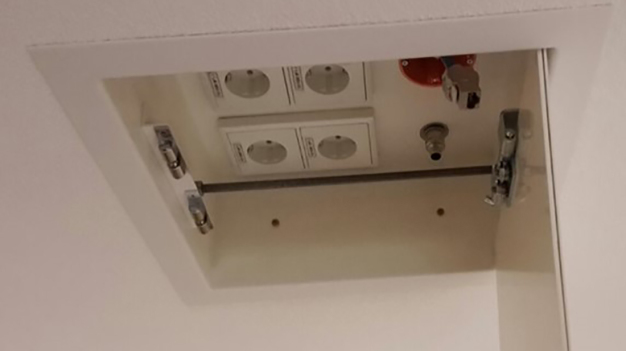
Media box integrated into the suspended ceiling (Image rights: BRIEM Steuerungstechnik GmbH)
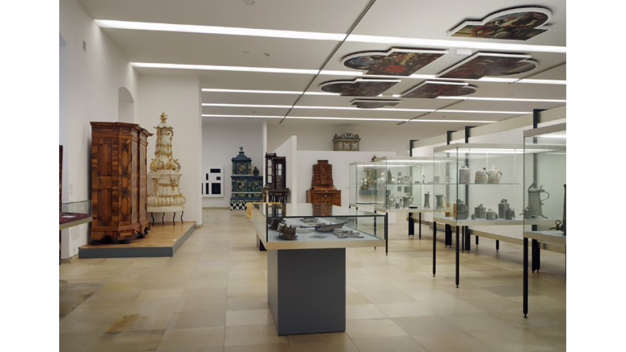
Permanent Exhibition of Applied Arts (Image rights: Linz Castle Museum)
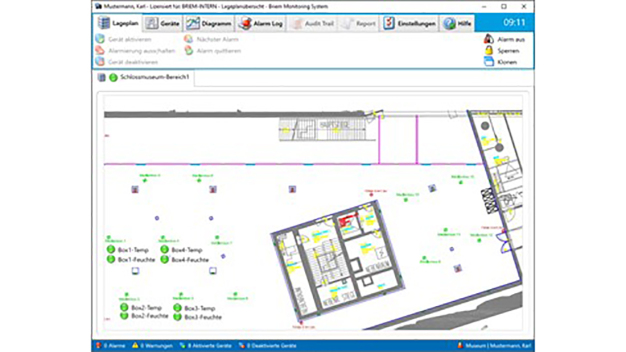
Real-time monitoring of climate measurement values using BRIEM Monitoring Software (BMS). (Image rights: BRIEM Steuerungstechnik GmbH)
The Castle Museum in Linz offers an extensive insight into the natural, cultural, and art history of Upper Austria on over 10,000 m² of exhibition space, from the beginning of life to the 21st century. The permanent exhibitions, located in the historic castle as well as in the new south wing, are broad in scope. They range from earth history to contemporary history.
To record temperature and humidity for a variable exhibition area of approximately 1200m², the Department of Building and Procurement Management of the State Government of Upper Austria issued a tender for a monitoring system.
Challenges and the Search for the Suitable Project Partner
"The biggest challenge of the project was to find a system that is as flexible as possible, allowing measurements to be taken at various exhibition setups. These setups often change, e.g., through new partition walls or other installations," describes Alfred Füreder, the responsible building technician of the Upper Austria State Museum, the initial situation of the project.
Another important requirement was the integration of measurement and control sensors. The main focus here is on avoiding measurement errors and ensuring a clear structure for climate control.
Points such as expandability and reliable adherence to deadlines by the supplier are indispensable in such a project.
"Furthermore, the strict requirements of the lenders had to be considered," explains Alfred Füreder. "The lenders of artworks demand guaranteed climate values, which must be recorded using tamper-proof monitoring."
When searching for a suitable partner for this project, the following points were decisive:
- Tamper-proof monitoring software
- Flexible integration of sensors
- Provision of measurement data for control technology
- Display of measurement values on screens at multiple fixed exhibition measurement points
- Compliance with the available budget
- Installation in Austria / deadline compliance
- Very good system expandability
The choice of project partner fell on the Swabian medium-sized company BRIEM Steuerungstechnik GmbH from Nürtingen, which could fully meet the required points and already had extensive experience in the field of tamper-proof monitoring systems.
"Our building services planner recommended BRIEM to us because their systems are also used in the pharmaceutical industry," describes Mr. Füreder his approach to selecting the right supplier.
Monitoring systems from BRIEM have proven themselves in over 300 installations worldwide. The fact that their self-developed software – the heart of the monitoring system – also meets the enormous security and data integrity requirements of the pharmaceutical industry significantly influenced the decision in awarding the contract.
Implementation
To ensure the high level of flexibility required, the project partners decided on a solution using media boxes. These boxes, mounted in the suspended ceiling of the exhibition rooms, offer the possibility of direct sensor connection at each measurement point if needed. Standardized 4-pin connectors were used as plug-in connectors.
A combined temperature/humidity sensor of the GB281 type from BRIEM was selected as the sensor. In this sensor type, the measuring electronics are housed in a sturdy plastic case, and the actual sensor is connected via a cable.
In the first expansion stage, a total of 10 media boxes were installed. Five of the sensors were put into operation as fixed installations, and five more as mobile units to ensure high flexibility.
"The sensor placements can be adjusted to the respective exhibition setup, i.e., changing partition walls," describes Alfred Füreder the flexible configuration of the system.
The measurement values from the five fixed measurement points are visualized via the integrated 4-digit digital display with red, yellow, and green LED indicators and are mounted on an aluminum carrier plate across the area.
This solution allows – even without software – an immediate check to see whether all climate sensors' measurements are within the target range.
The measurement signals are additionally transmitted via optocouplers to the control system to ensure the integration of measurement and control sensors.
The Monitoring Software
All measurement values can be read out and analyzed securely at any time using the BMS software.
Automatic reports and clear visualizations via site plans complement the intuitive and user-friendly software operation.
If needed, the measurement data can also be exported for further processing.
Thanks to centralized storage in a database, the measurement data are available at the push of a button from the day of installation.
Conclusion
The challenge faced by the Linz Castle Museum—to equip climate-controlled exhibition rooms with a flexible and tamper-proof recording system—was successfully implemented by BRIEM Steuerungstechnik GmbH and the BRIEM monitoring system (BMS) in conjunction with the media boxes mounted in the suspended ceiling.
The monitoring system has been in use for several years now and has been expanded with additional measurement points during subsequent development stages. By using standardized sensors and control cabinet components, the Linz Castle Museum can look forward to many more years of operation with full flexibility and expandability, and can be assured that its valuable artworks will continue to be well protected in the future.

BRIEM Steuerungstechnik GmbH
Lauterstraße 23
72622 Nürtingen
Germany
Phone: +49 7022 60920
Fax: +49 7022 609260
email: info@briem.de
Internet: http://www.briem.de