

- Translated with AI
Philipp Schlor
Welder Training Field Study: Improvements in quality and reduced costs through the use of simulators
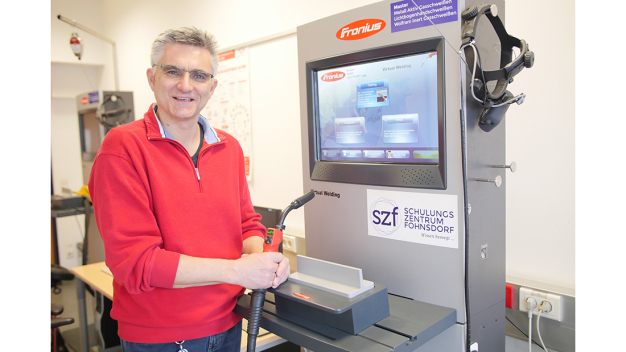
Hannes Krempl, Welding Technology/Transport Trainer at the Fohnsdorf Training Center. (Photo: Fronius International GmbH) / Hannes Krempl, welding technology and transport trainer at the Fohnsdorf Training Centre. (Copyright: Fronius International GmbH)
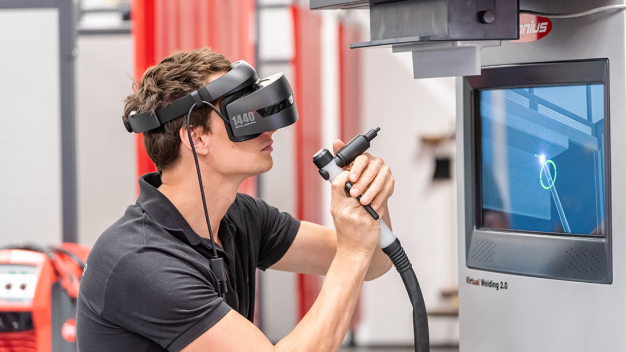
Virtual Welding brings the latest technology in consumer electronics into welding training. (Photo: Fronius International GmbH) / Virtual Welding combines state-of-the-art consumer electronics technology with welder training. (Copyright: Fronius International GmbH)
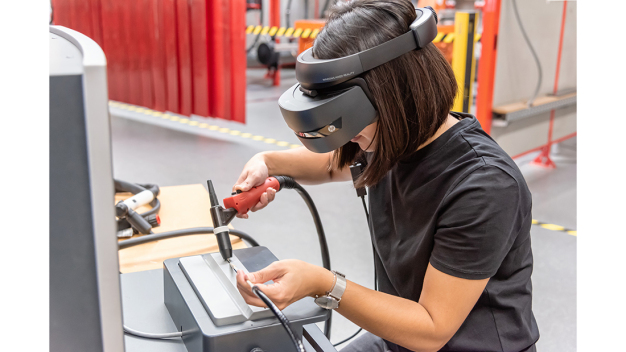
Fronius uses VR glasses that offer particularly high resolution and sharpness as well as a wide field of view. (Photo: Fronius International GmbH) / Fronius uses 3D glasses that feature a particularly high resolution and level of sharpness as well as a large field of vision. (Copyright: Fronius International GmbH)
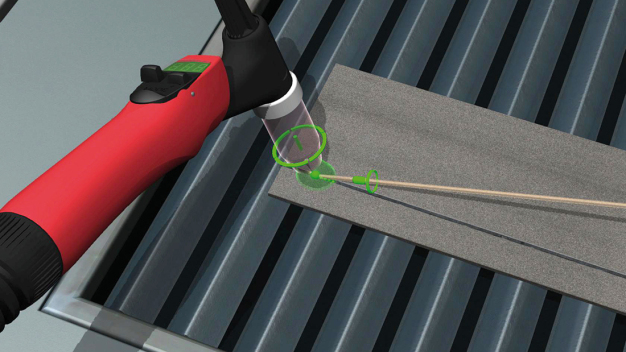
The so-called Ghost is the virtual trainer that indicates the correct welding speed, as well as the distance and tilt angle of the torch and filler metal relative to the workpiece using markings (shown in green in the image). (Photo: Fronius International GmbH)
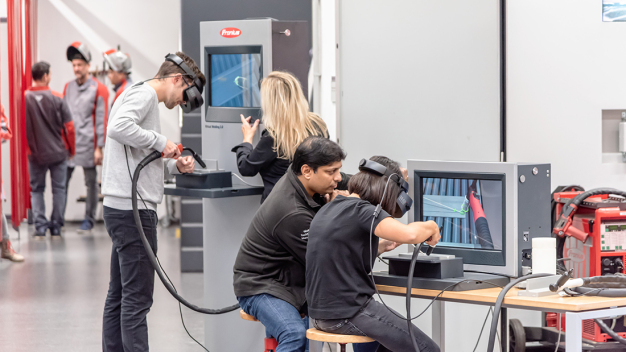
Virtual Welding is available in 2 versions (Standup Terminal or Mobile Case) and in over 20 languages. It can be used to learn manual MIG/MAG, TIG, manual arc welding, and MIG/MAG Robotics. (Photo: Fronius International GmbH) / Virtual Welding is available in two versions (StandUp terminal or Mobile Case) and more than 20 languages. It can be used to master manual MIG/MAG, TIG, manual metal arc welding, MIG/MAG Robotics. (Copyright: Fronius International GmbH)
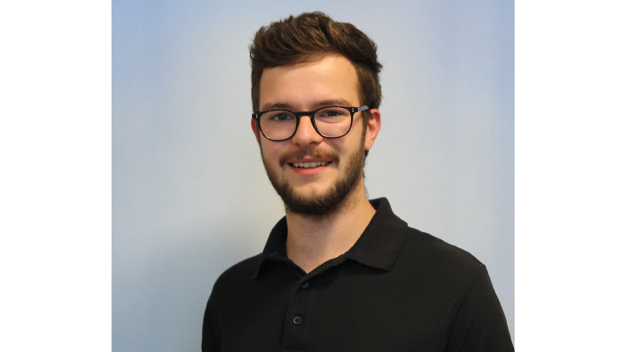
Philipp Schlor, Product Manager Virtual Welding, Fronius International GmbH. (Photo: Fronius International GmbH) / Philipp Schlor, Product Manager Virtual Welding, Fronius International GmbH. (Copyright: Fronius International GmbH)
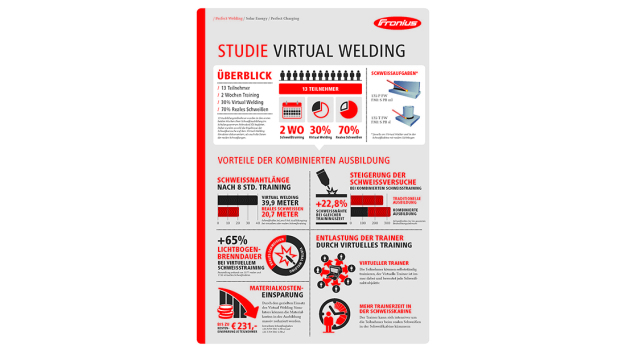
The infographic provides an overview of all the relevant information for the field study at the SZF Fohnsdorf. (Photo: Fronius International GmbH) / The infographic provides an overview of all the relevant information for the field study at the Fohnsdorf Training Centre. (Copyright: Fronius International GmbH)
No noise, no heat, no use of materials – Virtual Welding provides a totally safe and sustainable framework for training prospective welders. As with a flight simulator, 3D glasses and outstanding graphics provide a realistic welding experience, with the result being high-quality welder training that also saves money.
A holistic training approach to theory and practice
With Virtual Welding, Fronius has developed a well-thought-out training approach that includes imparting theoretical knowledge of the MIG/MAG, TIG, and MMA processes, which is also gaged in knowledge tests. A ranking list motivates students to gage their performance in relation to others.
The practical welding tasks in the Fronius Virtual Welding lesson plan are based on the training offered by the International Institute of Welding. This means that they correspond to the international standard for training welders.
Ghost: the trainer always by your side
To master the manual skills required, the trainee practices first with a virtual teacher, also referred to as the Ghost. Step by step, the Ghost specifies exactly the right welding speed, distance, and angle of the welding torch to the workpiece. Trainees therefore receive direct feedback from the Ghost. The degree of difficulty of the task gradually increases until welding is eventually being performed without the Ghost in realistic simulation mode. With Virtual Welding, the welding operations are recorded, and can be subsequently played back and analyzed together with the real trainer.
This combination of guided practical exercises and theoretical units allows the trainee to use the welding simulator to independently complete many of the training phases. In this way, trainees master the basic knowledge and the essential manual skills before working with a real welding system. Training equipment can therefore increase training quality and reduce costs at the same time.
Field study: Fohnsdorf Training Center
The Fohnsdorf Training Center, SZF for short, is one of the most modern and innovative facilities for professional training in Austria. The SZF has been using Virtual Welding in the metalworking sector since 2010, and 30% of practical welder training is now being carried out by means of simulation. As a result, this is a fixed component of the training content.
Research was conducted into what effects this has on the efficiency of the training by means of a field study. Data were analyzed from:
- 13 trainees
- 2 weeks training with 30% Virtual Welding and 70% real welding
- Fillet welds (135 P FW FM1 S PB ml) and fillet welds on pipes (135 T FW FM1 S PB sl), which were each welded in both a real and virtual environment
To determine the cost effectiveness of training using Virtual Welding, the metal, gas, welding wire, and energy consumed by a total of 1,577 real weld seams were also analyzed and compared with data from 1,733 virtual weld seams.
Improved training quality: 23% more practice time
With Virtual Welding, the SZF was able to increase the time actually spent welding by 23 percent. This means that more than three times as many seams can be produced virtually than by spending the same amount of time in the welding cabin. The main reason for this is that with virtual welding, there is no time-intensive preparation of test sheets, nor the need for cooling the metal sheets and cleaning the weld seams. A simulated weld seam only requires a click, leaving more time for mastering and practicing the required manual skills.
But it is not only the practice time that increases: “First of all, we see the use of Virtual Welding as an important contribution to improving training quality. The Ghost gives every student individual support and direct visual feedback – something that a real trainer simply cannot achieve,” says a convinced Hannes Krempl, trainer in welding technology/transport at SZF.
Cost saving: material costs reduced by €230
As well as improving the quality of the training, the welding simulator also increases the cost efficiency: by saving on consumables such as gas, wire, and metal sheets, training becomes far more cost effective. “The targeted use of Virtual Welding saves us in total around 230 euros in the cost of materials per student – despite the increased arc time,” calculates Krempl. Including virtual training guarantees that the welder training will be enormously effective, and use fewer resources.
Fronius International GmbH
4643 Pettenbach
Austria