



- Cleaning | procedures, devices, agents, media (Wipers, Swaps,...)
- Translated with AI
Water treatment: Nanotubes capture steroid hormones
Researchers at KIT investigate removal of microcontaminants in electrochemical membrane reactor with carbon nanotube membrane
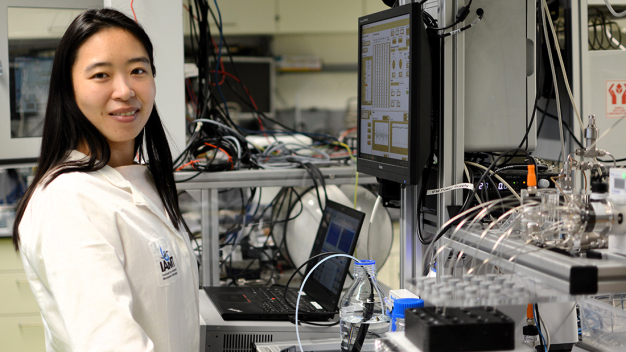
At IAMT, Dr. Siqi Liu researches electrochemical oxidation and membrane separation for water treatment. (Photo: IAMT, KIT)
Steroid hormones are among the most common microcontaminants in water. They harm human health and disrupt the ecological balance of water bodies. Researchers at the Karlsruhe Institute of Technology (KIT) have investigated how the breakdown of steroid hormones works in an electrochemical membrane reactor with a carbon nanotube membrane. They found that the adsorption of steroid hormones onto the carbon nanotubes does not limit their subsequent degradation. The scientists report their study in Nature Communications (DOI: 10.1038/s41467-024-52730-7).
Providing clean water to people worldwide is one of the major challenges of the present and future. Wastewaters contain various microcontaminants, meaning organic and inorganic substances that occur in low concentrations but can still adversely affect human health and the environment. Particular risks come from endocrine-disrupting substances, which can affect the hormonal system, such as steroid hormones. These are widely used in medicines and contraceptives. They are difficult to detect in water but can seriously disturb human health and the ecological balance of water bodies.
Oxidation enables the breakdown of microcontaminants
Conventional water treatment methods cannot detect or remove steroid hormones. An advanced approach increasingly recognized is electrochemical oxidation (EO): EO systems consist of an anode and a cathode connected to an external power supply. The electrical energy of the electrodes is modulated, leading to oxidation at the anode surface and breaking down contaminants. Electrochemical membrane reactors (EMRs) utilize EO more effectively: a conductive membrane serves as a flow-through electrode, improving substance transport. Additionally, active sites for reacting molecules are fully accessible.
Carbon nanotubes possess unique physical and chemical properties
Researchers at the Institute for Advanced Membrane Technology (IAMT) of KIT, together with scientists from the University of California, Los Angeles, and the Hebrew University of Jerusalem, have now further elucidated the complex mechanisms in EMRs: As reported by the researchers in the special issue "Water Treatment and Harvesting" of the journal Nature Communications, they examined the breakdown of steroid hormone microcontaminants in an EMR with a carbon nanotube membrane. Carbon nanotubes (CNTs) have diameters in the nanometer range and possess unique physical and chemical properties: "Their high conductivity enables efficient electron transfer," explains Andrea Iris Schäfer, Professor of Water Process Engineering and head of the IAMT at KIT. "Thanks to their nanostructure, CNTs have an extraordinarily large surface area and thus enormous potential for adsorbing various organic compounds, which facilitates subsequent electrochemical reactions."
In their study, the researchers used state-of-the-art analytical methods to investigate the complex interplay of adsorption and desorption, electrochemical reactions, and the formation of by-products in an EMR. "We found that the prior adsorption of steroid hormones, meaning their accumulation on the surface of the CNTs, does not restrict the subsequent degradation of the hormones," reports Dr. Siqi Liu, postdoctoral researcher at IAMT. "We attribute this to rapid adsorption and effective substance transport." The analytical approach of the study also makes it easier to determine the factors limiting hormone degradation and changing conditions. "Our investigation clarifies some fundamental mechanisms in electrochemical membrane reactors and provides valuable insights for further developing electrochemical strategies to eliminate microcontaminants in water," Schäfer summarizes. (or)
Original publication:
Siqi Liu, David Jassby, Daniel Mandler, Andrea I. Schäfer: Differentiation of adsorption and degradation in steroid hormone micropollutants removal using electrochemical carbon nanotube membrane. Nature Communications, 2024. DOI: 10.1038/s41467-024-52730-7
Karlsruher Institut für Technologie
76131 Karlsruhe
Germany