




- Ultrapure media (water, ...)
- Translated with AI
Water treatment: Light aids in the breakdown of hormones
Researchers at KIT use titanium dioxide-coated polymer membranes for photocatalytic cleaning – Nature Nanotechnology publishes results
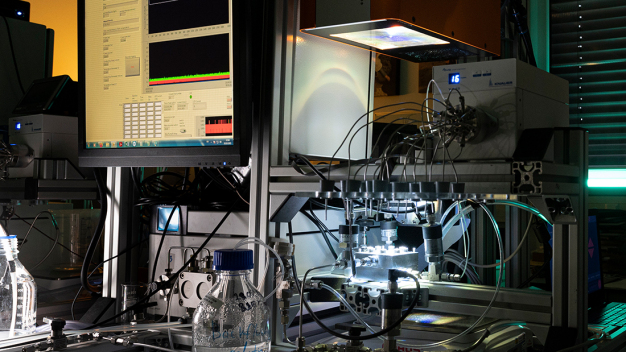
Photocatalytic membrane filtration system with solar simulator. The membranes are coated with titanium dioxide. (Photo: Markus Breig, KIT)
Micropollutants in water often consist of hormones that accumulate in the environment and can negatively affect humans and animals. Researchers at the Karlsruhe Institute of Technology (KIT) and the Leibniz Institute for Surface Modification (IOM) in Leipzig have developed a process for the photocatytic degradation of these pollutants in a flow-through system using polymer membranes, and have presented it in the journal Nature Nanotechnology. By irradiating with light that triggers a chemical reaction, steroid hormones are broken down on membranes coated with titanium dioxide.
Wherever people live, hormones used in medicines for contraception and in agriculture enter wastewater. Steroid hormones such as sex hormones and corticosteroids can accumulate in the environment and have negative effects on humans and animals by impairing behavioral development and reproductive capacity. For example, sex hormones can cause male fish to develop female sexual characteristics. Therefore, it is especially important to remove hormones from wastewater, along with other micropollutants, before they re-enter the natural water cycle from which drinking water is sourced. "Providing people with clean drinking water is one of the most important challenges of our time worldwide," says Professor Andrea Iris Schäfer, head of the Institute for Advanced Membrane Technology (IAMT) at KIT. "Trace pollutants pose a huge threat to our future because they impair our fertility and brain function."
Inspiration from Solar Cell Technology
Schäfer has been working for years on water treatment via nanofiltration. For this, she uses polymer membranes with nanometer-sized pores. However, nanofiltration operates under high pressure and therefore requires a lot of energy. Additionally, micropollutants can accumulate in the polymer membrane materials and gradually pass into the filtered water. Even if the removal of pollutants is fully successful, this process produces a stream with concentrated contaminants that must be further treated.
Inspired by solar cell technology, which is also studied by Professor Bryce S. Richards at KIT, Schäfer came up with the idea of coating polymer membranes with titanium dioxide to develop photocatytic membranes: Photocatalytically active titanium dioxide nanoparticles are applied to microfiltration membranes, which have slightly larger pores than nanofiltration membranes. When irradiated with light that triggers a chemical reaction, steroid hormones are broken down on the membranes. Schäfer and her team at IAMT of KIT, together with colleagues at the Leibniz Institute for Surface Modification (IOM) in Leipzig, realized this idea and introduced the new technology in the journal Nature Nanotechnology.
Catalyst for Water
"We have essentially developed a catalyst for water," Schäfer summarizes. Using the photocatalytic polymer membranes, they managed to remove steroid hormones in a continuous flow to such an extent that the analytical detection limit of four nanograms per liter was reached — values that even came quite close to one nanogram per liter, aligning with the new WHO drinking water guidelines. The researchers are working to further develop their technology to reduce the time and energy required, as well as to enable the use of natural light. Most importantly, further research aims to break down other pollutants using photocatalysis, such as industrial chemicals like per- and polyfluoroalkyl substances (PFAS) or pesticides like glyphosate. Another challenge is to implement the technology on a larger scale." (or)
Original Publication
Shabnam Lotfi, Kristina Fischer, Agnes Schulze, and Andrea I. Schäfer: Photocatalytic degradation of steroid hormone micropollutants by TiO2-coated polyethersulfone membranes in a continuous flow-through process. Nature Nanotechnology, 2022. DOI: 10.1038/s41565-022-01074-8
Abstract at https://www.nature.com/articles/s41565-022-01074-8
Background of the publication: https://engineeringcommunity.nature.com/posts/catalyst-for-water-removing-steroid-hormone-micropollutants-in-flow-through-photocatalytic-membrane
Karlsruher Institut für Technologie
76131 Karlsruhe
Germany