- Battery
- Translated with AI
Water Shock Test System for Lithium-Ion
Weiss Technik equips certification testing center
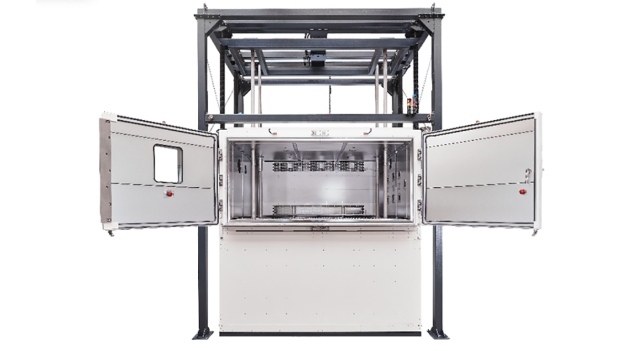
The testing system was installed in a pit provided by the customer, ensuring level access to the testing room.
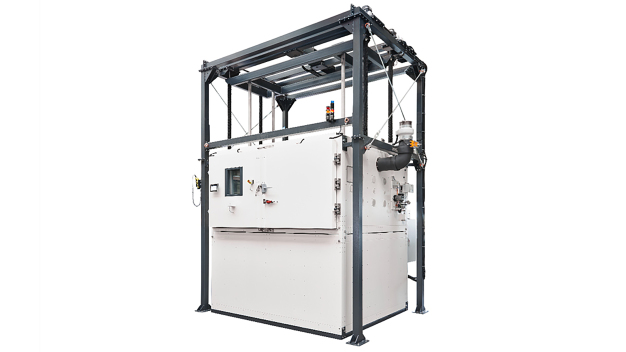
During the ice water shock tests according to LV 124 K13, the heated test specimens are immersed into the basin beneath the test chamber within seconds.
For the new test laboratory of an internationally leading certification body, a system was required for conducting water shock immersion tests on large batteries in the e-mobility sector. Weiss Technik developed and supplied a solution that enables, among other things, testing according to LV 124 K13, ISO 16750-4 (immersion test), and ISO 20653 (IPX7 immersion test).
Special equipment for a new multi-test center
A major certification body was seeking a specialist to install a water shock testing system. This facility was intended for testing lithium-ion batteries for electric vehicles in accordance with test and standard specifications LV 124 K13, ISO 16750-4, and ISO 20653. Based on years of experience with testing equipment in the automotive sector, Weiss Technik developed a customized system concept suitable for both series-like test samples and prototypes.
Complex test setup for lightning-fast cooling
LV 124 is a comprehensive testing regulation in the automotive field, including the test section K-13 "Temperature Shock Immersion." The test sample is first heated to its maximum operating temperature. Then, within just five seconds, it is immersed in a saltwater bath (5% NaCl) at about 0 degrees Celsius for five minutes. After removal, the sample is reheated and immersed again (20 cycles). A particular challenge is to control the descent of the heavy test sample, weighing up to 1,200 kg, within the prescribed five seconds. Weiss Technik was able to draw on experience with similar systems and develop a safe and reliable solution.
Unique system in impressive dimensions
Only a few test centers worldwide have such a large testing system with dimensions (WxDxH) of 6,680 x 5,500 x 5,100 millimeters for standards-compliant tests according to K-13. Due to the height of the system, it was recommended to either build it over two accessible levels or install it in a pit to allow for level entry of the test sample. Because of the corrosive atmosphere, the test chamber and fixtures must be made from high-alloy, corrosion-resistant materials.
Rapid lowering of connected test samples
The testing system consists of four main components: the air space, the actual test chamber, a water basin beneath it, the steel structure, and the machine unit positioned behind the system. The test sample is fixed on a lifting platform and, after heating, is lowered evenly into the water basin using electric drives. The drive technology is designed so that any shift in the test sample's center of gravity does not affect movement. Additionally, the system features an energy feed for the test sample, ensuring secure guidance of the cables during vertical movement. This allows continuous contact and monitoring of the test sample in various operational modes during testing.
Additional specifications
The platform on which the test samples are fixed measures 2,900 x 1,900 millimeters and allows maximum test sample dimensions of (WxDxH) 2,500 x 1,700 x 750 millimeters. The maximum permissible immersion volume is 3.18 m³, and the maximum test sample weight is 1,200 kg. The heating rate in the test chamber is 2 Kelvin per minute. The water basin is equipped with a cooling device and a circulation pump to maintain a constant water temperature of approximately 0 degrees Celsius. The testing system can be seamlessly integrated into existing building management systems via standard interfaces.
Weiss Technik for proven testing technology
The delivered testing solution is based on a proven system concept and Weiss Technik's many years of experience as a specialized partner for the automotive industry. Equipped with a S!MPAC control system and web-based season connection, the testing system allows easy programming of test sequences, offers multi-user functionality, and enables worldwide access via tablet or PC. The sophisticated air guidance ensures high temperature stability within the test chamber.
Safety equipment for lithium-ion batteries
The testing system enables tests of batteries up to Hazard Level 6. Weiss Technik, together with the testing center, developed a safety concept that includes both factory-installed components and on-site safety measures. The system is equipped with visual and acoustic alarm functions, as well as an electrical door lock to prevent unauthorized opening during tests or in case of test sample failure. Additional safety features include pressure relief valves, fresh air ventilation, and CO and CH gas detection. Furthermore, the system must be installed in a dedicated fire compartment. For cooling the test chamber during a thermal runaway, a water high-pressure fog system should be planned on-site.
Seamless project implementation
The system was developed in collaboration with partner companies and assembled in Middle Hesse. After an intensive factory test run, it was disassembled into several components for transport. The division into individual parts was designed so that the system could be quickly assembled on-site and put into operation promptly.

Weiss Klimatechnik GmbH
Geräte- und Anlagenbau
Greizer Str. 41-49
35447 Reiskirchen
Germany
Phone: +49 6408 846500
email: info@weiss-technik.com
Internet: http://weiss-klimatechnik.com