




- Translated with AI
Water or land? Completely irrelevant – plants control photosynthesis independently of their origin uniformly
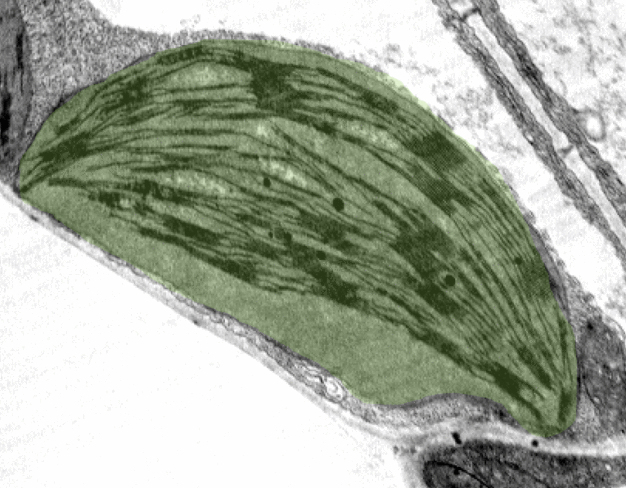
Microscopic image of a chloroplast where photosynthesis takes place. (Photo: Dr. Alexander Hertle, MPI for Molecular Plant Physiology)

Junior Professor Dr. Felix Willmund (Photo: TUK)
Plants carry out photosynthesis and thus form the basis for most life on Earth. Researchers from Kaiserslautern and Potsdam have now investigated whether the production of photosynthesis proteins differs between land plants and algae. To do this, they examined translation; the process by which genetic information is converted into proteins. They discovered that all plants produce the same amounts of these proteins, but sometimes with different strategies. The results show how important these proteins are for plants, regardless of their habitat. The findings of the study can help make crops more resistant to climate change. The work has been published in the journal Nature Plants.
During photosynthesis, plants produce carbohydrates from CO₂ using light energy. In the process, they also release oxygen. This biochemically complex process takes place in the chloroplasts; small green organelles that have their own genetic material. “It also contains the genes for the proteins involved in photosynthesis,” says Junior Professor Dr. Felix Willmund from the Department of Eukaryote Genetics at the Technical University of Kaiserslautern.
To "convert" this genetic information into proteins, a copy of the genetic material, ribonucleic acid (RNA), is first created. “The copy serves as a kind of blueprint, with which large molecular complexes, the ribosomes, assemble proteins from individual amino acids,” says first author Dr. Raphael Trösch, who researches in the Willmund group on the Kaiserslautern campus. This process is also called translation.
In the current study, Trösch and Willmund, along with colleagues including Dr. Reimo Zoschke from the Max Planck Institute for Molecular Plant Physiology (MPI-MP) in Potsdam-Golm, investigated whether there are differences in this process among evolutionarily distant land plants and algae. They compared these molecular processes in a green alga, the tobacco plant, and the common mallow using a new method. This method is called ribosome profiling. With this technique, researchers look at the RNA and ribosomes present during translation. Similar to a fingerprint, ribosomes leave traces on the RNA, allowing scientists to create a characteristic picture showing which proteins are produced and in what quantities. The special thing about this: “With this technique, we get an overview of the entire translation process but can also examine details more closely,” says Zoschke, who leads the translation regulation group in plants at MPI-MP.
“In all three plant species, we found that the same amounts of proteins are produced during translation that play a role in photosynthesis,” says Zoschke. However, the researchers also found that there are differences in the molecular processes that occur before and during translation. “Nevertheless, the different plants have developed mechanisms over the course of evolution to produce the same photosynthesis components in equal amounts during translation,” says Willmund. “This shows the central importance of these molecules.”
The work was conducted within the Collaborative Research Center (SFB Transregio TRR175) “The Green Hub – The Chloroplast as the Center of Acclimation in Plants,” which has been funded by the German Research Foundation since 2016. Research teams from Berlin, Potsdam-Golm, Munich, and Kaiserslautern are investigating how plants manage to adapt to changing environmental conditions.
The results of the current study also show that plants with different strategies repeatedly manage to achieve a very similar photosynthesis process despite various living conditions. Therefore, it is important to study such fundamental processes to better understand which mechanisms plants use to cope with environmental influences such as extreme temperature or light changes. In the future, this knowledge should help make crops more resistant to climate change.
The study was published in the renowned journal Nature Plants: “Commonalities and differences of chloroplast translation in a green alga and land plants” DOI: 10.1038/s41477-018-0211-0
Technische Universität Kaiserslautern
67663 Kaiserslautern
Germany