

- Building technology
- Translated with AI
Dipl.-Wirtsch.-Ing. (TU) Jens Amberg, Geschäftsführer halstrup-walcher GmbH
Ventilation costs are allocated according to consumption
For variable flow rate and different usage times, the surface key has become obsolete.
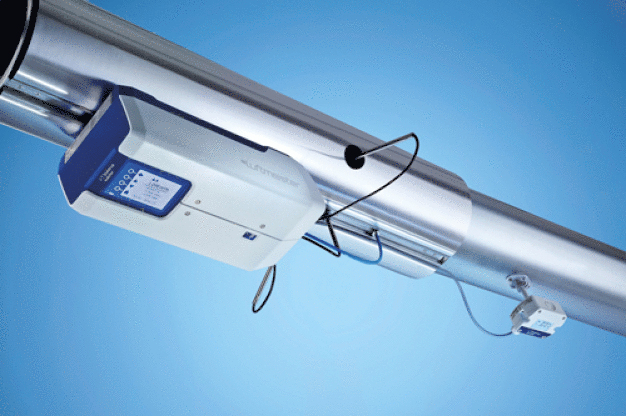
Fig. 1: Capture with the Luftmeister from halstrup-walcher Luftenergie and bill according to consumption.
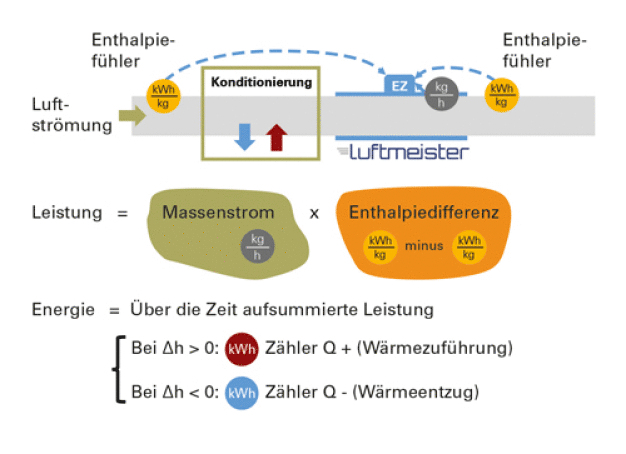
Fig. 2: Measurement of the thermal air output and energy by the air master EZ.
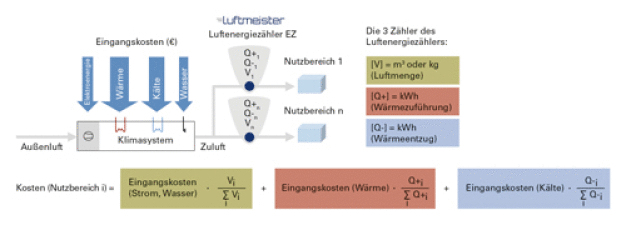
Fig. 3: Consumption-dependent ventilation cost billing using air energy meters.
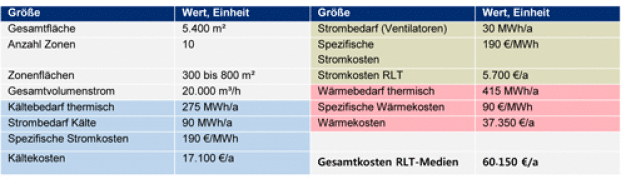
Tab. 1: Ventilation Cost Indicators of the Example Building (Usable Area).
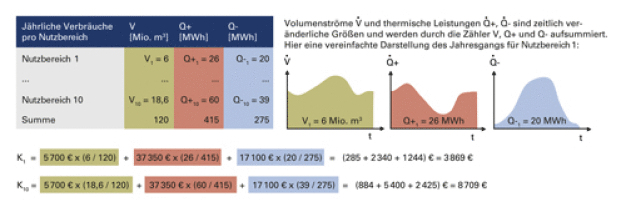
Fig. 4: Example of a consumption-dependent ventilation cost billing using air energy meters.
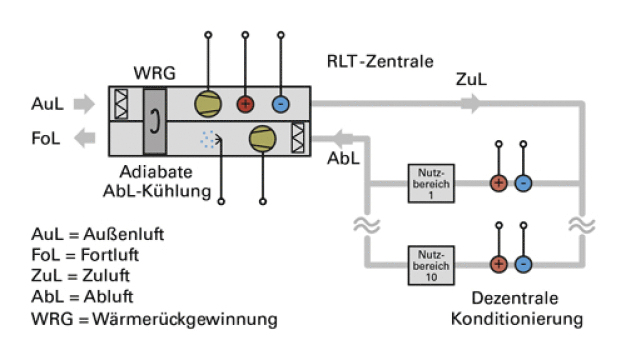
Fig. 5: System diagram of the example project (office complex with 10 rental zones).
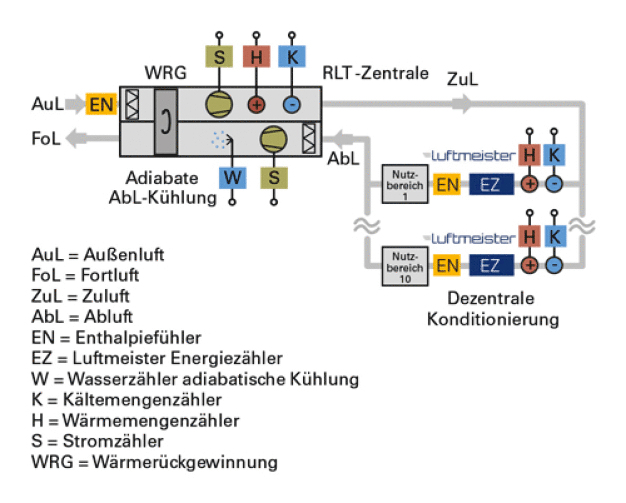
Fig. 6: Measurement point concept of the example project.
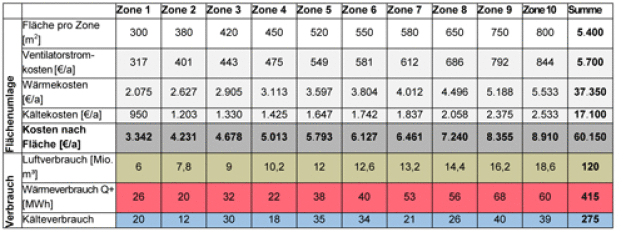
Tab. 2: Comparison of area-based and consumption-based ventilation costs (*The comparison refers to an initial billing year and does not yet account for the savings that will occur in subsequent years).
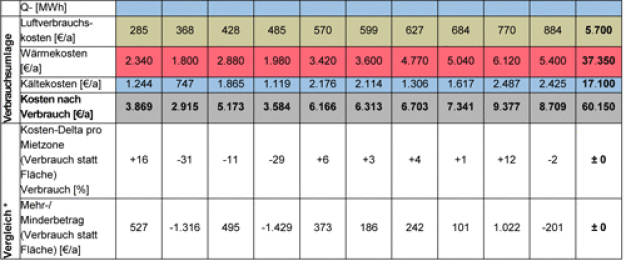
Tab. 2: Comparison of area-based and consumption-based ventilation costs (*The comparison refers to an initial billing year and does not yet account for the savings that will occur in subsequent years).
For many years, it has been customary to distribute ventilation costs of air handling systems based on the floor area, provided multiple users share a common air handling system.
In medium and large industrial complexes/buildings, large volumes of air are moved. Their verification is usually only carried out during commissioning, not during ongoing operation. This is where the measurement solution "Luftmeister" by halstrup-walcher comes into play. Based on precise volume and mass flow measurements in the air duct, not only is the amount of air flowing through summed up. Using enthalpy or temperature sensors, the thermal energy transferred via the air duct is also determined. With this continuous consumption and energy flow information, the entire air technology system, especially its heat recovery, can be integrated into operational energy management.
Consumption-based Ventilation Cost Distribution – Based on the new VDI 2077 Part 5
For over 25 years, the German Heating Costs Ordinance (Heizkostenverordnung) has mandated a consumption-dependent billing of heating costs when a heating system is used collectively. So far, there are no laws, regulations, or guidelines in ventilation and air conditioning technology that require similar regulations for ventilation cost billing.
A guideline group of the VDI is working to close this gap. A corresponding directive, VDI 2077 Part 5, is currently being developed. A more detailed and final presentation of the guideline contents can only be provided after its upcoming publication. However, industry consensus suggests that the following should apply:
New air handling systems that are used collectively AND
• Their individual users have variable volume flows over time OR
• Their individual users have different usage times,
require an air measurement concept that allocates ventilation costs based on consumption. For existing systems, a consumption-based allocation can also be agreed upon, but this will likely be left to the discretion of the contractual parties.
But how can the floor area distribution be practically replaced by a consumption-based measurement? VDI 2077 Part 5 will include a case distinction for this purpose. Special attention is given to the so-called "air energy meter," which is demonstrated using the Luftmeister® by halstrup-walcher.
Functionality of the halstrup-walcher Luftmeister® EZ (Air Energy Meter)
In 2016, the measurement technology specialist halstrup-walcher launched the first "air energy meter" on the market with the Luftmeister® EZ. It can measure the flow rate in climate or process air ducts with high accuracy, specifically the volume flow and also the mass flow. This flow value is continuously accumulated, resulting in a so-called "air meter" V (measurement units: [kg] or [m³]). (see Fig. 1)
Additionally, the Luftmeister® EZ measures the energetic content of the air via so-called "enthalpy sensors" EN 55. Figure 2 shows how it works: The Luftmeister® EZ multiplies the mass flow [kg/h] of the flowing air by the increase/decrease in enthalpy [kWh/kg]. In other words, it measures how much energy is added or removed between two points in the air duct system. The resulting thermal air power [W] is integrated over time (summed), producing a thermal energy value [MWh]. It distinguishes whether the enthalpy is increasing or decreasing. In the first case, the corresponding energy value is credited to the "heat supply account" Q+, and in the second case, to the "heat extraction account" Q-. This allows for each period to be determined how much heat or cooling cost can be allocated to each individual consumer.
Thanks to the three independent measurement sensors (air volume V, heat supply Q+, heat extraction Q-) of the Luftmeister® EZ, ventilation cost billing can now be designed to be very fair and precise. Specifically, as shown in Figure 3, the costs related to electricity, heat, and cooling can be allocated separately.
An optional, calibrated Luftmeister® will be available. Especially in complex billing situations, it will be helpful for all parties to have a legally secure billing basis. Additionally, it will be possible to implement "air contracting" based on calibrated meters – where the consumer pays the contractor only for the actual amount of air taken in and its effective conditioning.
Consumption-based Billing in Practice
Let’s consider a usage area with a total of 5,400 square meters of floor space. How are ventilation costs currently distributed based on area, and how would the situation change with a consumption-based cost distribution using the Luftmeister® EZ? The total area is divided into 10 usage zones, ranging from 300 to 800 square meters.
Table 1 shows the ventilation cost key figures derived from operations over the past years, and Figure 4 illustrates the application of the formula shown in Figure 3.
The air for the entire building is processed in a central air handling unit (AHU). Figure 5 shows the system diagram. In the AHU, a volume flow of 20,000 m³/h is pre-conditioned using recuperative heat recovery and adiabatic exhaust air cooling.
Subsequently, within a heating and cooling register, the conditioning within the AHU is completed. The climate conditions of the supply air volume flows can be individually adjusted within each usage zone to a permissible extent. Decentralized heating and cooling registers in the supply air duct ensure appropriate post-conditioning.
How can the floor area distribution be replaced by a consumption-oriented billing? Figure 6 shows the measurement points to be installed:
- Heat energy meters (H) sum the heat energy amounts [MWh] delivered by the AHU and to the individual usage zones (heating registers in the supply air ducts). These meters represent the energy supplied for warming the air.
- Cold energy meters (K) sum the cold energy amounts [MWh] delivered by the AHU and to the individual zones (cooling registers in the supply air ducts). These meters represent the energy removed for cooling the air.
- Water meters (W) measure the amount of water [m³] supplied for adiabatic exhaust air cooling. These meters also represent an energy removal for cooling the air.
- Electricity meters (S) record the electrical energy [MWh electric]. These meters represent the energy supplied to operate the fans.
All these meters record the input quantities. They are evaluated per billing period and assigned a respective euro amount per meter unit. These amounts are then allocated to the ten usage zones based on the consumption data from ten Luftmeister® EZ units and eleven enthalpy sensors.
Table 2 compares the area-based and consumption-based billing in the example project. For area-based billing, the cost contribution per square meter is calculated from past values (see Table 1). For consumption-based billing, the formulas shown in Figure 3 are used. For example, in Zone 1, the ventilation cost amount is about 16% higher than with area-based billing because relatively high cooling and heating energies were consumed in this zone. This results in an annual difference of approximately 527 euros.
Cost Savings Lead to Quick Amortization of the Luftmeister® Measurement System
With consumption-dependent billing, the respective "savings" are immediately tangible for each usage zone, whereas with area-based billing, the effect for individual users is hardly noticeable. Energy management is thus "internalized": each individual contributes to the overall savings through their user behavior – and benefits directly from the cost reductions.
What realistic savings can be expected over several years of practice, when consumers are presented with consumption-based costs in this manner? According to energy agencies, realistic savings of 10–25% are reported for other media. These savings are also achievable with the Luftmeister® in air handling systems,
- by enabling individual users to make more cost-conscious demands on climate conditions (less cold in summer, less warm in winter, fewer extreme humidity levels, and optionally, adjusted volume flows, e.g., reduced during off-peak times).
- by operators implementing control optimizations based on operational data from the Luftmeister®, e.g., regarding heat recovery functions.
Since the enthalpy measurement point relevant to each rental area is positioned directly in the supply air stream of the rental area, only the actual delivered useful energy and the useful air volume are billed. It is therefore (and this is fundamentally important for the "generation" of savings) in the operator's interest to supply this useful energy and air volume efficiently.
This provides the operator with an immediate motivation to ensure optimal equipment and control of the air handling system and to minimize losses along the air ducts.
With annual total costs of 60,000 to 150,000 euros, assuming the aforementioned 10 to 25% savings, the example project would save approximately 6,000 to 15,000 euros annually. A Luftmeister® system, for which the costs in the example project amount to around 25,000 euros, would thus be amortized in 1.5 to 4 years.
Additional Benefits of Using Luftmeister®
This rough calculation does not yet consider the additional benefits that the use of the "multitalent" Luftmeister® offers:
- Hygiene monitoring (flow, dew point distance, and filter monitoring)
- Flow regulation (in tandem with volume flow controllers)
- Energy management (providing energy flow data for continuous performance monitoring and optimization)
There are good reasons for investors and engineering firms to agree on deploying the Luftmeister®. Based on this, investors can demonstrate further arguments for the sustainability of their property. At the same time, planners know they are designing with future-proof technology in mind. And finally, operators and facility managers will welcome the ability to implement a fair, legally compliant, consumption-based ventilation cost billing.
halstrup-walcher GmbH
79199 Kirchzarten
Germany