
- EDP, Hardware, Software
- Translated with AI
Validated Data at the Point of Use: The Last Mile of Digital Pharmaceutical Production
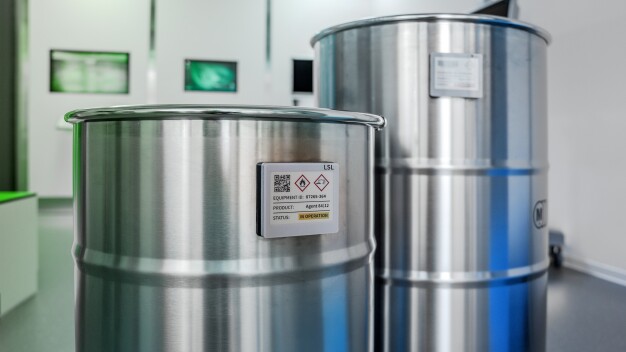
The digital labels display the data in real time at the place of use.
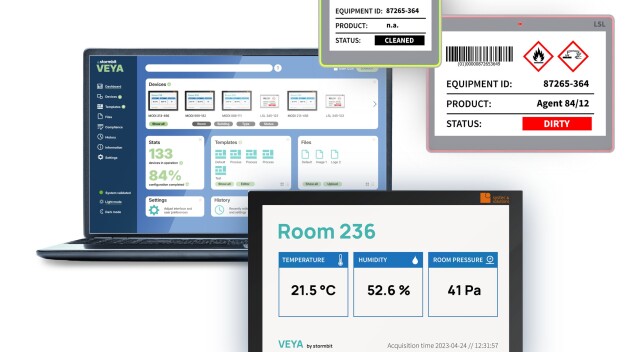
The VEYA solution consisting of the app, MODI display, and digital LSL labels.
Paper remains the biggest competitor to digital transformation.
The statement may come as a surprise in the age of digital production platforms. After all, pharmaceutical and biotech companies have invested heavily in MES, LIMS, EAM, EMS and ERP systems over the past two decades. Process data, batch information and equipment statuses are now often available digitally, maintained and validated.
However, a typical batch changeover shows where digitalisation often ends: In the MES, a batch is completed and the production suite is set to “cleaning.” Seconds later, a display at the cleanroom door shows the new room status, alongside the current temperature, humidity and differential pressure values from the Environmental Monitoring System (EMS). The E-Paper labels on the tank and bioreactor switch to “dirty.” The containers holding the intermediate product already display the batch and status from the MES, without a label having been printed. No operator had to log in at a terminal, and no paper notice had to be replaced. This is precisely where the benefits of modern manufacturing IT become apparent. The relevant information is usually already available and validated. The real challenge is to provide this data digitally rather than on paper wherever operators make decisions. MES and other production systems only deliver their full value when information is available without a media break at the cleanroom door, on the equipment or on the container.
All the necessary data is already available
As a rule, the problem is not a lack of systems. Modern MES solutions orchestrate processes, manage orders, batches and approvals, and provide the digital foundation for production. LIMS, EAM, EMS and ERP systems also supply the necessary information. The challenge often only arises after the data has been recorded. Validated data is available in the respective systems, but often does not reach the point of use digitally. Instead, paper, label printers or manual status notifications handle the last mile. According to Stormbit, nearly half of production sites in Europe and the United States still operate on a paper-based basis. Even companies with extensive MES, LIMS and ERP initiatives cannot completely eliminate paper. At one top-10 pharmaceutical company, around 25 percent of production processes are still paper-based. The consequences include media breaks, additional process steps, delays and potential risks of error.
The solution therefore does not lie in another layer of process control. Rather, the aim is to extend existing systems to the places where information is actually needed.
VEYA as an extension of the MES
VEYA pursues precisely this approach. The platform does not replace an MES and assumes neither process control nor batch logic. The MES remains the leading system for processes, approvals, orders and data storage. VEYA makes the validated data already available in the MES visible exactly where operators make decisions: at the cleanroom door, on the equipment and on the container. The platform does not generate new production data or create an additional data source. Instead, it extends the reach of existing systems to the point of use.
Technically, VEYA acts as a command centre between source systems and display media. Integration is carried out via standard interfaces such as OPC UA, REST API, MQTT, BACnet IP, databases or CSV files. The information is then displayed on cleanroom-compatible MODI LCD displays with 7- or 10.1-inch screen diagonals or on wireless LSL E-Paper labels, which can be attached directly to rooms, equipment or containers. The real added value lies in bringing together different data sources. An MES knows the order, batch and equipment status. An EMS provides temperature, humidity and pressure values. It is only at the point of use that this information is combined into an overall view that provides the operator with all relevant information at a glance.
Six fields of application for the digital last mile
The use cases available today all follow the same principle: Information already available from MES and similar systems is made visible directly at the place where things happen. Existing paper-based processes can thereby be eliminated.
1. Room identification
With digital room identification, information is displayed directly at cleanrooms and production suites. In addition to the room status, product and batch data from the MES as well as environmental parameters such as temperature, humidity or differential pressure from the EMS can be displayed. The benefit: Employees can see before entering a room whether it has been released, is occupied, in production or undergoing cleaning. Paper notices and manually maintained status signs thus become unnecessary.
2. Equipment labels
Tanks, bioreactors and other production equipment are identified using electronic labels or displays. The equipment ID, product, batch and current status are shown. If the status in the MES or electronic logbook changes from “clean” to “in operation” or “dirty,” the change appears immediately on the asset. Outdated paper tags and potential mix-ups can be avoided.
3. Container labels
For bulk and intermediate-product containers, the material number, batch and release status are automatically transferred from the MES or ERP. The identification is updated even when the container is already in the material flow. This eliminates label printing, manual label changes and time-consuming label reconciliation. This use case is particularly relevant for cleanroom processes: Since material, batch and status information is updated digitally, paper-based identification processes can be reduced and additional printing operations in the cleanroom avoided. In addition to efficiency gains, this can also reduce the risk of particle emissions from paper and printing processes.
4. Digital dashboards
Digital dashboards display production progress, order status or process KPIs directly on the shop floor. The information typically comes from MES, EMS or DCS systems. Shift teams receive an up-to-date overview of ongoing production without having to update printouts or log in at separate terminals.
5. Calibration labels
Electronic calibration labels can be used for equipment and measuring instruments subject to calibration requirements. These display the current status, the next due date and other compliance information. The data typically comes from EAM, CMMS or LIMS systems. Outdated paper stickers are avoided and critical deadlines are immediately visible.
6. Warehouse and inventory identification
Status and identification data can also be displayed digitally in the warehouse. Information from ERP, warehouse management or MES systems is updated automatically and displayed directly at storage locations or on materials. This eliminates repeated relabelling while ensuring that current inventory and status information is always available.
Compliance considered from the outset
For pharmaceutical and biotech companies, regulatory suitability is a priority alongside efficiency. VEYA therefore includes an audit trail, role concepts, approval processes and version control and is designed to meet the requirements of EU-GMP Annex 11. Since the platform does not generate its own production data but makes already validated data from the leading systems visible, validation efforts focus primarily on integrations, templates and display logic. The data itself remains in the source systems.
VEYA: Connected digitalisation for regulated GxP environments
With VEYA, Stormbit offers a platform that combines cleanroom-compatible hardware with flexible no-code software. This includes IP65-protected displays and wireless digital E-Paper labels, among other components. Through interfaces, VEYA can be seamlessly connected to existing systems such as MES, LIMS, EAM and ERP. This makes validated data available exactly where it is needed. A complete audit trail supports the requirements of Annex 11 in regulated GxP environments. VEYA was developed jointly with AbbVie and Fareva-Excella. Today, the platform is already in productive use in GxP environments, including at Takeda, Pfizer and Eli Lilly.

Systec & Solutions GmbH
Wilhelm-Schickard-Str. 9
76131 Karlsruhe
Germany
Phone: +49 721 663510
email: talk@systec-solutions.com
Internet: http://www.systec-solutions.com