

- R+D & Community of Interest
- Translated with AI
Universal weapon against machine standstills
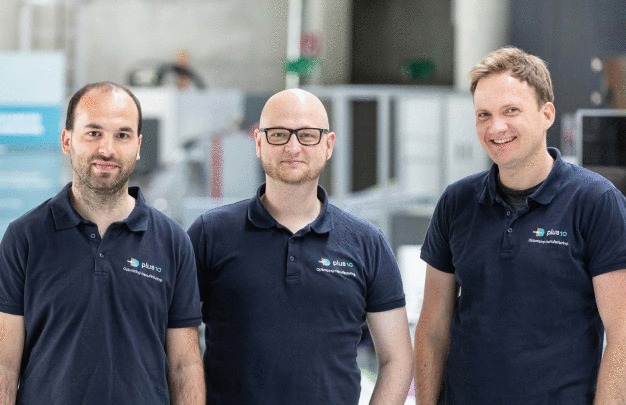
Thomas Hilzbrich, Pablo Mayer, and Felix Müller (from left) developed the "Smart System Optimization" and founded the start-up plus10 GmbH. (Source: Fraunhofer IPA / Photo: Rainer Bez)
Researchers at Fraunhofer IPA have developed an analysis tool that, thanks to self-learning algorithms, detects defects in high-speed manufacturing systems, assists with troubleshooting, and performs automated machine benchmarking. Now, the scientists are commercializing this technology themselves.
Especially the pharmaceutical and consumer goods industries operate with capital-intensive manufacturing systems and rely on constantly maximizing productivity. Otherwise, they face cost pressures and funding gaps. However, in practice, it is often said: "The more complex the system, the lower the productivity." This is succinctly summarized by Felix Müller, head of the Autonomous Production Optimization group at Fraunhofer IPA. Additionally, many manufacturing systems comprise numerous stations and operate so quickly that root causes of errors are not visible to the naked eye.
With the "Smart System Optimization," Müller and his team have developed an analysis tool that continuously detects errors and their causes in high-speed, interconnected manufacturing systems: A powerful connector accesses data in the machine control system via the respective manufacturer protocol at high frequency. This creates a continuous data basis that is evaluated synchronously by multiple self-learning algorithms. These algorithms precisely identify where errors occur in the manufacturing system, how they are interconnected, and what priorities they have for resolution. In this way, defects that could lead to system failure can be resolved more quickly or even predicted in advance.
The system learns continuously
However, it is not always clear what actions to take when a fault is imminent. Additional system messages can further complicate the situation for operators. For this reason, Müller and his team developed Shannon®, an intelligent operator assistance system for complex manufacturing systems built on the "Smart System Optimization." Previously, it was often up to machine operators to decide what to do to fix a fault. Now, however, the affected machine sends them a detailed step-by-step instruction via smartphone or tablet. The data basis and the links between disturbances and solutions are constantly expanded during system operation.
Operators can also create their own instructions, for example, for troubleshooting. These instructions can include text, photos, and videos. Furthermore, operators can provide feedback on the information provided, which is used to improve it. They are also actively encouraged to contribute knowledge, for instance, by describing detected but unknown events. Over time, this builds a clear, understandable, and comprehensively linked knowledge database consisting of errors, events, and solutions. Shannon® is currently in use as a tablet and smartphone app in several factories, where it has significantly shortened downtime for troubleshooting.
Efficiency increases of up to 18 percent
An automated machine benchmarking is also possible with "Smart System Optimization": Many production halls contain dozens of identical or similar machines performing the same processing cycle. Examples include injection molding, die casting, blow molding, or deep drawing machines. Although all are built the same, some operate slower than others. This is often due to wear of certain components, varying sensor behavior, different tool settings, or material fluctuations.
In machine benchmarking, the overall process of a machine is first defined and divided into individual steps. Then, the high-frequency connector at the machine control generates a data basis evaluated by a machine learning algorithm package. This happens simultaneously for all connected machines and is virtually merged into an ideal process flow. The tool immediately detects if a machine is running slower than intended and links this to a technical cause. Users can thus not only fix issues before they occur but also achieve an optimized cycle time for the connected machines by combining the best individual steps. Depending on the machine, previous prototype applications have achieved cycle time reductions between two and 18 percent. Even the fastest machine can become faster. The application has now been integrated into a continuously learning software called Darwin.
Researchers found a startup
Darwin, the intelligent machine benchmarking system, has already been used across multiple automotive suppliers and a injection molding machine manufacturer, even across different plants. Shannon® is already in use by major automotive and pharmaceutical companies. This prompted Felix Müller and his two co-founders, Thomas Hilzbrich and Pablo Mayer, to become independent with the "Smart System Optimization." Their startup, plus10 GmbH, currently maintains offices in Stuttgart and Augsburg and is launching operations today.

Fraunhofer-Institut für Produktionstechnik und Automatisierung IPA
Nobelstraße 12
70569 Stuttgart
Germany
Phone: +49 711 970 1667
email: joerg-dieter.walz@ipa.fraunhofer.de
Internet: http://www.ipa.fraunhofer.de