



- Translated with AI
TUK brings physics expertise to the table
Transregio Collaborative Research Center "Quantum Cooperativity of Light and Matter"
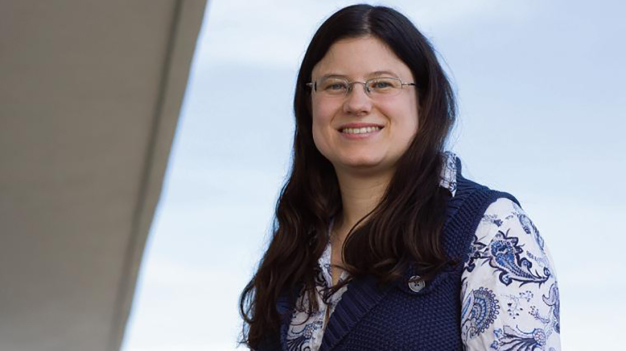
Elke Neu Ruffing
Swarm behavior, as we know it from birds and fish, serves as an inspiration for researchers in a recent project funded by the German Research Foundation (DFG). The goal of the transregional collaborative research center (TRR-SFB) "Quantum Cooperativity of Light and Matter," supported with 11 million euros, is to understand and harness cooperative behavior in the quantum world, ultimately to improve, for example, the performance or signal sensitivity of sensors. Several universities are networked across regions within the SFB. Junior Professor Elke Neu-Ruffing from TU Kaiserslautern (TUK), is involved with a subproject in this initiative.
The Friedrich Alexander University Erlangen-Nürnberg (FAU) forms the core team together with Johannes Gutenberg University Mainz (JGU) and Saarland University, in the new TRR-SFB "QuCoLiMa." The researchers investigate collective behavior in the quantum world. The phenomenon of swarm behavior known from the animal kingdom—meaning that cooperation produces effects that go beyond the sum of individual contributions—serves as the foundation. The focus is on interactions at the interface of quantum optics and condensed matter. Ultimately, the scientists aim within the framework of the TRR-SFB to find out whether and how cooperative behavior arises in the quantum world and how it can be controlled. The insights are expected to be applied, among other things, in secure communication technology, high-performance sensors, and computers.
"We bring a small number of atom-like particles into a closed system, a so-called resonator made of silicon carbide," explains Neu-Ruffing. "The light emitted by the particles is repeatedly reflected back to them, which ultimately leads to synchronized emission of light. The particles thus form a collective system together with the light. There have been studies on collective quantum systems before, but never in this new material system. With our approach, we can better understand how these effects arise and build upon that."
While the physicist from Kaiserslautern works with light, FAU is simultaneously investigating collective particle behavior in connection with mechanical vibrations. Johannes Kepler University Linz provides the theoretical foundation and calculates the effects of light and vibration in the closed systems or resonators.
An important role is played by silicon carbide as a "building material" for the resonators and for creating atom-like systems. "We use this chemical compound as a platform to closely align our systems with existing technology. Silicon carbide is already widely used in power electronics in the form of semiconductor components," says Neu-Ruffing. "The future vision is that our findings will enable the integration of quantum technologies with classical technologies."
Regarding future application scenarios, Neu-Ruffing cites quantum sensors as an example: "If a sensor behaves quantum mechanically, it is much more sensitive to incoming impulses from its environment," explains the physicist. "Diffuse signals, such as noise, can be measured much more effectively with such sensors." The joint research on collective quantum systems within the transregional collaborative research center QuCoLiMa aims to pave the way for unlocking such potential, for example, in sensor technology, as well as enabling advances in information and communication technology.
Questions answered by:
Junior Professor Elke Neu-Ruffing
Tel.: 0631 205-5788
Email: nruffing@rhrk.uni-kl.de
Technische Universität Kaiserslautern
67663 Kaiserslautern
Germany