



- R+D & Community of Interest
- Translated with AI
TRUMPF and Fraunhofer IPA bring artificial intelligence to industrial maturity
Research Partnership
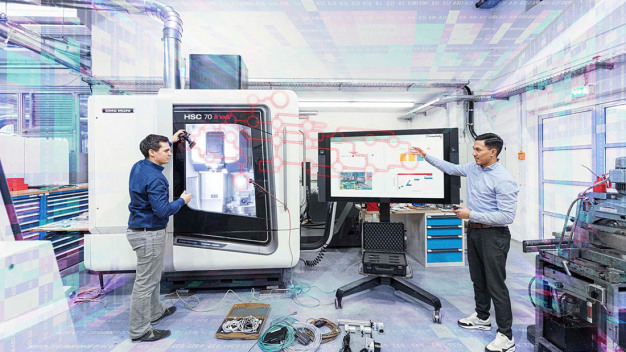
Smart Factory: TRUMPF and the Fraunhofer IPA have entered into a research partnership until 2025 to bring AI solutions in sheet metal manufacturing to industrial maturity. (Source: Fraunhofer IPA, Rainer Bez)
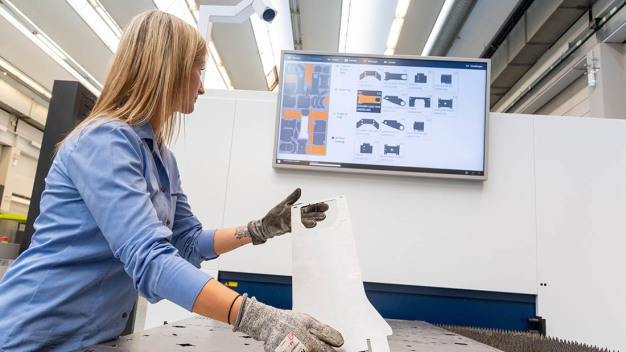
Sorting Guide: One result of the collaboration is the TRUMPF Sorting Guide, which uses AI to assist employees in removing laser-cut sheet metal parts. (© TRUMPF)

Dr.-Ing. Thomas Schneider is the Managing Director of Development at TRUMPF Machine Tools. (© TRUMPF)

Prof. Dr.-Ing. Thomas Bauernhansl is the head of the Fraunhofer IPA. (© Fraunhofer IPA)
TRUMPF and Fraunhofer IPA conclude research cooperation until 2025. The goal is to develop solutions for networked sheet metal manufacturing with Artificial Intelligence.
The high-tech company TRUMPF and the Fraunhofer Institute for Production Technology and Automation IPA in Stuttgart have agreed on a research cooperation until 2025. The aim is to bring solutions for connected manufacturing with Artificial Intelligence (AI) to industrial maturity. The funding amount for the project over the next five years is around two million euros. A total of ten employees from TRUMPF and Fraunhofer IPA are involved in the projects. »TRUMPF wants to further expand its leading position in AI in sheet metal manufacturing. That’s why we are already investing in future technologies today that help companies achieve significant efficiency gains and increase their competitiveness,« says Thomas Schneider, Managing Director of Development at TRUMPF Machine Tools. TRUMPF and Fraunhofer IPA have been working together on the topic of Smart Factory for five years and also plan to continue previous projects as part of the new research partnership. »For years, TRUMPF has been working with us on connected production because the company – like us – recognizes the developments around Industry 4.0 as a great opportunity. The next few years will therefore be so exciting because they will decide everything. We expect that the COVID-19 pandemic will act as a catalyst here: those who are prepared will be able to massively exploit the opportunities that arise from it. Now it will also become clear whether we have prepared ourselves well for the future with our work in the joint projects,« says Professor Thomas Bauernhansl, Director of Fraunhofer IPA.
Future projects to make AI explainable
In the next five years, TRUMPF and Fraunhofer IPA aim to develop solutions for better data quality in production. High-quality data is a prerequisite for achieving efficiency improvements with AI. In this context, the partners are increasingly researching the topic of »Explainability of AI« (English: Explainable Artificial Intelligence, XAI). The goal is to make the workings of neural networks understandable. Such results are of great benefit for sheet metal manufacturing. The data analysis results can improve production quality and save costs and time.
New solutions are close to market maturity
The collaboration between TRUMPF and Fraunhofer IPA on digital manufacturing began in 2015. First results are now approaching market readiness. This includes the »Sorting Guide« assistance system from TRUMPF, which supports employees in sorting laser-cut sheet metal parts. The AI solution recognizes the pick-up process and automatically provides the worker with all necessary information for intralogistics. It clearly displays related sheet metal parts in different colors, for example based on the order, customer, or subsequent processing step. In this way, the solution replaces accompanying papers, saves time, and helps avoid errors. To build on these successes, the partners are continuing the strategic cooperation.
Data quality for production planning and control in sheet metal manufacturing
There is a long-term research cooperation between Fraunhofer Institute for Production Technology and Automation IPA and TRUMPF Machine Tools, working on various projects for the future of sheet metal manufacturing. The cooperation itself focuses on TRUMPF’s customers: they are to improve their service offerings through the results and thus better support their own customers.
Customer requirements for sheet metal processing
Customers of sheet metal manufacturers have the following requirements: The sheet metal production is often customer-specific and frequently as single or small series. Motivated by online retail in the consumer sector, customers expect short delivery times with reliable deadline adherence; many also demand express orders. Additionally, there is high price pressure with constant or increased quality requirements.
Challenges of production planning and control for sheet metal manufacturers
A multitude of small orders with various production processes must be scheduled in terms of deadlines (and prices), monitored in real-time during order processing, and managed reactively. This is especially true for express orders, which should not jeopardize already committed deadlines.
Data quality as an enabler
Complete, current, and accurate movement and master data form the basis for effective production planning and control (PPC). This insight has been well known for a long time. However, in practice, it still proves surprisingly difficult to achieve or ensure adequate data quality: missing, incorrect, or late feedback on order progress or machine status remains typical.
Assessment of data quality
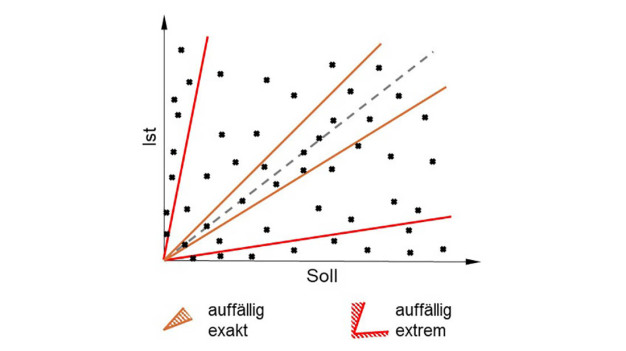
To objectively assess data quality, the project developed a data quality evaluation method and applied it anonymously both within TRUMPF and at TRUMPF’s customers. An illustrative example is the so-called »Starry Sky Analysis«. This compares pairs of target and actual values and visualizes the results. For example, the analysis of processing durations on a machine shows:
- Remarkably extreme: Target and actual values deviate significantly from each other (red area). These processes are therefore very uncertain: this either indicates technical causes such as processing at the technological limit or that employees do not consistently follow organizational rules (null values indicate joint processing and feedback of different work steps, so no actual times were reported for others).
- Remarkably precise: Along the bisector (yellow area), target and actual values deviate only slightly. Here, either measurement accuracy is too low or employees have manipulated the data so that supervisors are unlikely to ask questions.
Tracking systems to improve data quality
Organizational and technical measures are fundamentally possible. To relieve employees from the tedious and non-value-adding routine of feedback, the project continued to pursue the implementation of technical measures. The realization of the vision of largely automated movement data collection requires a suitable tracking system. This should track the order along its production path and provide the necessary information. The system developed by TRUMPF, Track & Trace, tracks the production process exactly to the order, replacing manual entry by the employee and significantly improving data quality. Only such an approach creates the foundation for improved PPC and paves the way toward self-controlled production.

Fraunhofer-Institut für Produktionstechnik und Automatisierung IPA
Nobelstraße 12
70569 Stuttgart
Germany
Phone: +49 711 970 1667
email: joerg-dieter.walz@ipa.fraunhofer.de
Internet: http://www.ipa.fraunhofer.de