




- Translated with AI
Tracking Weyl points: Publication by Kaiserslautern physicists as "editors' suggestion" published
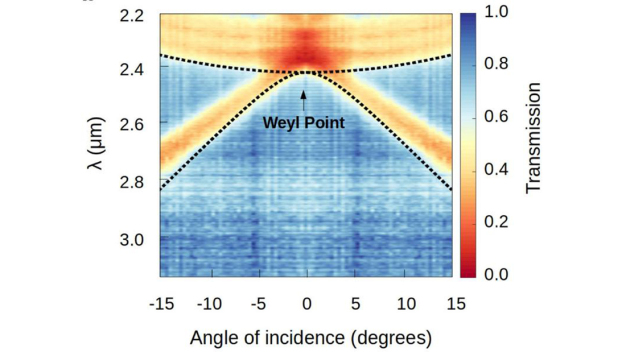
Weyl point experimentally demonstrated using Fourier-transform infrared spectrometer. Clearly visible is how the two bands touch. (Source: C. Jörg / S. Vaidya / J. Noh)
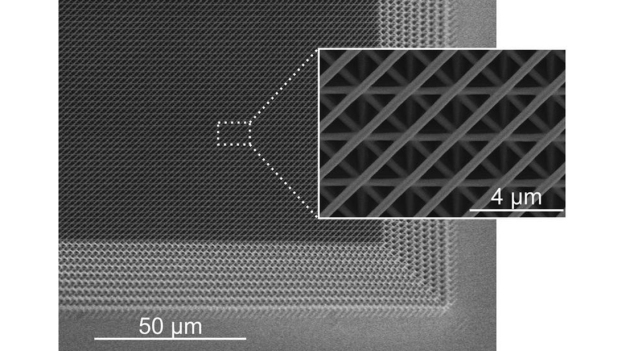
According to field emission raster electron microscopy, the chiral, woodpile-like structure of the photonic crystals becomes visible, which the researchers produced using two-photon polymerization and used for their investigations. (Source: C. Jörg)
A material that conducts and insulates – does it exist? Yes, researchers first described so-called topological insulators in 2005, which prevent current flow inside but are extremely conductive on the surface. The states that lead to the formation of three-dimensional solids around the disturbance points are again anchored at so-called Weyl points. A team of scientists at Pennsylvania State University (PSU) and TU Kaiserslautern (TUK) has recently succeeded for the first time in making these points visible with infrared light. Their publication has been featured as an "editors’ suggestion" in the journal Physical Review Letters.
Actually, Kaiserslautern physicist Dr. Christina Jörg would have liked to start her postdoctoral position in person at Pennsylvania State University in March. However, COVID-19 delayed the Humboldt Fellow. Instead, she was given the opportunity to start the postdoc "from home" and conduct her experiments at TUK in the "Optical Technologies and Photonics" working group led by Prof. Dr. Georg von Freymann. A fortunate coincidence, as it turned out. "I am continuing the research my colleagues in the USA have already begun, characterizing surface states and the associated optical Weyl points in topological photonic crystals," explains the physicist. "Due to the pandemic situation in the USA, laboratory work at Pennsylvania State University is limited. However, in Kaiserslautern, I have full access to the necessary equipment and measurement technology."
Jörg describes what makes topological insulators with an example: "In electronic or optical components, when conducting electricity or light, exactly what we know happens when we turn on high beams in fog: the light is scattered or particles of light bounce off the fog droplets and are reflected back. Transferred to the component, the signal to be conducted does not pass losslessly and weakens on its way."
In the case of topological insulators, it behaves differently. Here, signals can flow losslessly around internal disturbance points via the surface. "The special states that enable this diversion are always anchored at very specific points in the band structure – the roadmap that describes how signals can flow," Jörg further explains. "These are points where two bands touch. These points are called Weyl points. Topological Weyl points are extremely robust and insensitive to external influences. In optical materials, Weyl points have so far been difficult to access experimentally because observing them clearly requires a material contrast as high as possible."
The team used a special 3D printer to produce photonic crystals suitable for research with a total size of one square millimeter. For the first time, they were able to detect quadratic optical Weyl points using infrared light waves. An important milestone: "Even though we are not yet in the visible range, with these findings, we are significantly closer to a future application," summarizes Jörg.
The renowned journal Physical Review Letters is also convinced of the potential of the research work by the physicists from Kaiserslautern and America and has given the paper a prominent place in the current issue.
Information about the original publication:
Observation of a Charge-2 Photonic Weyl Point in the Infrared
Sachin Vaidya, Jiho Noh, Alexander Cerjan, Christina Jörg, Georg von Freymann, and Mikael C. Rechtsman
Phys. Rev. Lett. 125, 253902
DOI: 10.1103/PhysRevLett.125.253902
Questions answered by:
Dr. Christina Jörg
Tel.: 0631 205-5230
E-Mail: cjoerg[at]rhrk.uni-kl.de
Technische Universität Kaiserslautern
67663 Kaiserslautern
Germany