




- R+D & Community of Interest
- Translated with AI
Klaus Jacob
Tiny, highly precise, and sensitive - a challenge in every dimension
Business Field Electronics and Microsystems Technology
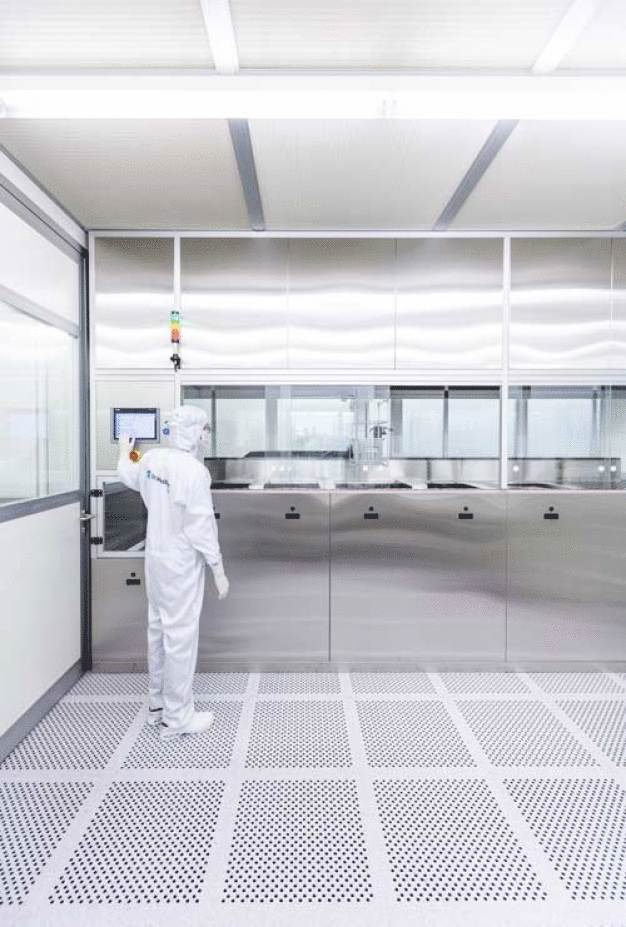
Ultrasound precision cleaning of components in a cleanroom of ISO 1 air cleanliness class.
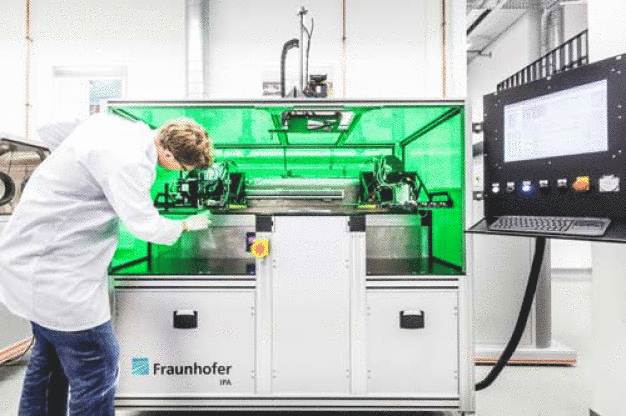
From replacement of conventional screen printing processes to generatively manufactured components and applications in the biomedical field – the possibilities of digital printing technologies are almost unlimited.
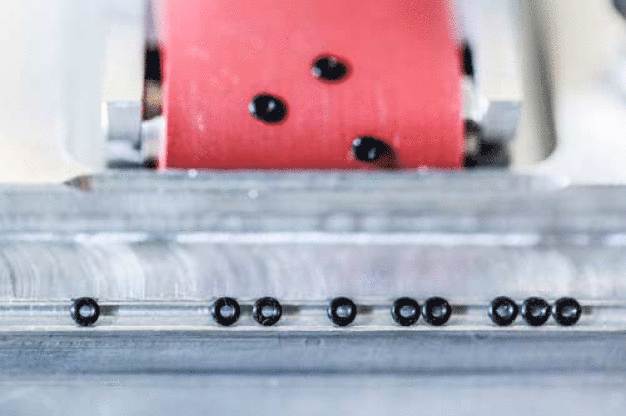
For contamination- and damage-free singulation, sorting, and feeding of sensitive micro-components smaller than 500 micrometers, Fraunhofer IPA utilizes surface effects in liquids. The parts to be processed are selectively transferred from a collection container onto the surface of the process liquid, which is set based on the fill level in the liquid reservoir. Gravity moves the floating parts toward the edge of the liquid against a removable stop edge, where the parts line up.
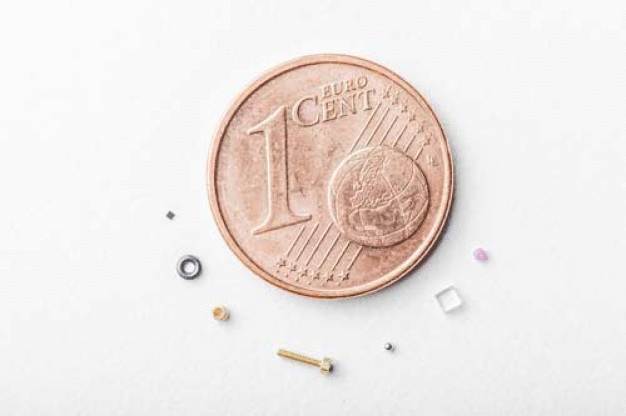
IPA.FluidSorting – Fluid-based separation and feeding of microtechnical components.
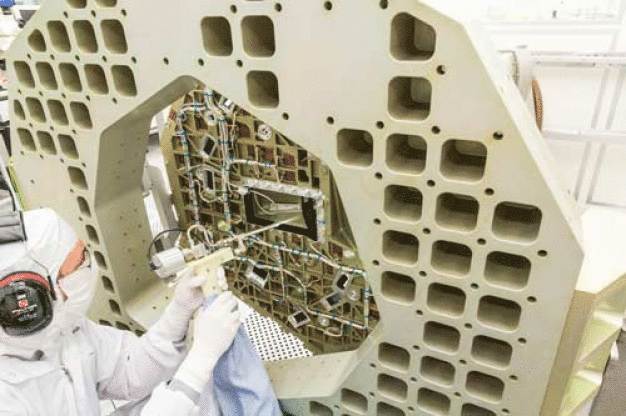
CO2 Cleaning Satellite
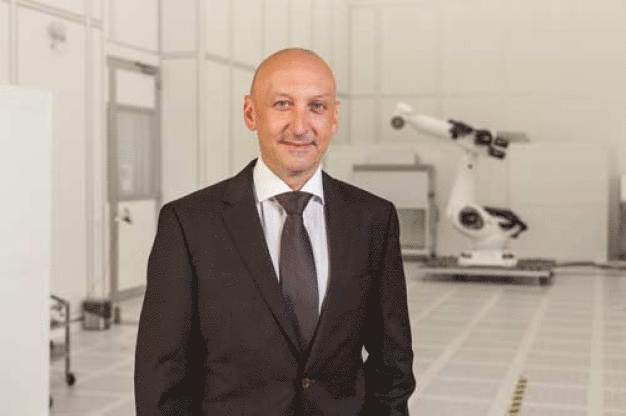
Dr.-Ing. Udo Gommel
The first PCs, which appeared on the market in the early 1980s, were bulky suitcases that offered little comfort. Today, every smartwatch on the wrist provides multiples of these dinosaurs. Miniaturization has reached a level that no one could have dreamed of a decade ago. A transistor on an integrated circuit is smaller than any bacteria, sensors measure only millimeters, and for a closer look at some tiny speck, a magnifying glass is needed. There are pacemakers the size of a pill and disposable laboratories for blood analysis, including pumps, valves, and channels that fit on a silicon chip. Tiny pico-satellites launched into space weigh hardly more than a piece of butter.
The tendency towards small and very small is especially evident in electronics and microsystem technology. "Miniaturization sets the highest demands on manufacturing and sometimes requires entirely new approaches," explains Dr. Udo Gommel, who led the business field until February 2016. Above all: It must be extremely clean. If a speck of dust can cause a total failure of a component or even an entire device, cleanliness is of the utmost importance. The processing and assembly at this level of miniaturization also require new technologies. For example, handling the tiny and sensitive components with conventional tools and methods is only feasible to a limited extent. Additionally, applying adhesives during assembly must be done with the highest precision. The staff in the "Electronics and Microsystems Technology" division face the challenges associated with manufacturing such products. They make a significant contribution to solving the production engineering questions of industry. This includes product approaches developed alone or together with partners, such as a compact radar scanner realized within the Fraunhofer network, which penetrates optical obstacles and sees clearly even in dust, smoke, fog, or rain.
World's Largest Research Cleanroom
The prerequisite for manufacturing hair-thin structures or processing the smallest components is a contamination-controlled environment, usually a cleanroom. To research and evaluate the dependencies of contamination behavior of production facilities and the achievable quality of the products produced, Fraunhofer IPA has, in addition to numerous analysis systems, the world's largest research cleanroom of ISO Class 1 with laminar displacement airflow. It covers approximately 150 square meters with a ceiling height of over 6 meters. With its heavy-duty design, it can accommodate not only very small end products but also, in combination, the usually large and heavy production systems weighing up to nearly 40 tons. One cubic meter of its air contains at most 10 particles of 0.1 micrometers in size, compared to 10¹³ particles in typical city air. The institute also possesses state-of-the-art equipment such as scanning electron microscopes, micro-CT scanners, or mass spectrometers, enabling it to measure contamination on components and assess and compare the effectiveness of various cleaning processes. It is no wonder that experts from Stuttgart sit on the important committees responsible for standardizing cleanliness and cleaning procedures.
Industry Associations "Cleanroom Suitable Consumables" (CSC) and "MediClean"
The importance of this topic for industry is demonstrated by the establishment of two new initiatives initiated by IPA. The industry association "Cleanroom Suitable Consumables" (CSC) concerns consumables used daily in cleanrooms, such as coveralls, gloves, masks, wipes, and similar items. The motivation: the best cleanroom is useless if it is constantly recontaminated by impurities released from consumables during proper use. So far, reliable rules or even comparative measurements are missing, often leading to exceeding product-specific cleanliness limits. "We are trying to shed light into the darkness," says Frank Bürgen, the responsible IPA expert. Companies from all sectors that rely on cleanliness-controlled environments participate, especially from pharmaceuticals, electronics, and aerospace. The resulting regulations are intended to be established as an international standard. The second industry group pursues similar goals in the medical field. "MediClean" focuses on the cleanliness of medical devices, such as implants or injection needles. Even during manufacturing, as well as in hospitals and doctor’s offices, cleanliness and hygiene are vital because biological contamination (e.g., germs) can lead to infections or rejection of a medical implant. So far, there are no binding standards for clean manufacturing or effective cleaning. This can lead to repeated complications. The health insurance companies estimate the economic damage caused solely in Germany by body reactions to unclean implants at around 7 billion euros annually. The industry group led by IPA aims to remedy this. On the technological side, Fraunhofer IPA also makes a decisive contribution through the competencies bundled in its business field to the possible industrial implementation of high-tech products. For example, if a contamination-sensitive component needs cleaning—no problem. IPA has the essential cleaning methods, whether plasma, ultrasound, or carbon dioxide, wet or dry.
CO2 Cleaning
IPA has particular expertise in CO2 cleaning, which is unbeatable for highly sensitive parts. The Stuttgart experts are developing a method to clean films and glass substrates, such as those used in many smartphones, during roll-to-roll manufacturing. Using a patented two-material nozzle, the surfaces to be cleaned are "irradiated" with crystalline CO2 snow. By varying parameters such as spray pressure, mixture ratio, spray angle, and distance, optimized cleaning efficiencies can be achieved depending on the surface specifics. First, at room temperature, due to the temperature difference of nearly 100 Kelvin between the surface and CO2, filmic contaminants like oils or fats are dispersed. The spray pressure then causes torn, filmic impurities to flake off and be transported away immediately. Furthermore, the CO2 snow sublimates upon contact with the surface, instantly turning into gas. It explodes, expanding its volume by a factor of 800. During this process, the dispersed dirt particles inevitably detach without damaging the sensitive substrate. A current highlight in this area is the cleaning of satellite and space probe components conducted in IPA laboratories.
Cleanliness of Manufacturing Processes
Besides cleaning individual components, the cleanliness of manufacturing processes is crucial for quality. Microchips and displays are particularly sensitive parts that tolerate virtually no contamination. Even a single fine dust particle can cause a short circuit and ruin the electronics. To avoid nasty surprises, the entire manufacturing setup must be designed accordingly from the start, including the design and cleanroom equipment, tools used, material selection, and personnel clothing. IPA experts, such as the team around Frank Bürgen, provide appropriate solutions. In case of uncertainties, they conduct necessary tests and can even train staff if desired.
Handling Tiny Parts
A particular challenge in the production of microelectronic and microsystem products, such as smartphones, is handling tiny parts. Separating, grasping, feeding, fixing, and positioning—all these cannot be managed like furniture production. Innovative methods are required. For example, the team led by Dirk Schlenker developed a methodology to individualize and transport microscopically small components lying in a disordered pile to where they are needed. Conventional vibration feeders reach their technical limits with parts smaller than half a millimeter because the "dwarfs" simply stay on the belt due to their low weight. The team had to completely rethink the approach. Inspiration ultimately came from nature: water striders can walk on water by utilizing its surface tension. Tiny screws, gears, balls, chips, or sensors are also light enough not to sink. In the patented process called "IPA.Fluid-Sorting," successfully implemented in a prototype, the lightweight parts float on a generated liquid surface and, thanks to gravity, glide automatically to the edge of the liquid film. There, they hit a stop edge and line up like pearls on a string. After pulling back the liquid, they can be easily collected. The method is suitable for all parts smaller than one to two millimeters. There is almost no lower limit: "In principle, we can even sort dust particles. The smaller, the better," says Schlenker. Although the demand for such micro-sorting systems is currently limited, it is foreseeable that more and more tiny parts will be needed, whether in medical technology, watchmaking, or microelectronics.
Microdosing Technology
In addition to handling, assembling the smallest components requires new ideas. For example, gluing: everyone knows the annoyance when the adhesive drips after work because the pressure in the tube slowly decreases. When it comes to micro-assembly, such issues cannot occur. A single drop can ruin an entire product. The team led by Schlenker successfully brought the "IPA.VALVE," developed at IPA, to market in cooperation with an industry partner. The shut-off valve, which can be easily screwed onto current dosing systems to prevent the typical dripping, allows for more reliable dosing of all kinds of liquids, including adhesives, oils, or sealing materials. At the latest production and assembly automation trade fair Motek, "the valve was the hit," Schlenker reports. It is so simply constructed that it will soon be available as a disposable component for just a few euros.
Intelligent Workpiece Carrier
Alongside technological advances, IPA also offers innovative production solutions. Currently, IPA experts are working on the factory of the future, which, under the slogan "Industry 4.0," will usher in a new era of manufacturing. An important topic for the business field is intelligent components. The idea: individual machines and production resources are no longer lone fighters but work in teams. They communicate with each other and find the optimal solution themselves. This significantly increases the flexibility and efficiency of a factory. IPA engineers contributed another component to the connected factory within the framework of the BMBF-funded joint project "smartWT": an intelligent workpiece carrier that transports components from one machine to another and supplies them during the process. The "smartWT" enables continuous recording of logistics and process data and transmits it wirelessly. It is equipped with miniaturized modules for signal processing, communication, and energy storage. Moreover, it is designed to perform tasks autonomously during transport, such as positioning a component. The task of IPA was to integrate the individual functional units into the workpiece carrier and develop possible application scenarios.
The Modular Assembly System
Connected with the trend toward intelligent systems, there is an increasing need for production solutions that allow for cost-effective manufacturing of application-specific products, such as sensors. For high batch sizes like in mobile phone production, investing in large systems makes sense. In the sensor sector, manufacturing must look different because the quantities are smaller and the variety of variants is large. The early phase of industrial implementation is particularly risky, as processes and their sequences are not yet finalized. Together with partners, IPA developed a solution within the framework of the BMBF-funded and microTEC Südwest-associated joint project—the modular assembly system "VolProd." It allows for the easy exchange of individual process modules and, as needed, their stepwise automation and linking. An IPA-built demonstrator shows how this can look.
Digital Printing Technology
Besides developing adaptable and miniaturized systems for microsystem technology, IPA researchers are working on production solutions for a new generation of products. These are the innovative solutions from 3D printers that are widely discussed. However, IPA focuses not only on the challenge of reliably building individual layers but also on the production engineering question: the direct integration of components during the build process. Together with partners, innovative process and system solutions have been developed, now available as a basis for development and demonstration. For example, a assembly module that can insert tiny LEDs into a pocket of a carrier film, which is part of a multilayer lighting film.
The list of expertise that IPA has for electronics and microsystem production could be extended further, for example, to research areas such as electroplating, image recognition, sensor networking, or information processing.
Martin Schleef has been leading the "Electronics and Microsystems Technology" business field since March 2016. Dr. Udo Gommel, who has held the position successfully since then, is his deputy. He heads the "Cleanroom and Microproduction" department.
Dr.-Ing. Udo Gommel:
Head of the Cleanroom and Microproduction Department, Deputy Business Field Leader for Electronics and Microsystems Technology

Fraunhofer-Institut für Produktionstechnik und Automatisierung IPA
Nobelstraße 12
70569 Stuttgart
Germany
Phone: +49 711 970 1667
email: joerg-dieter.walz@ipa.fraunhofer.de
Internet: http://www.ipa.fraunhofer.de



