


- Translated with AI
There is something in the air
Functionality and performance capability of modern particle accelerators
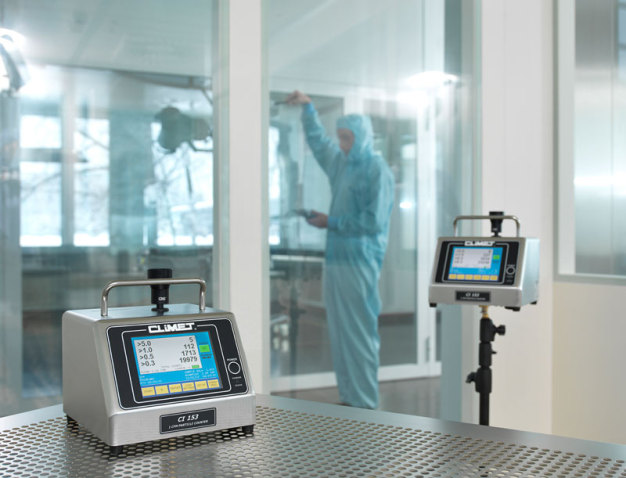
Climet Particle Counter
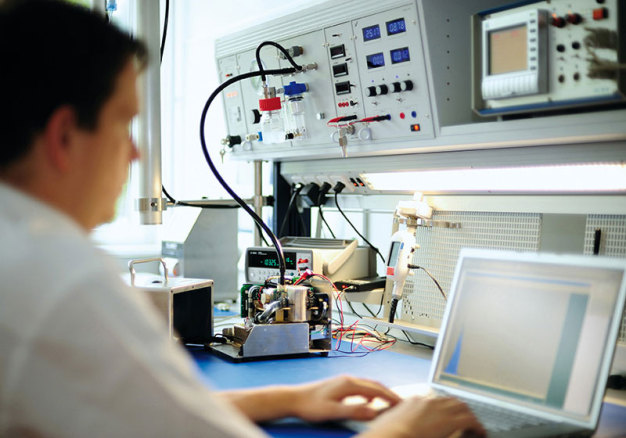
Calibration Laboratory of the CAS
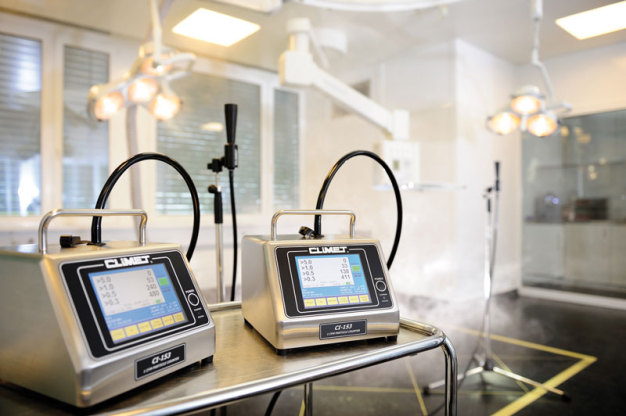
Climet particle counters in use

Company headquarters of CAS in Switzerland
The formation of particles cannot be prevented. However, in the wrong place with the wrong concentration, they can have fatal effects. In hospitals, for example, they can lead to infections or contaminate products in the pharmaceutical industry. This can only be prevented with complex measuring instruments and a reliable service partner who has many years of experience in particle measurement technology and knows the most important criteria when purchasing such a particle counter.
Few of us are surrounded by pure air. It does not occur in our normal daily life. Nevertheless, it has become indispensable in certain areas, such as pharmaceuticals or healthcare. These segments have changed markedly in recent years. For example, new guidelines for ventilation systems in healthcare and controlled environments have been established in Switzerland, Germany, and Austria. Their goal is to keep the concentration of airborne particles in sensitive areas as low as necessary.
We are all surrounded by a multitude of particles every day. Some of them are even produced by humans themselves. The volume of these particles varies greatly. They become visible to the human eye only from a size of about 50 micrometers (µm), such as pollen, cement dust, or sneezing droplets. Bacteria, which have particle sizes from 0.3 to 30 µm, are no longer visible by conventional means, let alone the usual outdoor air pollution (0.01 to 1), tobacco smoke (0.01 to 0.3), or viruses and proteins (0.01 to 0.1). These are dimensions under which we can hardly imagine anything. To give a size comparison, imagine the volume ratio of the Earth compared to a tennis ball. This ratio is roughly equivalent to comparing a particle of 1 micrometer diameter to a tennis ball. Even then, we can only roughly guess the actual size, as it exceeds our imagination. However, for our daily life, the measurability and clear definition of such particles has become indispensable.
Aerosols in Daily Use
Aerosols — small particles that occur everywhere in the air — are now used in various fields. Because aerosols are so small, they can pass through human respiratory filters unhindered. Depending on their size, they penetrate the bronchi into the so-called alveoli of the lungs and from there, sometimes also enter the bloodstream. This ability of aerosols is utilized in medicine: for example, active ingredient particles are used in inhalation sprays. However, if these particles carry carcinogenic substances, it is correspondingly dangerous for our bodies. This is the case, among other things, with smoking or inhaling exhaust fumes.
In agriculture, aerosols are also used. They are needed for spraying insecticides and plant protection products. And in the technical field — for coatings or coloring — or for private use — in hairsprays or cleaning agents — they are also indispensable.
Dust as an Interference Factor
Particles can also act as interference factors. In the electronics industry, where chips are manufactured with conductors only a few micrometers apart, a dust particle can even cause a short circuit. It is therefore essential to create a dust-free working environment for the production of such products. The same applies in the pharmaceutical industry or healthcare. It is unthinkable what infections could arise from bacteria or viruses. Since germs cannot be completely prevented, dust-free air must also be ensured here. The technology that deals with preventing dust contamination in medicine and technology is called cleanroom technology.
What Humans "Produce"
Basically, there are two sources of aerosols: natural aerosols such as fog, Sahara dust, bacteria, viruses, smoke from wildfires, and pollen dust. Or industrial aerosols such as emissions from factories, traffic, or household fires. Humans are also avid aerosol producers. Without any specific activity, they generate around 100,000 particles per minute. With a slight head movement, it’s already 500,000 particles, and when walking, the number jumps to 5 million. The large emission of particles is one reason why in various fields, special work clothing must be worn. Proper behavior in a so-called cleanroom is trained through specific courses to keep "contamination" as low as possible.
How Particle Counters Work
The formation of particles cannot be prevented. However, depending on the application, the effective concentration of such substances is important. For this purpose, particle counters are used. The operating principle of these devices can be explained with a simple example: standing in a dark barn illuminated by sunlight through the wooden walls, you will notice that some rays appear dimmer than others. These differences in light can be explained by the dust particles floating inside the barn. A particle counter works on a similar principle. A laser beam replaces the sunlight, and the darkness in the barn is replaced by the sensor’s dark chamber. Dust that is detected by the particle counter can no longer be seen with the naked eye. In a cleanroom, particles from 0.3 to 5.0 µm are typically measured. In electronic device production, particles with a diameter of 0.1 µm are sometimes also considered.
Data Analysis
The procedure for measurement is always the same: basically, the particle counter is set so that nothing happens as long as only clean air flows through the measurement chamber. However, if small dust particles enter the described dark chamber (measurement cell) and pass through the laser beam, its light is scattered. Usually, a small particle produces a weak light, while a large particle produces a strong one. The mirror chamber reflects these rays onto a photodetector, which converts the light energy into electrical signals.
The basis for the final calculation is the formula that the light is proportional to the size of the particle, just as the electrical signal is proportional to the particle. Further data analysis and evaluation follow from this. Their accuracy ultimately depends on the construction of the particle counter. To complete this, special electronic circuits are added, and an amplifier stage supports the very weak electronic signal. Additionally, a supplementary system filters out all unwanted "noise." Ultimately, the signals are evaluated by a patented digital processor. Additional digital circuits enable the data to be displayed on the screen and printed out.
Faster Evaluations
Time is also a crucial factor for particle counters. The different providers of such devices promote their products based on the time span in which they can measure one cubic meter of air. Previously, the intake volume of the counters was mainly one cubic foot per minute, which corresponds to 28.3 liters per minute. This unit comes from the American standard "US Federal Standard." To measure one cubic meter of air, such devices require more than 35 minutes of measurement time.
However, development has not stopped there. Nowadays, devices with flow volumes of 50, 75, or 100 liters per minute are available on the market. This significantly reduces the measurement time; for a sample of 1 cubic meter of air with a 100-liter device, the measurement time is just 10 minutes.
Calibration Means Quality
Calibration is critically important for the quality of a particle counter. Each manufacturer has its own instructions on how to calibrate and adjust the devices. For size calibration, certified monodisperse latex particles are usually used. These are crushed and introduced into the device. The round, white beads now produce a Gaussian distribution curve, which is crucial for the counting accuracy of the particle counter. This curve can shift from year to year. Factors influencing this can include contamination of the measurement chamber or detector, changes in laser power, flow rate being too low or too high, etc.
The calibration process of a particle counter should be carried out in the following steps:
- Incoming inspection (recording the current state, i.e., how it was measured)
- Maintenance and repair work
- Adjustment (setting to the smallest possible deviation)
- Calibration at the output (comparison test of counting efficiency)
To achieve optimal calibration and maintenance, it is recommended to send the device for annual inspection only to an authorized service partner. Only these official calibration laboratories have the technical data of the measuring devices and know the exact maintenance procedures.
Self-Diagnosis
To ensure that the devices can be checked for proper function at any time during daily on-site operation, many particle counters feature an integrated "self-diagnosis." This monitors the laser and flow status. After calibration, a deliberate contamination can be produced, for example, by a light finger snap. The particles produced by the snap are detected by the laser, ensuring that the counting mode is functioning properly. Subsequently, a zero-count filter can be used to perform a system test. The filter is best attached directly to the measurement hose. Air is drawn through the filter and directed via a hose to the measurement chamber. If no particles are measured, it confirms that all elements are clean and that the measurement result is not affected by existing interference factors. Such functional checks can generally be repeated at any interval. Of course, the more frequently a system check is performed, the greater the certainty.
Application of Particle Counters
Particle counters are used in various fields and situations. Primarily, they are employed in "classification," "filter system integrity testing," "compressed air measurements," and "monitoring systems."
Cleanrooms are required for specialized manufacturing processes — especially in semiconductor fabrication — where particles present in normal ambient air would interfere with the structuring of integrated circuits at the sub-micrometer level. Other applications of cleanroom technology are found in optics and laser technology, aerospace, biosciences, medical research and treatment, food and pharmaceutical production, and nanotechnology.
Measurement at Difficult Locations
For precise particle determination, an isokinetic probe is used. Isokinetics ensures that particles fall into the probe rather than being sucked in. The reason is simple: suction creates air vortices that could lead to measurement errors. The isokinetic probe prevents this and ensures extremely accurate results. Usually, round probes are used. Their diameter varies depending on the intake volume of the particle counter. Typically, the probe is connected to the measuring device via a hose. This allows installation in difficult-to-access locations, preventing measurement disturbance or falsification by humans or machines.
It is important that the hose — called "Hytrel hose" in technical jargon — has a special coating. It is characterized by the fact that no particle deposits form inside. Additionally, the isokinetic probe must be positioned at specific points in the airflow. If the airflow direction cannot be controlled or predicted — for example, in turbulent mixing flows — the inlet of the sampling probe must be directed vertically upward. In general, the particle counter must be set up according to the manufacturer's instructions. Deviations from this can lead to measurement errors.
However, using a Hytrel hose also has certain disadvantages. Although no extensive studies exist on this topic, practical experience suggests that particles of 1.0 µm size are lost in the hose and do not reach the measurement chamber. The suspicion that these particles remain in the hose and are detected as false measurements has not been confirmed so far. It is more likely that larger particles are broken down during transfer and recorded as smaller particles by the measurement chamber.
Classification of Air Cleanliness
To operate a cleanroom, particle measurements must be performed after construction and during operation. Based on these measurements, the classification of air cleanliness for cleanrooms and related cleanroom areas can be carried out. It is regulated by ISO standard 14644-1. The standard applies exclusively to the concentration of airborne particles. The actual element of cleanroom qualification is the measurement value and the derived statement whether the respective cleanroom meets the requirements. Particularly in the pharmaceutical industry, the results are crucial for ensuring operation. The demanding applications require stable environmental conditions. Any non-compliance with the prescribed standards can lead to production failures and costly situations. Therefore, the testing procedure during classification is very comprehensive. Besides counting airborne particles, factors such as airflow, differential pressure, temperature, and humidity are also checked.
A cleanroom is fundamentally designed to keep the number of airborne particles introduced or generated in the room as low as possible. Depending on the use, only particle count or also the number of germs is monitored, as required, for example, in pharmaceutical manufacturing. Various procedures are applied to prevent unwanted particles from entering the air and to remove particles already present in the air.
Filter System Integrity Test Using Particle Counters
The filter system integrity test is another application of particle counters. It is necessary to reliably exclude potential damage to HEPA or ULPA filters. The principle of the test is relatively complex: before the filter, the raw air is contaminated with aerosol. This means a deliberate contamination of the air. Since this air now contains a high concentration of particles, a dilution stage is connected between the air and the particle counter. Such systems are usually available with a dilution ratio of 1:100 or 1:10. They allow measuring the raw air throughout the test. To detect a potential leak, the entire filter system must be scanned with a measurement probe. Preferably, this is done with an angular probe, as such a shape — unlike, for example, a round probe — reduces the scanning time. If the permissible particle count is exceeded during the process, this indicates a possible leak. More precise detection can be achieved through subsequent local leak verification.
Measuring Compressed Air with a Particle Counter
When talking about cleanroom air, it primarily refers to the pure air in the environment. Compressed air is the air needed for a process (e.g., pneumatics or control air). Here too, it is air that can come into contact with a product and contaminate it.
However, compressed air should not be measured directly with the particle counter because the air could damage the measurement chamber of the particle counter or influence its flow. For this reason, a so-called diffuser must be installed between the compressed air and the particle counter. The ISO 8573 standard can be used as a reference for this measurement.
Monitoring
Until now, the application areas mainly involved mobile particle counters. Stationary monitoring devices are used for continuous operation. They monitor specific processes, such as medication filling. These are often highly complex systems that require professional maintenance.
Conclusion
A particle counter is an extremely complex measuring instrument capable of detecting the smallest airborne particles. However, there are significant qualitative differences among manufacturers. The accuracy and reliability of the devices are important criteria for their purchase. Other absolute must-have criteria are: particle counters should be calibrated once a year, and the buyer should have a good service partner. Those who follow these simple principles will never regret such an investment.
ISO Standard 21501-4
ISO standard 21501-4 defines the procedure for calibrating particle counters. Among other things, the standard requires that the counting efficiency (quantity calibration) be specified. Monodisperse latex particles are introduced into the test device and the reference particle counter, and the two quantities are compared. For size resolution, it is then checked whether the particle assignment in the smallest channel is correct. A zero-count filter is further used to verify that the measurement chamber is free of particles. ISO 21501-4 recommends an annual calibration interval.
CAS Clean-Air-Service AG
9630 Wattwil
Switzerland