


- Battery
- Translated with AI
The square must become round
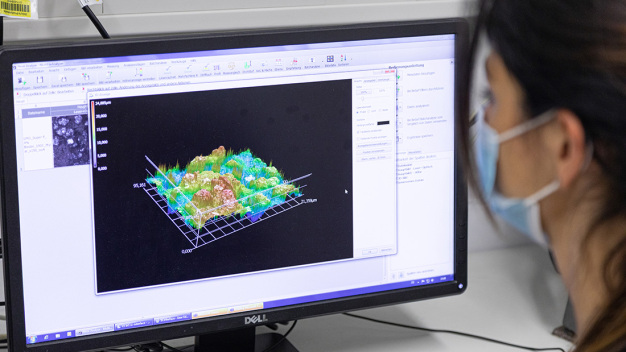
Morphological characterization of the solid-state electrolyte and the composite cathode. © Fraunhofer IPA / Photo: Rainer Bez
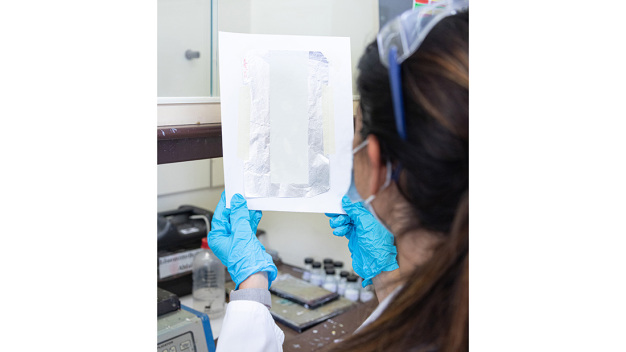
Festkörperelectrolyt nach der Beschichtung über den Stromableiter. © Fraunhofer IPA/Photo: Rainer Bez
Batteries with as much energy as possible are especially in demand for electric vehicles. The Fraunhofer IPA is working on solid-state batteries that are supposed to have an energy density of almost twice that of today's lithium-ion batteries, with 700 watt-hours per kilogram. Digital twins are intended to help remove existing hurdles for mass production.
At the Fraunhofer Institute for Production Technology and Automation IPA, the focus is on technologies where scaling up from laboratory prototypes to industrial mass production seems feasible. A key factor is that novel batteries can also be produced on existing plants with some modifications. The final product is intended to be cylindrical cells in the common format 21700, which have a diameter of 21 millimeters and are 70 millimeters long.
Manufacturers like VARTA AG, a project partner of Fraunhofer IPA for battery research, have not chosen these cylindrical cells without good reason. Individual cells are easier to inspect within a battery module and can be replaced in case of a possible defect. Heat can be dissipated through hollow spaces between the cells. Often, the cells are still used as energy carriers in other applications after the car battery has been retired. Standardized cylindrical cells make this easier.
Fragile material presents challenges
Solid-state battery cells do not contain liquid electrolyte like lithium-ion batteries, but instead have a ceramic or sulfide-based, i.e., sulfur-containing, solid electrolyte. Polymer electrolytes are also an option, but they require higher operating temperatures of over 60 degrees Celsius. Today, the cells are mostly built as flat, rectangular pouch cells. Current developments in the field of ceramic solid electrolytes at Fraunhofer IPA aim to accelerate the sintering process for the ceramic material and to produce the desired geometry for later use in the battery during this step. However, the fragility of the material makes post-processing and winding into a cylindrical cell difficult.
For use in cylindrical cells, sulfide-based solid electrolytes offer a significant advantage. With proper processing, flexible layers can be produced that remain stable even at small winding radii. Additionally, the so-called Thio-LISICON sulfide family, inorganic electrolytes, shows promising results for ionic conductivity at low temperatures. Although sulfide electrolytes exhibit excellent ion conductivities and could compete with organic liquid electrolytes, they are currently much more expensive. Building appropriate production capacities can enable cost-effective manufacturing of sulfide-based electrolytes.
The path to industrial production of solid-state batteries is still long. Currently, solid-state batteries are mostly built with lithium as the anode, which presents particular challenges for assembly environments. To prevent the material from reacting with oxygen or moisture in the air, expensive dry-room conditions are required, and sometimes additional sealed production areas with protective gases like argon are necessary. Researchers at Fraunhofer IPA are therefore investigating how solid-state batteries can be manufactured under moderate conditions. "A promising approach is the in-situ deposition of lithium metal. During the first charge cycle, the lithium ions present in the cathode form a layer on the negative electrode's collector," says Duygu Kaus from the Center for Digitized Battery Cell Production (ZDB). Experiments are intended to show which collector material best facilitates in-situ anode formation.
Digital twin supports battery cell development and production optimization
To determine which of the many parameters are most suitable for manufacturing, extensive testing is currently required — not only in the laboratory but also under scalable industrial production conditions. Material consumption would be significant, and each modification would affect subsequent steps in the process chain.
"An elegant solution is the digital twin. It assists production staff with its monitoring, analysis, and prediction capabilities," says Soumya Singh from ZDB. The digital twin is a virtual replica of individual process steps or entire production lines, continuously enriched with additional operational data. It helps engineers simulate the future behavior of manufacturing under various parameter settings and evaluate their impacts in advance. Fueled by extensive data sources from production, the digital twin provides insights into the efficiency of individual process steps, as well as the effects of different processing parameters on the quality of intermediate products, process times, and their stability. For example, the digital twin can determine on the operator's computer how the processing steps for an electrode should look so that it is elastic enough to be wound at the end."
After implementation, the digital twin is synchronized with the production step and continuously fed with current data from manufacturing. It now monitors how stable the production runs and becomes an integral part of quality management.

Fraunhofer-Institut für Produktionstechnik und Automatisierung IPA
Nobelstraße 12
70569 Stuttgart
Germany
Phone: +49 711 970 1667
email: joerg-dieter.walz@ipa.fraunhofer.de
Internet: http://www.ipa.fraunhofer.de