
- Buildings & Rooms
- Translated with AI
Dr. Volkmar Hovestadt, Dr. Christian Voigt
The "modular system" makes it possible
Modular Construction: Flexible Laboratory Buildings for the Life Sciences Industry through Digital and Modular Planning and Control
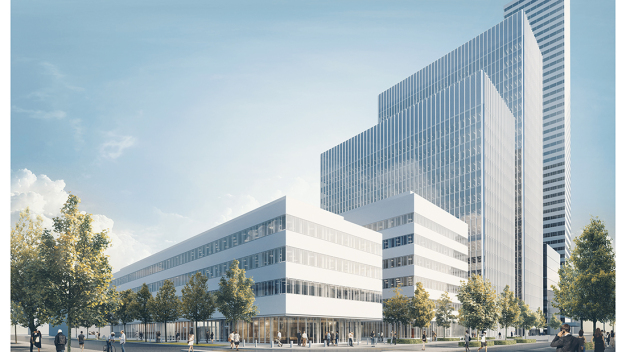
Roche pRED Research Center Basel (Photo: Beat Ernst; Rendering: Herzog & de Meuron)
Buildings for the life sciences industry require a high level of expertise in internal processes. Whether research, laboratory, or production spaces: safety and hygiene regulations as well as the specific requirements for different usage areas set the highest standards for construction.
Key factors for meeting the multitude of requirements are ultimately user orientation and flexibility. Especially the research sector is subject to constant change. Projects often require highly specialized laboratory layouts that must be set up individually each time. Because a quick reconfiguration of laboratories can be the decisive advantage in the search for a new active ingredient, a new medication, or a scientific innovation. Research projects are often scheduled in two- to five-year cycles. Since the construction of a corresponding laboratory landscape, including preparatory work, takes roughly the same amount of time, a custom-built new facility is not feasible: the building must be in place before the specific project needs are clarified—and for this reason, it must be adaptable.
Modular "building systems" open up the possibility to implement these requirements. An innovative approach to modular planning combined with complete digital modeling of the building now opens new dimensions—such as in the new construction of the F. Hoffmann-La Roche AG in Basel.
Flexibility is the prerequisite for successful research
To accommodate changing organizational structures and workflows, spaces, floor plans, and uses must be as freely configurable and adaptable as possible. The entire technical infrastructure of workplaces, such as ventilation, electrical, sanitary, or media systems, is thus a constant part of the configuration in the Roche new building. The demands of developers and property operators go even further: laboratory spaces should not only be quickly adaptable to the needs of various research projects, but also the simple conversion of office spaces into laboratories and vice versa should be possible to some extent.
High standards also for architecture, energy efficiency, and occupational safety
To attract talented researchers, a user-oriented and aesthetically demanding "well-being atmosphere" can increasingly serve as a compelling argument. The rising requirements for communication elements must also be met. With the interdisciplinary research approach, the need for meeting rooms for teams, informal meeting zones, and relaxation areas for long working days increases, demanding architecture tailored to these needs. Additional challenges include the placement of noise- or energy-intensive devices with high heat dissipation. These rooms should be easily and quickly separable from laboratory landscapes. Finally, safety requirements are also increasing. When working with hazardous substances, high air exchange rates are necessary. If needed, safety laboratories with airlocks or rooms with explosion protection requirements must be implemented.
Info Box:
The main requirements for modern laboratory buildings at a glance:
- Flexible workstations: adaptable design, modular laboratory equipment
- Configurable laboratory areas: ability to restructure according to organizational structures and workflows, change room layouts, freely position laboratory equipment
- Reversible technical installations: systematic building services routes, sufficient shaft space and floor height for retrofitting
- Transformability: enable quick reconfigurations to reduce downtime
The flexibility required in laboratory building construction can already be implemented to some extent with conventional modularization methods. An innovative approach now creates entirely new possibilities: instead of providing modules as before, from which planners can select, an existing architectural design is modeled into a project-specific toolkit. The actual design planning is then assembled from this toolkit and can adapt within defined rules to different requirements.
This principle is, for example, known from automotive manufacturing: the vehicle design is divided into modules and can be configured by the customer based on a set of rules to suit their needs.
The "digital" twin makes it possible
The key to efficient modularization is the digitalization of the design within a BIM model. "BIM" stands for Building Information Modeling, resulting in a so-called "Digital Twin" of the building. The building model is consistently built in a modular way. Locations and structures that occur repeatedly are modeled only once and stored in catalog models. This is where interdisciplinary work takes place. Examples of such modules include the furnishings of user-specific layouts, such as laboratory benches, office and meeting rooms, lockers, and kitchens, including all technical equipment and infrastructure.
The modules are inserted into the project model from the catalog according to user requirements. A restriction plan defines the interfaces and rules for how and where the modules can be integrated into the building model. Defined connection assemblies connect the modules structurally within the building context and ensure their reversibility. The user-specific layout becomes a configuration process.
The buildings of the pRED research center in Basel, primarily equipped with laboratories, are implemented using this method, with very high demands due to the necessary laboratory installations and the emphasis on flexibility of the structure.
The central system sets the framework
The project coordinate system is the central tool for simplification, modularization, and integration. It consists of four systems: The measurement system forms the geometric framework from points, axes, bonds, and planes. The surface system divides the design into as regular sub-areas as possible. The location identification system assigns a unique code to all rooms and structures anchored in the project coordinate system. In the so-called restriction planes, the relationships between objects are represented with rules and restrictions for all binding purposes.
The future belongs to adaptable buildings: Modular planning makes it happen
On the one hand, the demands of the life sciences industry require increasing flexibility. On the other hand, the interest of developers and operators is also high to make their buildings future-proof through high adaptability. The complexity of these tasks is hardly solvable with traditional planning systems, and in no case with the desired efficiency. However, combining modular and integrated planning with digital modeling of buildings enables the proverbial "quantum leap" toward highly adaptable, perfectly utilization-oriented, and maximally quality-built structures.
Info Box
Main advantages of modular, integrated, and digital building planning:
- Maximum user orientation through defined, quickly exchangeable modules
- Significantly higher productivity for research through customized laboratory landscapes
- Rapid adaptability of laboratories instead of new construction/restructuring
- Cost-effective construction and operation even with highly individual architecture
- Reliable planning and construction foundations
- Reduced planning effort, errors detectable early in the "Digital Twin"

Drees & Sommer SE
Geisenhausenerstraße 17
81379 München
Germany
email: lifesciences@dreso.com
Internet: https://www.dreso.com/life-sciences