- Translated with AI
The Kaiserslautern spin research has a new face
Professor Mathias Weiler comes from Munich to TUK
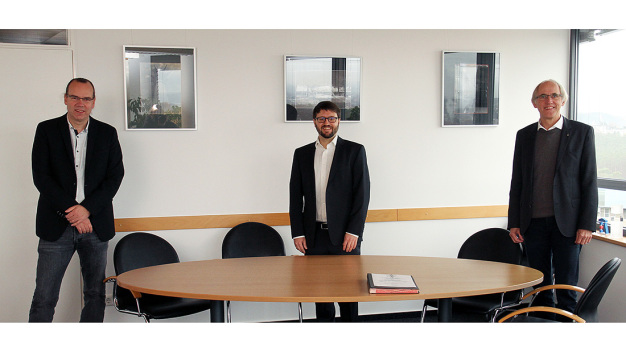
President Prof. Dr. Arnd Poetzsch-Heffter (right) and Prof. Dr. Herwig Ott, Dean of the Department of Physics (left), welcome Prof. Mathias Weiler to TU Kaiserslautern. (Thomas Koziel/TUK)
The spin research at TU Kaiserslautern (TUK) rests on three strong pillars: The State Research Center OPTIMAS focusing on optics and materials science, the Collaborative Research Center "Spin+X," and the new research building LASE (Laboratory for Advanced Spin Engineering), which will soon be ready for occupancy. In connection with LASE, the Department of Physics has now filled a professorship with Mathias Weiler, which is intended to play a central role in interdisciplinary spin research on solid-state materials. The Swiss researcher recently led a working group at the Walther-Meißner-Institut in Garching and taught at TU Munich.
In physics terminology, spin describes the intrinsic angular momentum of a fundamental particle, such as an electron, and thus forms the basis for magnetic phenomena. The insights gained from spin research are technologically valuable, especially when it comes to rapidly storing large amounts of data (hard drives & magnetic random access memory) or developing modern sensors.
Weiler has been engaged since the beginning of his scientific career with phenomena related to the dynamic interaction of electron spins with their environment. Therefore, he was the ideal candidate for the new professorship, which will be based in the LASE building: "Mr. Weiler's expertise is a great asset for the forward-looking spin research here on campus," explains Prof. Dr. Herwig Ott, Dean of the Department of Physics at TUK. "Furthermore, we are confident that, from his central role, he can also provide impulses to other research priorities of the Department of Physics — such as quantum physics, photonics, or biophysics. The interdisciplinary approach of his research also allows him to build bridges to other departments. There is no better place than LASE for this, where the departments of Physics, Chemistry, and Mechanical Engineering will pool their expertise in spin research in the future."
Weiler's decision to choose Kaiserslautern is based on research excellence: "The activities at TUK and the Department of Physics are perfectly tailored to my professional focus. I am now actively involved in OPTIMAS, the hub of spin research with the integrated Nano Structuring Center, as well as in the Collaborative Research Center Spin+X. A positive side effect of TUK's research strength is that many excellent scientists are on site, with whom I can exchange ideas. The proximity to the University of Mainz, with which we collaborate not only within Spin+X, also offers additional potential."
In terms of research, Weiler pursues an innovative approach. Until now, the interaction of spins with magnetic fields has formed the basis for magnetic sensors and data storage. Instead, the solid-state physicist investigates how other parameters — such as electric currents, sound waves, or thermal gradients — can be used for controlled manipulation of spins. "With our research, we can lay the groundwork for new concepts in magnetic data storage and information processing. By coupling spins to external degrees of freedom, we can realize not only classical bits (ones and zeros), but also superposition states, thereby qualitatively advancing information technologies."
Weiler studied physics at the Carl von Ossietzky University of Oldenburg and TU Munich. Subsequently, he earned his doctorate in Munich and habilitated in 2019. His research stays took him to the National Institute of Standards and Technology in Boulder, Colorado, and to the Walther-Meißner-Institut in Garching, where he worked as a group leader until he received the call to Kaiserslautern. Weiler is active as a reviewer for numerous renowned scientific publications and third-party funders and has received awards for his research (Chorafas Prize 2012) and teaching (Supervisory Award 2019) in Munich.
Questions answered by:
Prof. Dr. Mathias Weiler
Email: weiler@physik.uni-kl.de
Phone: 0631 205- 4099
Technische Universität Kaiserslautern
67663 Kaiserslautern
Germany