



- Automation
- Translated with AI
The fuel cell is booming ...
and Schmalz takes action
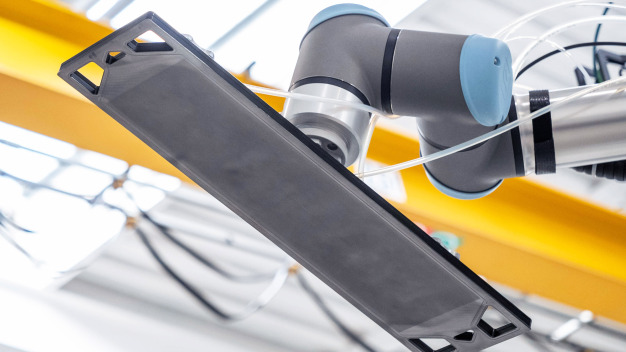
Handling of bipolar plates (BPP)
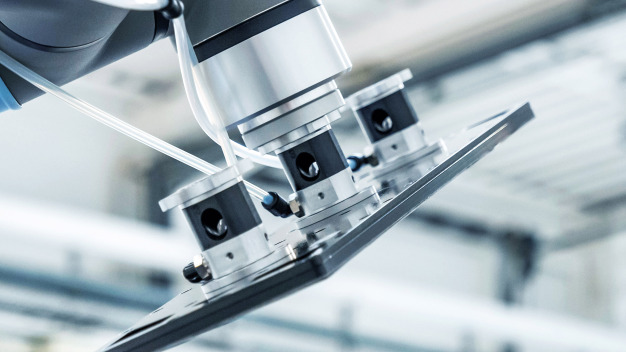
Surface gripper FLGR with high volume flow for full-surface gripping of sensitive workpieces such as membrane electrode assemblies (MEA) and bipolar plates (BPP)
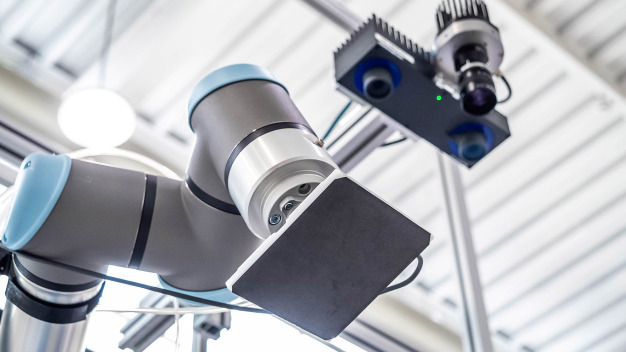
Gripper for gentle handling of gas diffusion layers (GDL)
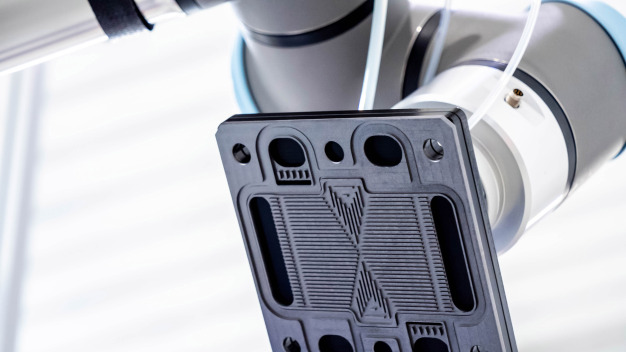
Handling of highly structured workpieces with penetrations
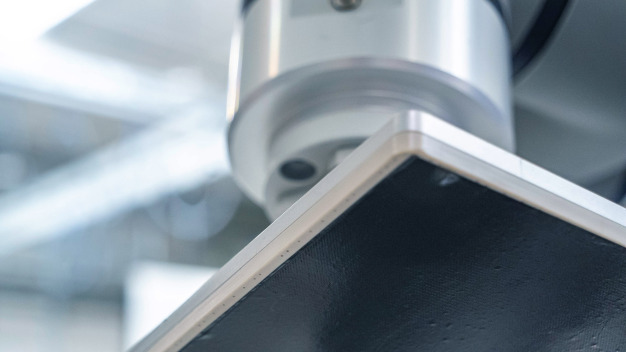
Flawless handling of films and membranes (CCM)

Matthias Müller, Head of International Sales and International Industry and Key Account Management at J. Schmalz GmbH
The fuel cell is a serious solution for emission-free mobility. While it was long absent from the public eye, it is now establishing itself as a viable path for zero-emission strategies. Accordingly, the development of hardware and automated manufacturing is highly dynamic. Here, Schmalz intervenes and adapts its handling systems to the constantly changing requirements – new process steps, surfaces, and materials.
Since 2001, unrest has been brewing among combustion engines. At the IAA early in the 21st century, more and more automakers directed attention to their "blue" vision of future mobility: vehicles with fuel cell drives. Even German car manufacturers sent test fleets onto the roads – quiet, clean, and as easy to handle as gasoline or diesel vehicles, with some safety precautions. Then, the fuel cell faded from public attention. After years of promoting battery electric mobility as energy storage, hydrogen users are now back in the spotlight. In a study published in April 2021, the VDE defines the "drive portfolio of the future" as a demand-oriented mix: batteries for passenger cars, batteries or fuel cells for trucks, and e-fuels for existing vehicles, motorsport, and classic cars. The Association of Electrical, Electronic & Information Technologies surveyed politicians and business leaders for this. The fact is: the fuel cell is establishing itself and offers an opportunity for emission-free driving and the economy in Germany. For efficient production, automated gripping systems are also needed to handle the different components and assemblies gently and safely.
"The fuel cell is currently a highly dynamic topic. Especially in Germany and Europe, as well as in some Asian countries, funding programs are bringing new players to the market, and the big names are continuing to establish themselves," says Matthias Müller, Head of International Sales and International Industry and Key Account Management at J. Schmalz GmbH. The challenge for him and his team is to stay on top of all projects and meet the high level of innovation. "We can do this without any problems – thanks to our industry management. This is our central hub that uncovers relevant contacts and properly supports customers. Behind our success is very close collaboration with our sales organizations. With highly innovative solutions and a strong development department, we can keep pace with market dynamics," Müller explains. Accordingly, the Black Forest-based company is well connected: Schmalz has been working with automakers for decades and participates in national research projects. The goal: economical series production of fuel cells. "Automation is crucial here, and that's where we come into play," Müller adds. With its comprehensive gripper portfolio, Schmalz is well equipped for this role. Yet, there is still plenty to do in the development department in Glatten. "The industry's dynamics are reflected in the demands placed on our designers and developers: they must constantly adapt the gripping systems to changing production steps, workpieces, materials, and new surface structures."
Hitting the Heart of the Fuel Cell
To understand what Matthias Müller means, it helps to look inside a fuel cell, whose structure essentially resembles a battery: an electrolyte layer separates the anode and cathode and facilitates ion transport. This membrane-electrode assembly (MEA) is the heart of every fuel cell. On the outside, there is a gas diffusion layer on each side, which is then backed by bipolar plates.
The systems that access the MEAs during manufacturing must be especially gentle on the sensitive surfaces and ideally handle all components. Therefore, Schmalz combines multiple vacuum circuits and gripping technologies to sequentially pick up the catalyst-coated membrane, gas diffusion layer, and sealing frame. A high volume flow and wear- and energy-efficient pneumatic vacuum generation through the compact ejectors SCPM prevent particle residues on the workpieces. "This allows our system to be used even in cleanrooms," Müller explains. Before the thin films deform, the full-surface gripping principle of the sheet gripper, which combines large-area contact with a low vacuum level and high volume flow, provides protection. As in battery production, the vacuum expert must constantly ensure safe electrostatic discharge – using ESD-compliant contact surfaces.
From BPP to Stack
Bipolar plates (BPP) made of metal or graphite materials frame the MEAs. Their task: to channel hydrogen to the anode and oxygen to the cathode, as well as to remove reaction water and dissipate thermal and electrical energy. The design of their surfaces influences the efficiency of the subsequent fuel cell. Accordingly, research and development are highly dynamic. "Our development must keep pace with this tempo and adapt our grippers to changing formats and structures," Müller emphasizes.
In principle, Schmalz uses sheet grippers for the safe handling of structured flow fields. Additional integrated suction grippers increase the permissible shear force – so the BPP remains in place despite high acceleration. The plastic of the suction plates and the HT1 material of the suction cups protect the coated surfaces from damage and chemical residues. Convex or concave BPP halves are securely sucked in by the floating gripper SBS and held with its high holding forces. Integrated sensors also clearly identify the components. These are also important during stack assembly, i.e., the joining of MEAs, gas diffusion layers, and bipolar plates.
According to the different components, the entire spectrum of special grippers from Schmalz can be found in this production step: sheet grippers FLGR, flow grippers SCG, floating grippers SBS, and conventional vacuum suction cups. Their different technologies – whether full-surface or contactless gripping – keep the surface pressure low and the surfaces free of contamination. At the same time, they keep pace with the dynamics of the production process.
"The requirements for fuel cell production are similar to those for battery manufacturing – as we handle comparable materials here. They are thin, coated, and therefore extremely sensitive. And we keep pace with the development dynamics – both in research projects and in series production," Müller summarizes. After speaking with the head of international industry management, it is clear: whether it's the "blue" vision of automakers or the "green" plan of policymakers – Schmalz's blue will repeatedly shine through in the automated production of fuel cells.
J. Schmalz GmbH
72293 Glatten
Germany