




- Transfer systems
- Translated with AI
The first AI-supported, intelligent assembly planning software
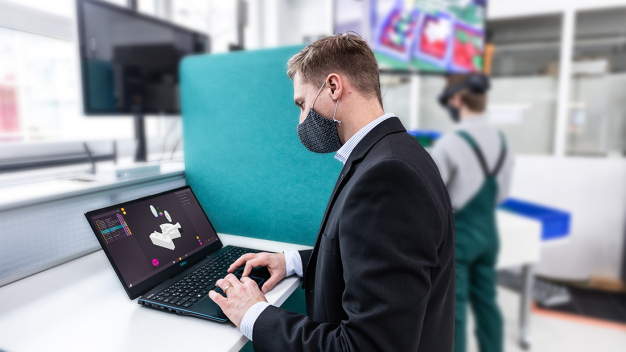
A graphical tool of the "Assembly Composer" enables the assembly to be implemented three-dimensionally and playfully. © Fraunhofer IPA
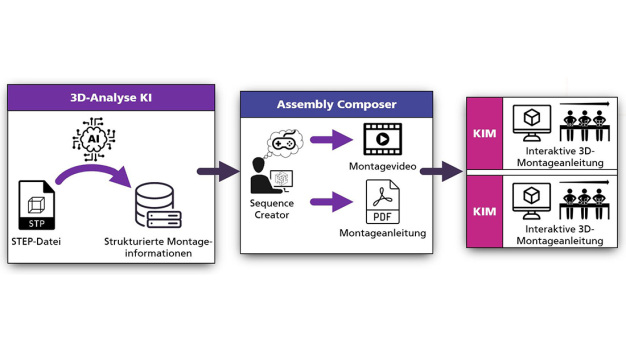
The software consists of three components that automate and significantly simplify assembly planning using AI. © Fraunhofer IPA
The Fraunhofer IPA is taking new approaches in assembly planning: Software analyzes existing CAD data, creates assembly instructions from the obtained information, and automatically generates cost-effective assembly aids.
Assembly planning and the assembly process itself are currently still costly and time-consuming. They account for 30 to 50 percent of personnel costs and about 20 percent of the total manufacturing costs of a product. Sometimes, half of the production time is spent on these tasks. Reasons for this include, on the one hand, a time-consuming approach to assembly planning with many iterations. On the other hand, initially obvious shifts towards more automation are often not feasible due to technical or economic reasons. Therefore, it would make sense to link assembly planning with the actual assembly process and optimize both areas. Experts from the Fraunhofer IPA have been working on this in recent years. Most recently, they received funding from the Federal Ministry for Economic Affairs and Climate Action through the EXIST program for this purpose.
Data analysis as a basis
The fundamental technology for all functions of the new software "ARCaide Assembly Suite" is artificial intelligence (AI), which analyzes and evaluates so-called STEP files. These information-rich files can be generated by any CAD system. They provide the "3D Analysis AI," one of three components of the software, with all the necessary information to derive structured assembly information accurately.
This process allows automating a previously laborious process: For assembly planning, it is common to use a mix of information such as 2D images, parts lists, and model descriptions. Especially for model descriptions, expertise and experience of specialists were often required – overall, an inconsistent, labor-intensive, and error-prone process. The software thus reduces preparation time and personnel costs and prevents misunderstandings or inconsistencies during data collection from various information sources.
Automatic assembly planning
The second software component is the "Assembly Composer." It reads the extracted assembly information from the STEP file and feeds it into a graphical tool for assembly planning. This allows specialists to see the visualized assembly information, enabling them to plan the assembly in three dimensions and in a playful manner. This was previously a purely manual and often unstructured process, which becomes faster, more affordable, and error-free with the software. Thanks to intuitive graphical operation, even less experienced users can quickly generate correct and consistent assembly instructions and videos. Initial internal studies on usage showed a time savings of 92 percent in creating assembly instructions.
User-specific assembly assistance
The trio of software components is completed by the AI assembly aid "KIM." After completing the assembly planning, the data from the office, on which the software quickly and cost-effectively provides an assembly aid, can be used directly at the assembly workstation. This assistance particularly supports specialists during complex products interactively. The design of the assistance can vary. For example, it is possible to generate a 2D or 3D-based aid or one that uses augmented reality and can, for example, be used via smart glasses. With KIM, personnel become more productive and make fewer errors both in the specific assembly task and in other factors such as the correct sequence of assembly steps.
Overall, ARCaide elevates manual assembly to a new level – and this starting from batch size 1. The software combines expert knowledge, intelligently utilizes available data with AI, and thus enables optimal support for personnel in their planning and execution activities. The industry interest in testing and further developing the software toward practical readiness is already high. Therefore, the developer team at Fraunhofer IPA is planning a spin-off soon and is looking for testers for this innovative technology.

Fraunhofer-Institut für Produktionstechnik und Automatisierung IPA
Nobelstraße 12
70569 Stuttgart
Germany
Phone: +49 711 970 1667
email: joerg-dieter.walz@ipa.fraunhofer.de
Internet: http://www.ipa.fraunhofer.de