


- Products, devices, systems, plants for applications
- Original text
Joost van Velzen
The critical interface in big bag discharge: engineering a retrofit route to better powder containment
Why the liner connection deserves more engineering attention
Big bag discharge is a familiar operation in industries handling powders and bulk solids. Yet one of the most important points in the process can also be one of its most challenging: the interface between the big bag liner and the discharge equipment. At this interface, operators must establish a reliable connection, manage the transfer of material and disconnect the system when the operation is complete. Depending on the powder, the process and the connection method, these steps can present challenges involving dust release, product loss, housekeeping, operator exposure and repeatability.
For manufacturers handling fine, hazardous or valuable powders, these are not merely operational inconveniences. They are engineering considerations that can influence the containment strategy, the design of the discharge station and the procedures used during bag changes. A useful starting point is to treat the liner connection as part of the overall containment system, rather than as a simple mechanical accessory.
Containment is a system property
A connection system can make an important contribution to powder containment, but its performance cannot be considered in isolation from the complete installation. The outcome depends on several interacting factors: the properties of the powder, the liner material and geometry, the discharge arrangement, the connection and disconnection procedure, and the condition of the equipment. Operator training and maintenance also influence how consistently the system performs in practice. This is particularly relevant when changing between products or handling powders with different flow characteristics. A connection arrangement that works well for one application may require further assessment before it is used with another.
Occupational Exposure Bands (OEBs) provide a framework for relating containment requirements to the hazards of the material being handled. They should not, however, be treated as interchangeable with a single universal measurement of performance. The appropriate containment level and the evidence needed to demonstrate it must be established for the specific application. For process engineers, the practical question is therefore twofold: what containment performance is required, and how can it be achieved within the constraints of the existing process?
Retrofit rather than complete replacement
When an existing big bag discharge station no longer meets a plant's containment requirements, replacing the complete installation is not always the only option.
The mechanical structure, lifting arrangement, discharge equipment and other components may still be suitable for continued use. In such cases, upgrading the liner connection can provide a more targeted route to improving the installation.
A retrofit approach requires an assessment of the existing equipment. Dimensional compatibility, available installation space, liner specifications, operating sequence and the required containment level all need to be considered. The proposed solution must also fit the plant's cleaning, maintenance and changeover practices.
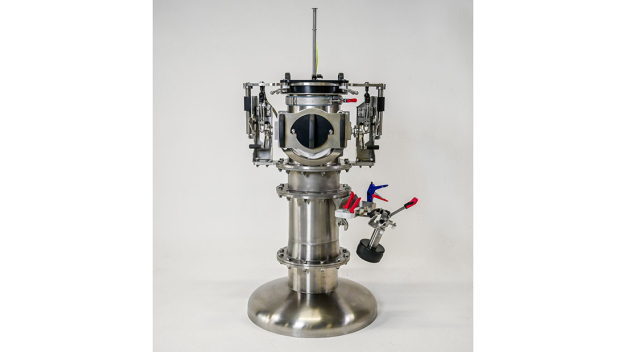
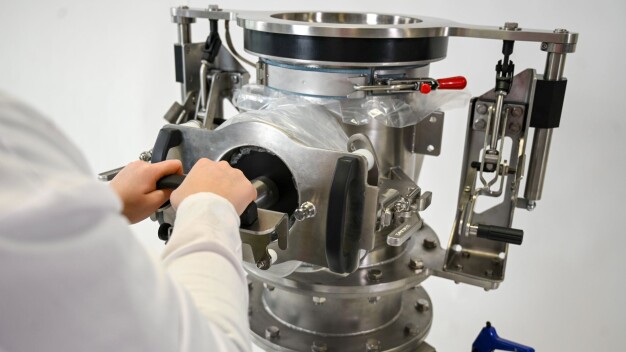
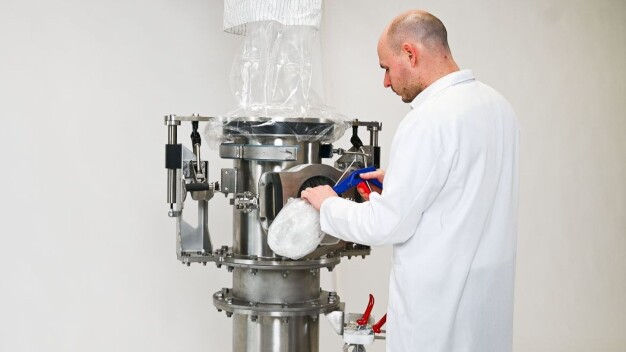
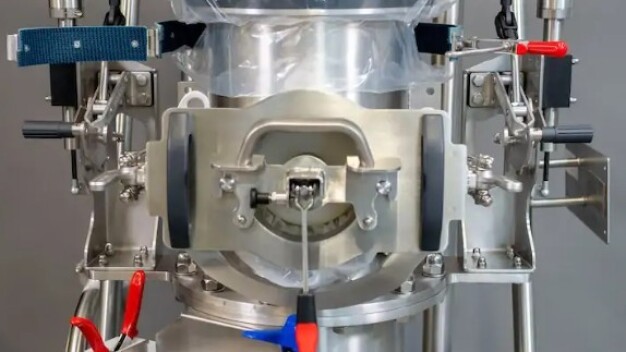
This is the engineering context for the HECHT LAS-MC Manual Connect liner connection system. Designed for suitable retrofit applications, the system provides a way to upgrade the liner connection while retaining existing equipment where technically appropriate. HECHT specifies containment performance up to OEB 4 for the LAS-MC, supported by third-party certification and validation. The value of this approach lies in addressing a defined process interface rather than automatically replacing the complete station. It gives engineering teams another option to consider when planning a containment upgrade https://www.youtube.com/watch?v=ZadXFQfkm-0.
Designing for different powders and liners
Powder-handling equipment rarely operates under identical conditions across every application. Particle size, flow behaviour, dustiness, moisture sensitivity and product hazards can all influence equipment selection and operating procedures. For that reason, flexibility across powder applications should not be confused with universal suitability. Each intended application needs to be assessed, including the compatibility of the liner, the connection arrangement and the discharge station.
The LAS-MC is specified for designated polyethylene (PE) and aluminium liners. HECHT's published product information also identifies stainless steel 1.4404 for the specified product-contact surfaces, with a surface roughness of Ra < 1.6 µm. These characteristics can be relevant when evaluating material compatibility and equipment design, although they do not replace an assessment of the complete process or its cleaning requirements.
HECHT also describes a connection arrangement that does not require O-rings in the specified configuration. The practical implications should be evaluated in the context of the actual installation, including the connection procedure, inspection requirements and any consumables used elsewhere in the process. The engineering objective is to establish a repeatable connection that suits the material, equipment and operating procedure, rather than to assume that one configuration is appropriate for every powder. Further technical product information is available on the HECHT international LAS-MC product page.
Verification must match the application
Containment claims are meaningful only when their scope is understood. Engineers should establish which equipment configuration was assessed, what test or validation method was used, and under which conditions the reported performance applies. A documented result for a defined configuration should not automatically be extrapolated to every installation, powder or operating procedure. Changes to the liner, connection arrangement, process conditions or equipment integration may warrant additional assessment.
The same principle applies to explosion protection. Where combustible dust is present, the potential for an explosive atmosphere must be evaluated as part of the plant's risk assessment. An ATEX-configured version may be available, but its suitability and certification must be confirmed for the intended installation and zone. These checks are not administrative details added after equipment selection. They are part of the engineering process that connects a specified performance requirement with a solution that is appropriate for the plant.
The wider containment strategy
A liner connection is one element of a broader powder-handling strategy. Depending on the process, other measures may include enclosed transfer, dust collection, controlled material charging, suitable discharge equipment and procedures designed to minimise exposure during cleaning and changeover. The right combination depends on the product hazards, the process layout and the required level of control. For some installations, upgrading a specific interface may be sufficient to address an identified limitation. In other cases, a wider redesign may be necessary.
HECHT supplies powder-handling and containment equipment for applications up to OEB 6. This wider portfolio reflects the need to select equipment according to the containment requirements of the individual process. It should not be taken to mean that every product or configuration achieves the same performance level. For plant owners and engineering teams, the important distinction is between selecting a product based on a headline specification and designing a system around a defined operating requirement.
Questions to ask before selecting a liner connection
Before choosing a connection system or planning a retrofit, process engineers should consider several practical questions:
– What containment level is required for the material and operation?
– What evidence supports the stated performance, and does it cover the intended configuration?
– Which liner materials and dimensions are compatible with the system?
– Can the connection be integrated into the existing discharge station?
– How will operators carry out connection, disconnection and product changeover?
– What cleaning, inspection and maintenance procedures are required?
– Does the installation present combustible-dust risks that require a specific explosion-protection assessment?
Addressing these questions early can help avoid treating containment as a component-selection exercise alone. It also provides a clearer basis for comparing retrofit options with complete equipment replacement.
Conclusion
The liner interface is a small part of a big bag discharge installation, but it can have a significant influence on how the process is operated and controlled.
For existing plants, a carefully engineered retrofit can provide an alternative to replacing a complete discharge station, provided that the retained equipment is suitable and the resulting configuration meets the required performance criteria.
The HECHT LAS-MC Manual Connect is one example of this approach: a liner connection system intended for suitable retrofit applications, with specified containment performance up to OEB 4 supported by third-party certification and validation. Ultimately, the objective is not simply to make a connection. It is to establish a repeatable, application-appropriate interface that forms part of a properly assessed containment system.
About the author
Joost van Velzen is Managing Director of Hecht Technology B.V., the BeNeLux representative of the HECHT powder-handling and containment technology group. His work focuses on powder-handling equipment, containment solutions and the practical integration of process technology into industrial applications.
Hecht Technology B.V.
2613 AX Delft
Netherlands